Odor & Corrosion Control for Sewer Collection Lines
Lift stations, force mains and gravity sewers smell and corrode when sewage runs out of oxygen. Oxygen dissolved into a side stream on the force main stops H₂S along the line.
01The Problem
Sewage That Sits Without Oxygen Makes H₂S
Sewer odor and corrosion start where sewage runs out of oxygen, above all in the force main, a full pipe with no air space. Pure oxygen dissolved into a side stream on the force main keeps the sewage aerobic, so hydrogen sulfide (H₂S) never forms. On Knoxville's 6.4-mile force main, average H₂S fell from 158 ppm to under 1 ppm.
Why It Happens
Bacteria in sewage use up its dissolved oxygen fast, at 5 to 15 mg/L an hour. Below about 0.5 mg/L, bacteria in the slime layer on the pipe wall turn to sulfate and make dissolved sulfide. Turbulence in the wet well and at the force main discharge then releases it as hydrogen sulfide gas, the rotten egg smell.
Time decides how much forms, and lift stations built for growth give it plenty. Raymore, Missouri's Owen Good pump station can pump over 7 MGD but pumps less than 1 MGD, so sewage sat in its 24 in. force main for up to 17 hours.
Sources: ECO₂, oxygen demand bulletin; WEF webcast, 2020; ECO₂, Raymore case study; Harshman and Hunniford 2024
Force Mains Make the Most H₂S
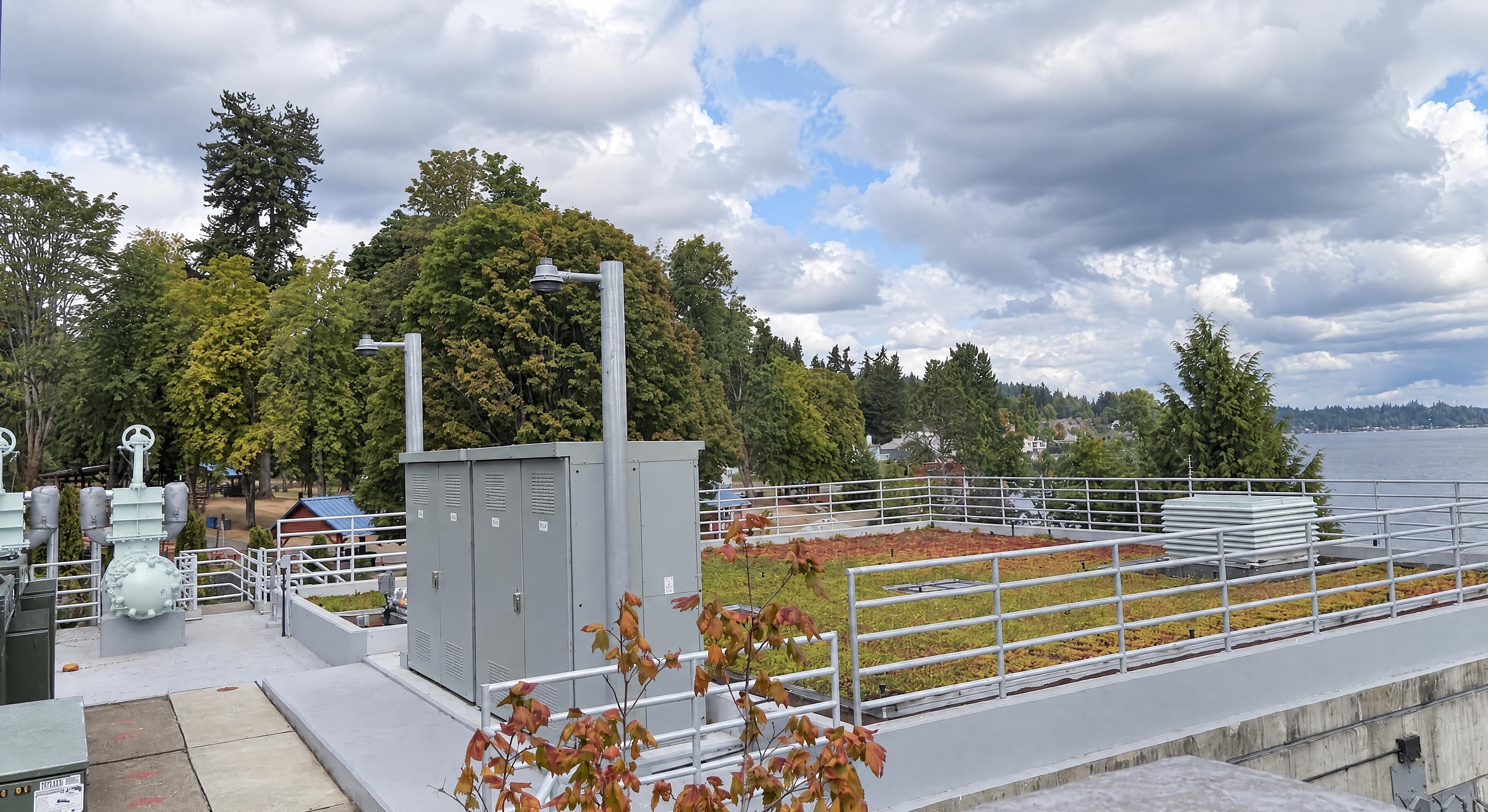
A force main runs full, with no air above the sewage, so every hour it spends there adds sulfide.
Why It Happens
In a gravity sewer, some oxygen enters from the air above the flow. A force main runs full, so once the dissolved oxygen is gone the sewage goes septic, after about 1 hour, and sulfide builds for the rest of the trip. Mains built for future growth carry less flow than they were sized for, so the sewage moves slowly.
The sulfide comes out where the pressure drops: at air release valves, at the discharge manhole, and in the gravity sewer and plant downstream.
Sources: WEF webcast, 2020; ECO₂, oxygen demand bulletin; Harshman and Hunniford 2024
In Gravity Sewers, H₂S Becomes Acid on the Crown
Sulfide forms in the water. The damage happens above it: on the pipe crown, in manholes and in wet wells.
Why It Happens
Where sulfide-laden wastewater tumbles, at a drop, a junction or a force main discharge, hydrogen sulfide escapes into the air above the flow. On the moist concrete it becomes sulfuric acid (H₂SO₄), which eats concrete and steel. Engineers call it crown corrosion, and it is often found only when a sewer fails.
A little gas does a lot of damage. Between 2 and 55 ppm of H₂S in the sewer air, sulfuric acid forms at about half its maximum rate, and that rate hardly changes with temperature. Odors fade below about 25 ppm, but corrosion barely slows, so the target is the sulfide in the water.
$130million
An EPA report cited a $130 million budget to repair 25 miles of one Los Angeles County interceptor. Source: Speece and Trollier
1 to 3ppm
Even 1 to 3 ppm of H₂S causes rapid deterioration of concrete and metal. Source: ECO₂ wastewater brochure
02How It Works
Oxygen Dissolved into the Force Main Keeps the Line Aerobic
Sulfide cannot form while the sewage holds dissolved oxygen. The job is to dissolve enough of it into the force main to last the whole trip.
The System in Detail
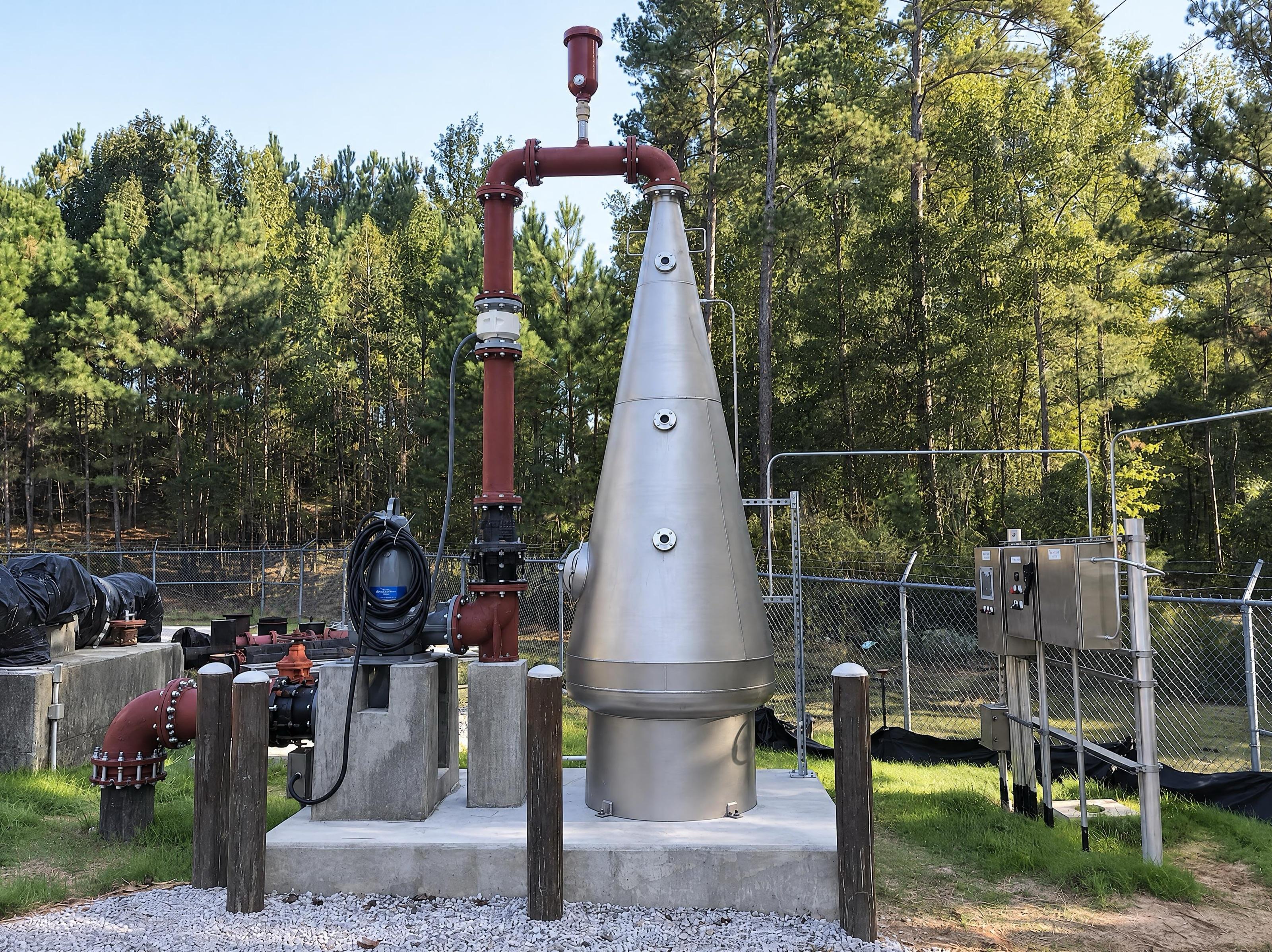
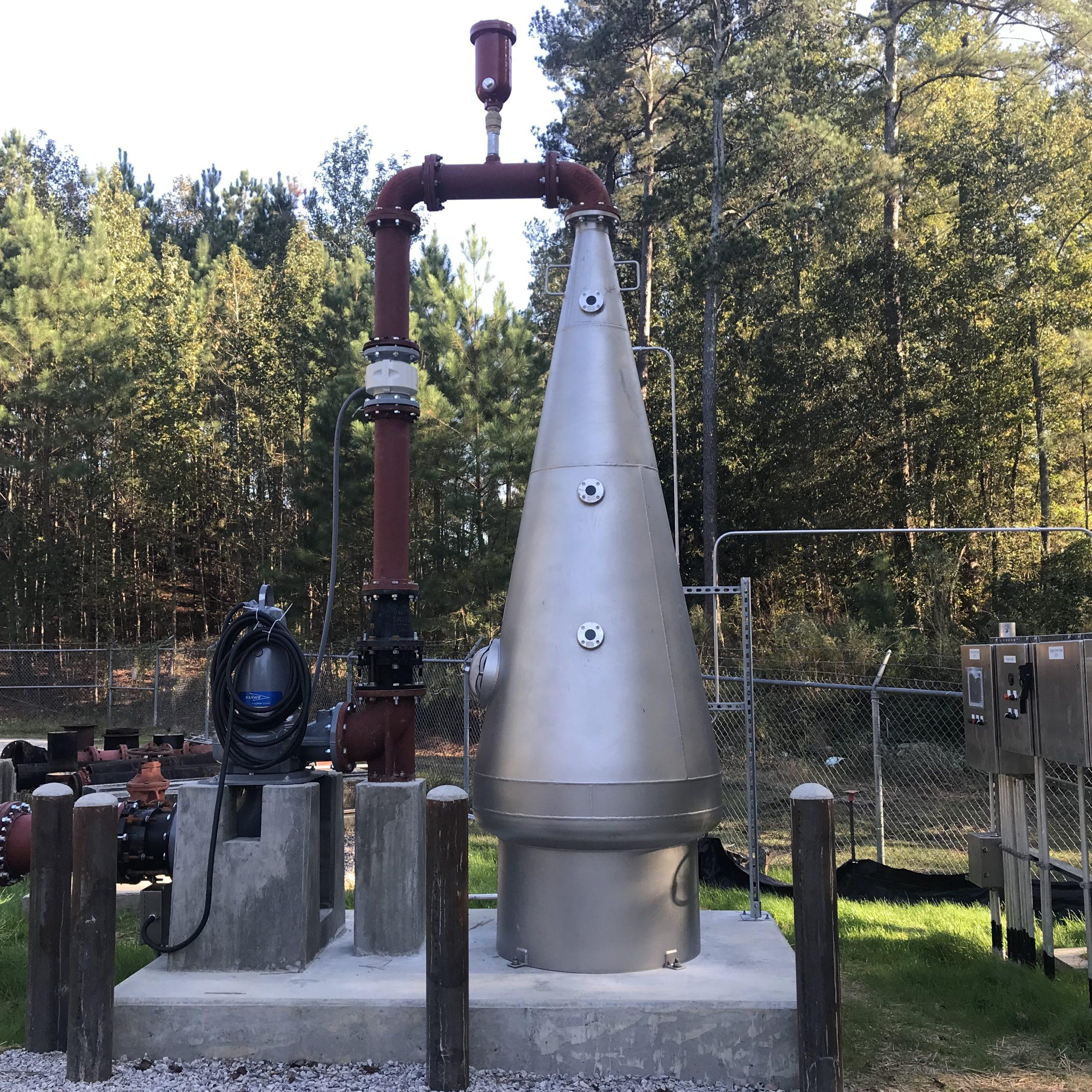
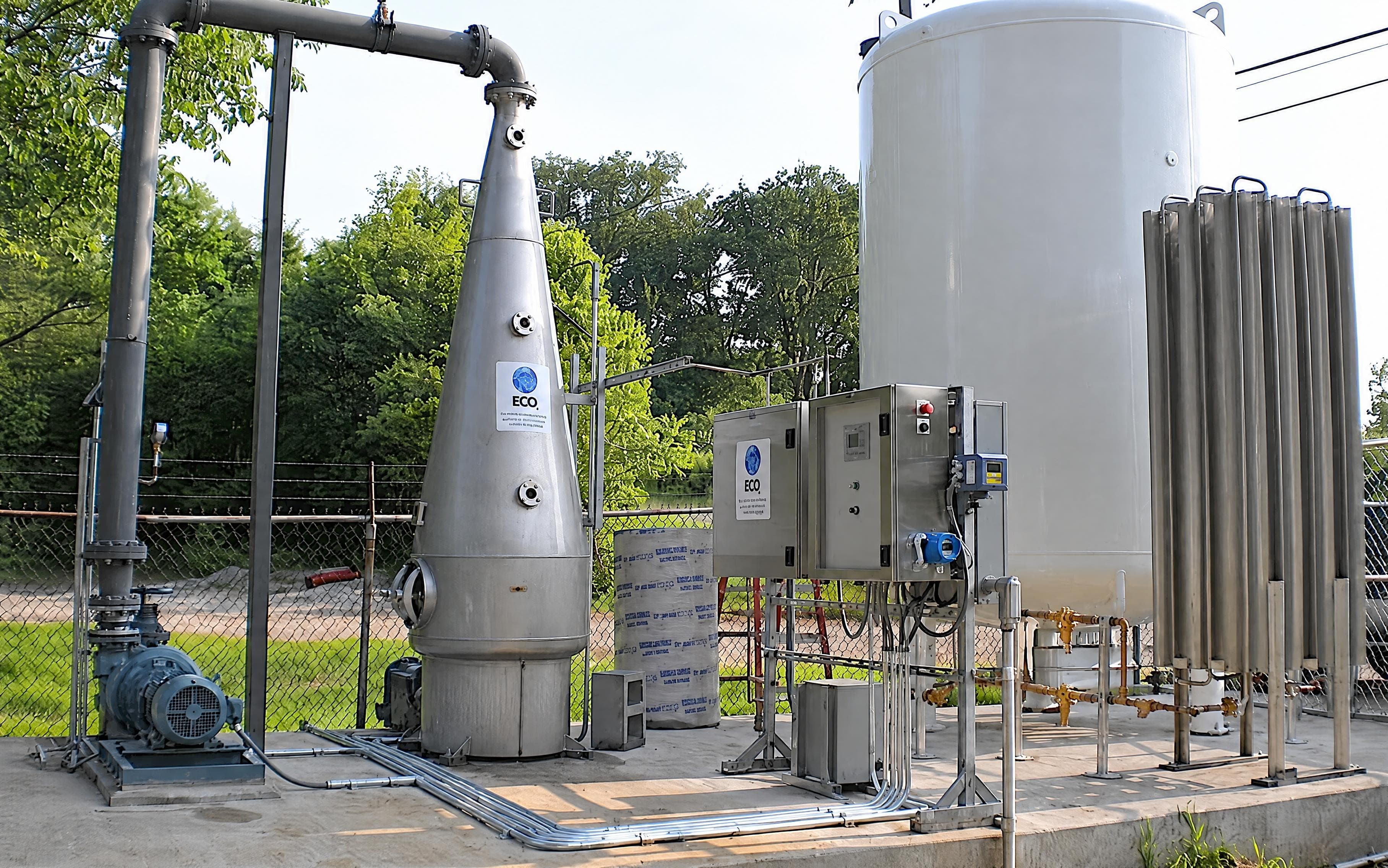
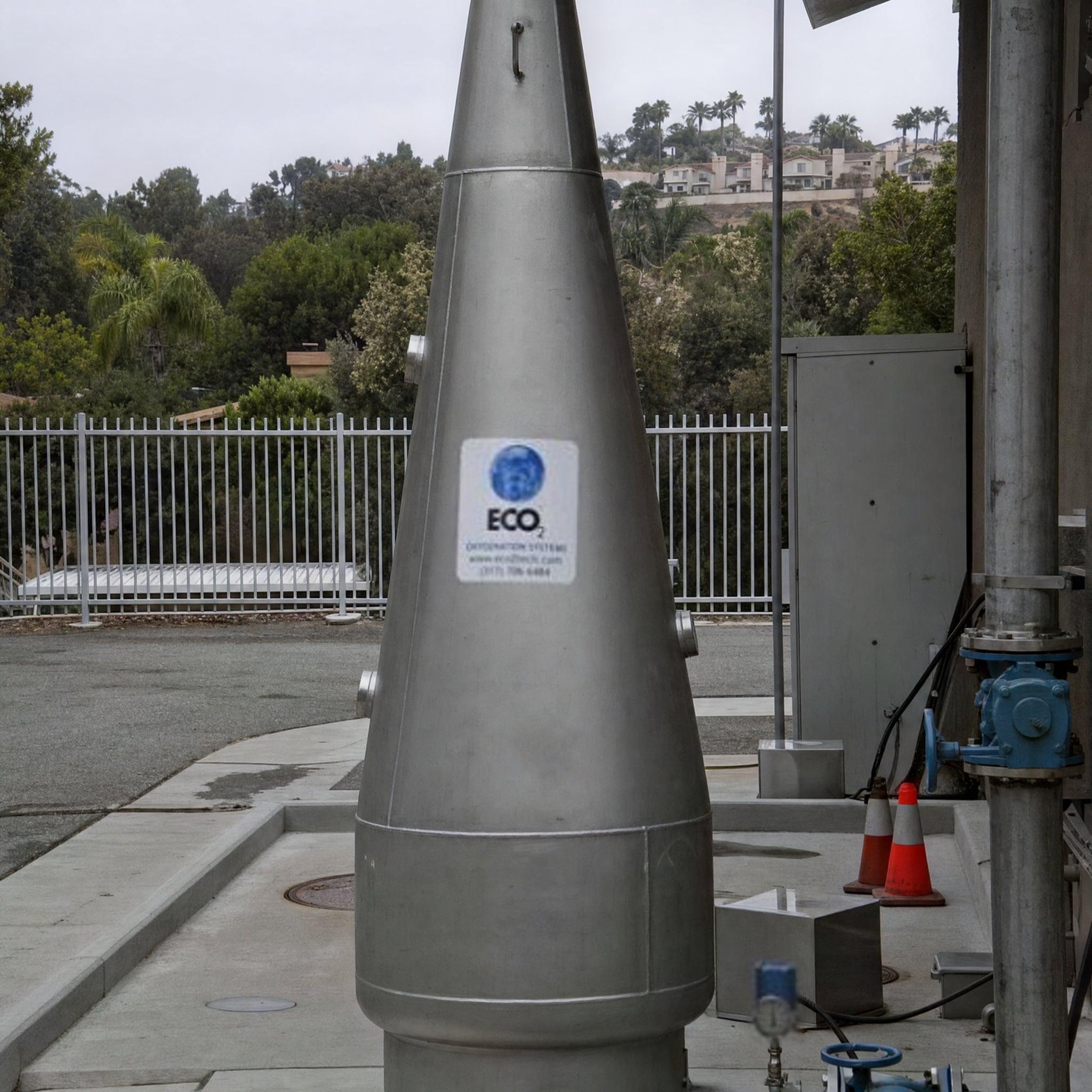
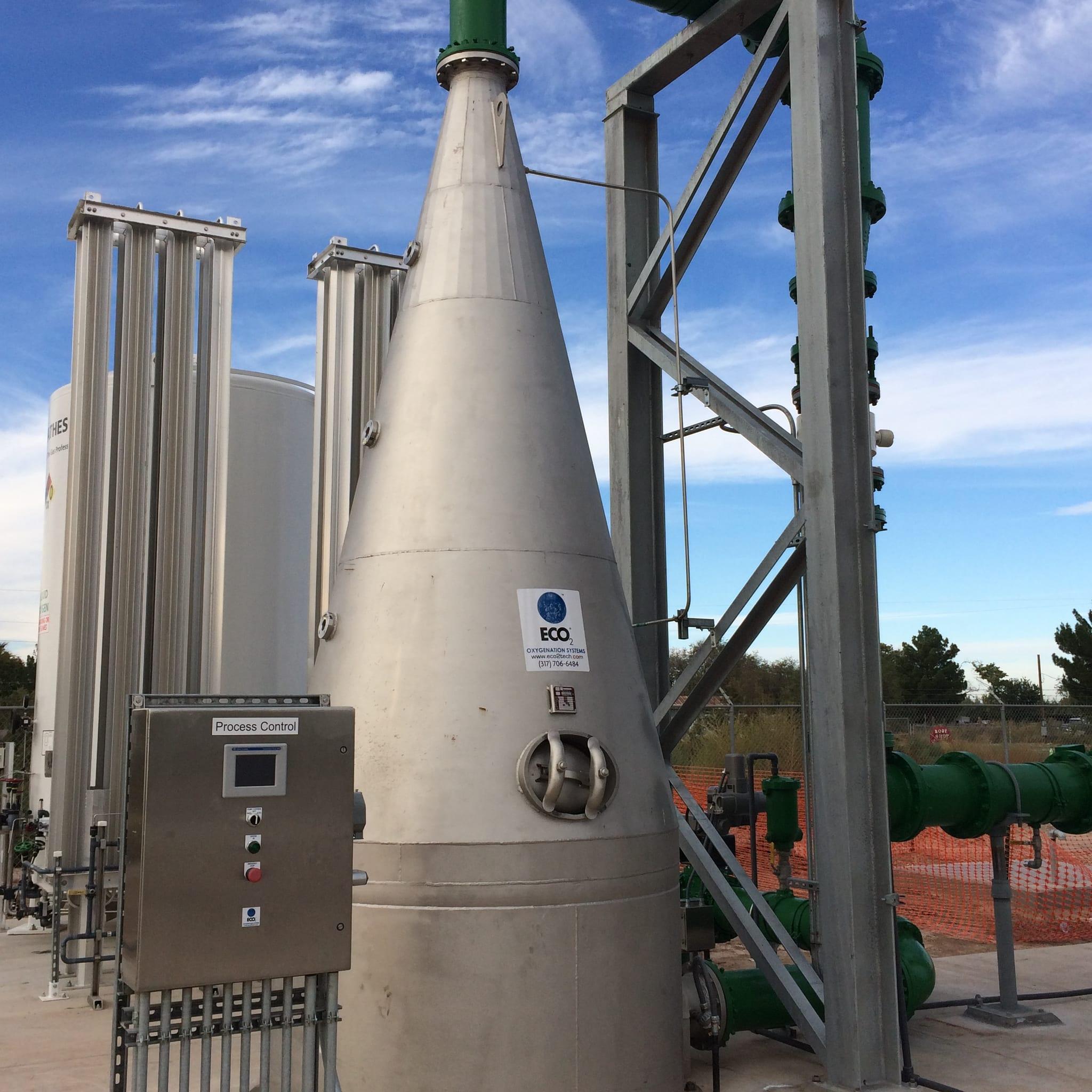
A small pump draws a side stream from the pressurized force main and sends it through a Speece Cone®. Pure oxygen dissolves completely in the cone, so only dissolved oxygen, with no bubbles, returns to the force main a short way downstream. Measured transfer: 95% to 98% at startup in Milford, Connecticut, an average of 95% at El Paso's Frontera pump station, and over 90% across operating conditions in Broomfield, Colorado.
Oxygen also clears sulfide that has already formed. It takes 2 mg/L of dissolved oxygen to oxidize 1 mg/L of dissolved sulfide, within 15 to 30 minutes, so ECO₂ places each system at least 30 minutes of flow upstream of the place that needs odor control. The oxygen keeps working past the discharge: at the White Rock pump station in British Columbia, oxygen carried over from a short force main reduces H₂S up to 5 miles down the gravity line.
Sources: Milford sewer system paper; ECO₂, El Paso case study; ECO₂, Broomfield case study; ECO₂, St. Joseph case study; ECO₂, oxygen demand bulletin; ECO₂ project record, White Rock pump station
Why the Oxygen Is Dissolved Before It Enters the Pipe
Oxygen gas injected straight into a force main mostly fails to dissolve.
Gas bubbles injected into a slow force main rise to the crown of the pipe within about 50 ft and travel along it, and the gas collects at high points, where it adds head on the pumps. In a 2-mile rising force main in San Diego with 440 ft of head, injected pure oxygen reached only 50 to 70% absorption.
A Speece Cone breaks the oxygen into bubbles in a fast downflow, and the widening cone holds them until they dissolve, so only dissolved oxygen enters the main.
Source: Speece, Facts and Myths
How the Oxygen Dose Is Set
The sewage's uptake rate, its time in the pipe and the sulfide already there, with a worked example.
The dose is the oxygen uptake rate times the retention time in the force main, plus 2 mg/L for each mg/L of dissolved sulfide already present, plus the oxygen wanted at the discharge. Pressure decides how much the water can hold: about 1 mg/L more for every foot of head. A Kentucky force main with 200 ft of head at its start is dosed above 100 mg/L and stays oxic at the discharge after 9 hours.
Worked example: how the Upper Salada lift station system in Moulton Niguel, California was sized (2008)
| Step | Value |
|---|---|
| Average flow pumpedMello 2011 | 820 gpm |
| Longest time in the force mainMello 2011 | Up to 4 hours |
| Oxygen uptake rate of the sewageMello 2011 | About 10 mg/L an hour |
| Dissolved oxygen the force main needsMello 2011 | 40 mg/L |
| Side stream oxygenated toMello 2011 | About 60 mg/L, then blended back |
Sources: ECO₂, oxygen demand bulletin; WEF webcast, 2020; WaterWorld, Fishers feature
The Equipment Fits at the Station, Often Inside It
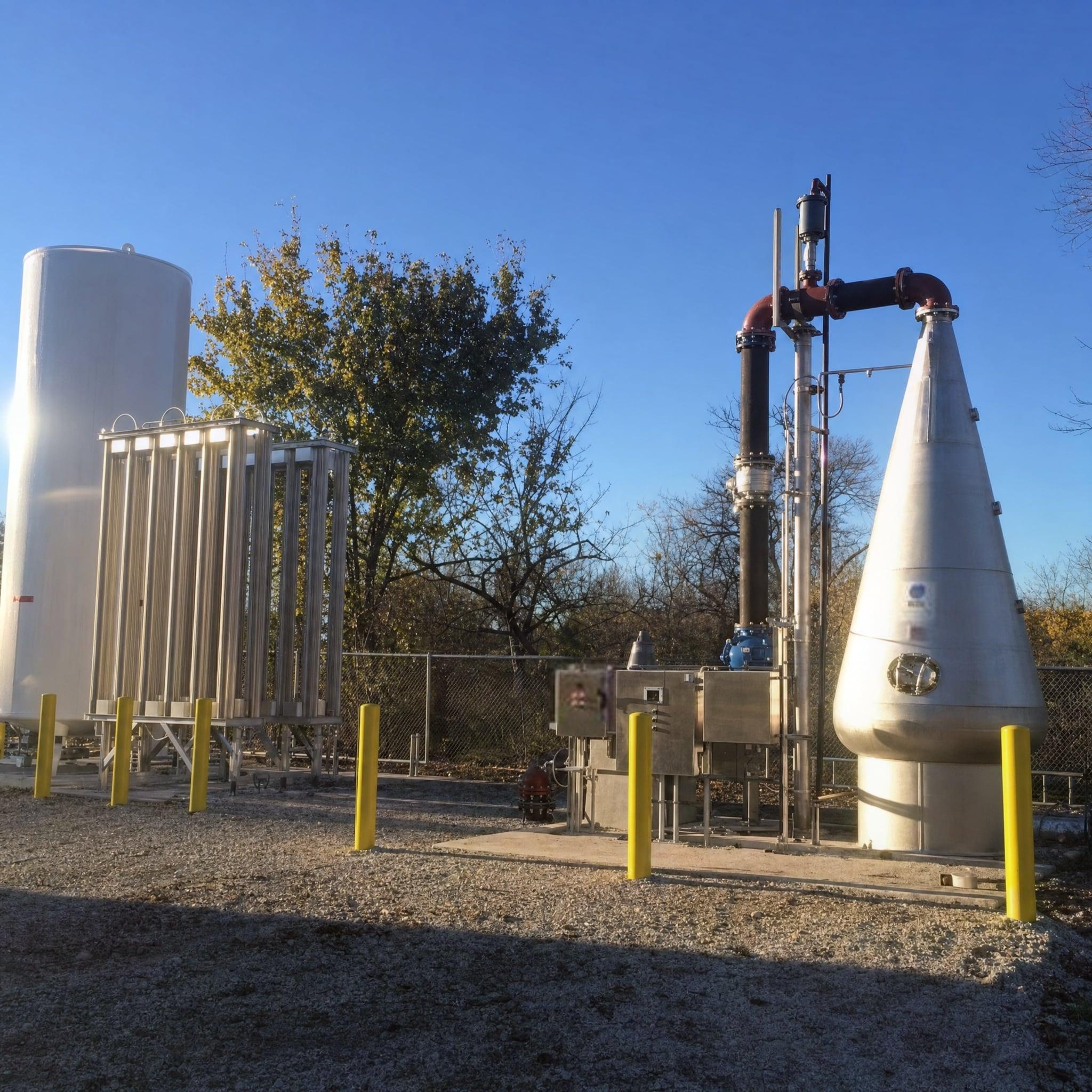
A cone, a side stream pump, controls and an oxygen supply. The cone itself has no moving parts.
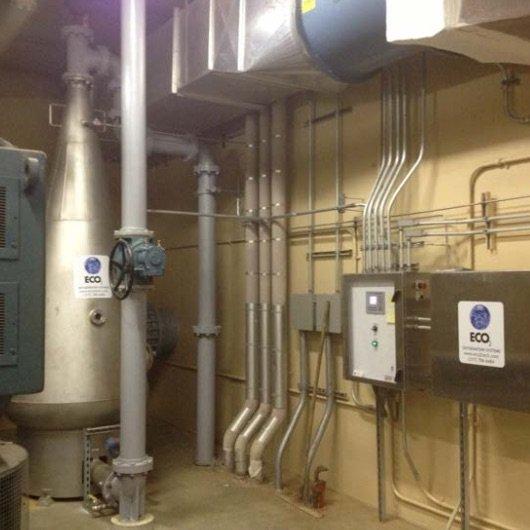
In Laguna Beach, California, the cone, an onsite oxygen generator, the piping, the pumps and the controls all fit inside the existing Bluebird lift station, out of sight of the beach community.
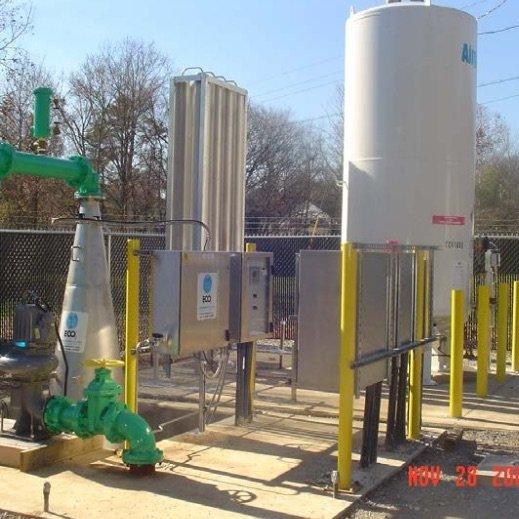
Oxygen comes from a liquid oxygen (LOX) tank filled by a local supplier, or from an onsite oxygen generator. St. Petersburg, Florida runs two stations on LOX: Lift Station 28 treats a 20 in., 3-mile force main with 1,100 lbs of oxygen a day, and Lift Station 85 a 30 in., 7-mile force main with 3,300 lbs a day, each from a 5 ft cone.
Running it is simple. In Fishers, Indiana, three lift station systems pretreat all of the plant's flow and have run for over 15 years. The only operating costs are the LOX and regular maintenance of the side stream pumps.
Sources: ECO₂, Laguna Beach case study; ECO₂, St. Petersburg case study; ECO₂, Fishers case study
Oxygen Can Also Go Straight into a Large Gravity Main
For long interceptors with no force main to treat, a side stream from the gravity sewer itself can be oxygenated and returned. The published work here is modeling, not field data.
The method pumps a side stream from the gravity main, dissolves pure oxygen into it completely and returns it upstream of the problem area. Two concerns come up: that oxygen above air saturation will bubble out, and that oxygen builds up in the headspace. The models below keep the headspace under the 23.5% limit.
What the published models show for large gravity sewers
| Case | Result |
|---|---|
| Dissolved oxygen raised to about 45 mg/L in a large interceptorSpeece and Trollier | Stays aerobic for roughly 4 miles |
| 5 ft pipe flowing half full, starting at 60 mg/LSpeece and Trollier | Headspace oxygen rises only to 21.6% |
| 4 ft pipe flowing half full at 1 ft/s, raised to 20 mg/LSpeece, Facts and Myths | Less than 1 mg/L lost to the headspace over 2 miles, about 2 hours |
Model results from the two papers, not field measurements.
03The Proof
Measured Along the Line: H₂S Near Zero
Readings before and after oxygen at lift stations, along force mains and in the sewers below them, each from its published source.
Every Result in One Table
H₂S and sulfide before and after dissolved oxygen in eight sewer collection lines
H₂S and sulfide before and after dissolved oxygen in eight sewer collection lines
| Where | Before | With oxygen |
|---|---|---|
| Knoxville, Tennessee: 24 in. force main, 6.4 miles, 24 hoursECO₂, Knoxville case study | 158 ppm average H₂S, spikes over 1,000 ppm | Under 1 ppm average |
| Raymore, Missouri: Owen Good pump station, 24 in. force main, up to 17 hoursECO₂, Raymore case study | Daily spikes of 600 to 900 ppm | Dropped as soon as the system started |
| Moulton Niguel, California: the interceptor below the Lower Salada lift stationMello 2011 | Daily peaks of 150 to 277 ppm | 0 to 2 ppm once the oxygen feed was adjusted |
| Milford, Connecticut: Gulf Pond's dual 20 in. and 24 in. force mains, 2.5 milesMilford sewer system paper | Sulfide 0.7 mg/L at the discharge, oxygen off (June 2012 test) | No sulfide detected and 8.3 mg/L of dissolved oxygen; H₂S 0 ppm in two manholes downstream |
| El Paso, Texas: Frontera pump station, 3.5-mile dual force mainECO₂, El Paso case study | 12 ppm average with calcium nitrate | 1 ppm average |
| Fishers, Indiana: three lift stations feeding the treatment plantWaterWorld, Fishers feature | 20 ppm average | 0 ppm |
| Broomfield, Colorado: the new Northlands force mainECO₂, Broomfield case study | Treated from startup | Non-detectable at every air release valve and at the discharge |
| Carlsbad, California: the gravity junction below the Leucadia force mainECO₂ project record, Leucadia force main | Extremely high H₂S spikes | Spikes eliminated, H₂S near zero overall |
H₂S gas in ppm and sulfide in mg/L, as each source reports them.
None
With the oxygen on, no sulfide was detected at Milford's force main discharge, against 0.7 mg/L with it off. 2 to 55ppm
At 2 to 55 ppm of H₂S in the sewer air, sulfuric acid forms at near half its maximum rate. Source: Gravity Sewer Odor and Corrosion Control (2020), page 1
What Cities Spend, & Save, Against Chemicals
Published costs and the cities' own studies of chemicals against oxygen.
- El Paso, Texas: the utility's consulting engineer compared five odor control chemicals, ozonation and oxygen, and oxygen had the lowest life-cycle cost. The project cost nearly $1.1 million, split almost evenly between equipment and installation, and reused the oxygen supply already on site.
- Laguna Beach, California: scrubbers would have tripled the city's chemical budget. The 2008 conference paper puts the payback against the chemicals the oxygen system replaced at 3.6 years.
- Milford, Connecticut: about $60 a day at maximum oxygen use. A 1995 study for the city found pure oxygen had the lowest cost per pound of H₂S removed.
- Raymore, Missouri: the city's odor study compared calcium nitrate, ferrous chloride, hydrogen peroxide, potassium permanganate, sodium hypochlorite and three oxygen injection systems. Oxygen was less expensive than any of the chemicals.
- Grand Rapids, Minnesota: on a force main from a paper mill, oxygen replaced calcium nitrate that cost nearly $500,000 a year.
- St. Joseph, Missouri: chemicals at the Faraon Street pump station were not enough, especially in dry weather. The city found oxygen more effective and more economical.
Sources: ECO₂, El Paso case study; Municipal Sewer & Water, 2020; ECO₂, Laguna Beach case study; Bluebird force main paper, 2008; Milford sewer system paper; Bradstreet et al. 2013; ECO₂, Raymore case study; ECO₂, Grand Rapids case study; ECO₂, St. Joseph case study
How It Compares with Chemicals, Covers & Scrubbers
Chemicals treat the sulfide; oxygen stops the bacteria from making it. Calcium nitrate needs 2 to 3 hours of contact and sends nitrate to the plant. Iron salts are hazardous to store and add solids, hydrogen peroxide suits mains under about 2 hours, and magnesium hydroxide holds sulfide in solution, which it can release again downstream. Covers, ventilation and scrubbers capture or dilute the gas after it forms. Dissolved oxygen removes sulfide and prevents it, with no byproducts, on mains with up to 10 to 20 hours of retention; very long mains can take a second system.
Sources: ECO₂, liquid phase comparison; ECO₂, gravity sewer application note; Western Canada Water, 2010; ECO₂, Knoxville case study; Harshman and Hunniford 2024; ECO₂, odor control strategies bulletin
Hydrogen sulfide odor control in force mains: the options compared
04For Engineers
Read the Papers
Questions Engineers & Operators Ask
How do you control sewer odor without chemicals?
Keep the sewage aerobic. A Speece Cone on a side stream from the force main dissolves pure oxygen into the flow, so sulfide cannot form in the main, and sulfide already formed is oxidized within 15 to 30 minutes. At Raymore, Missouri, daily H₂S spikes of 600 to 900 ppm dropped as soon as the system started.
Is pump station odor control the same as lift station odor control?
Yes. Utilities use both names for a station that pumps sewage into a force main, and the odor has the same cause: sewage that runs out of oxygen in the force main, a full pipe with no air space. At El Paso's Frontera pump station, oxygen took average H₂S from 12 ppm with calcium nitrate to 1 ppm.
How do I stop hydrogen sulfide in a long sewer force main?
Keep the sewage aerobic for the whole trip. Dissolve enough oxygen into the force main to cover the uptake rate for the full retention time, and on a very long main add a second system partway along. Knoxville's 6.4-mile Forks of the River force main has one at the start and one at the midpoint, and average H₂S fell from 158 ppm to under 1 ppm.
How much dissolved oxygen does a force main need?
The oxygen uptake rate times the retention time, plus 2 mg/L for each mg/L of dissolved sulfide already present, plus a residual at the discharge. At the Upper Salada lift station, up to 4 hours at about 10 mg/L an hour meant 40 mg/L, met with a side stream oxygenated to about 60 mg/L.
How does a Speece Cone differ from oxygen injection into the force main?
Oxygen gas injected straight into a slow force main mostly fails to dissolve: it rises to the crown and collects at high points, and in a 2-mile rising main in San Diego it reached only 50 to 70% absorption. The cone dissolves the oxygen on a side stream first, so only dissolved oxygen enters the main, at an average of 95% transfer at El Paso's Frontera pump station.
What H₂S level causes sewer pipe corrosion?
Less than most people expect. Between 2 and 55 ppm of H₂S in the sewer air, sulfuric acid forms at about half its maximum rate, and 1 to 3 ppm already causes rapid deterioration of concrete and metal. Odor fades below about 25 ppm, but corrosion barely slows.
How do you prevent H₂S corrosion in large diameter gravity sewers?
Remove the sulfide from the water. Where a force main feeds the sewer, oxygen dissolved into the force main protects the gravity line downstream: at the White Rock pump station it reduces H₂S up to 5 miles down the line. For long interceptors, a side stream from the gravity main can be oxygenated and returned; the published models show about 45 mg/L keeping a large interceptor aerobic for roughly 4 miles.
Will the equipment fit at our station?
Usually. In Laguna Beach, California, the cone, an onsite oxygen generator, the pumps and the controls all fit inside the existing Bluebird lift station. Where there is no room inside, the cone and a liquid oxygen tank sit beside the station.
Other Wastewater Odor Control Problems
05The Next Step
Send Us Your Collection Line's Numbers
Flows, the force main's length and diameter, the sewer it feeds and any H₂S readings are enough for a budgetary price. The Force Main Design Data Checklist helps. ECO₂'s engineers check the data for a technical fit, then send a system design with its estimated capital and annual operating costs, and can visit your site to confirm the data.