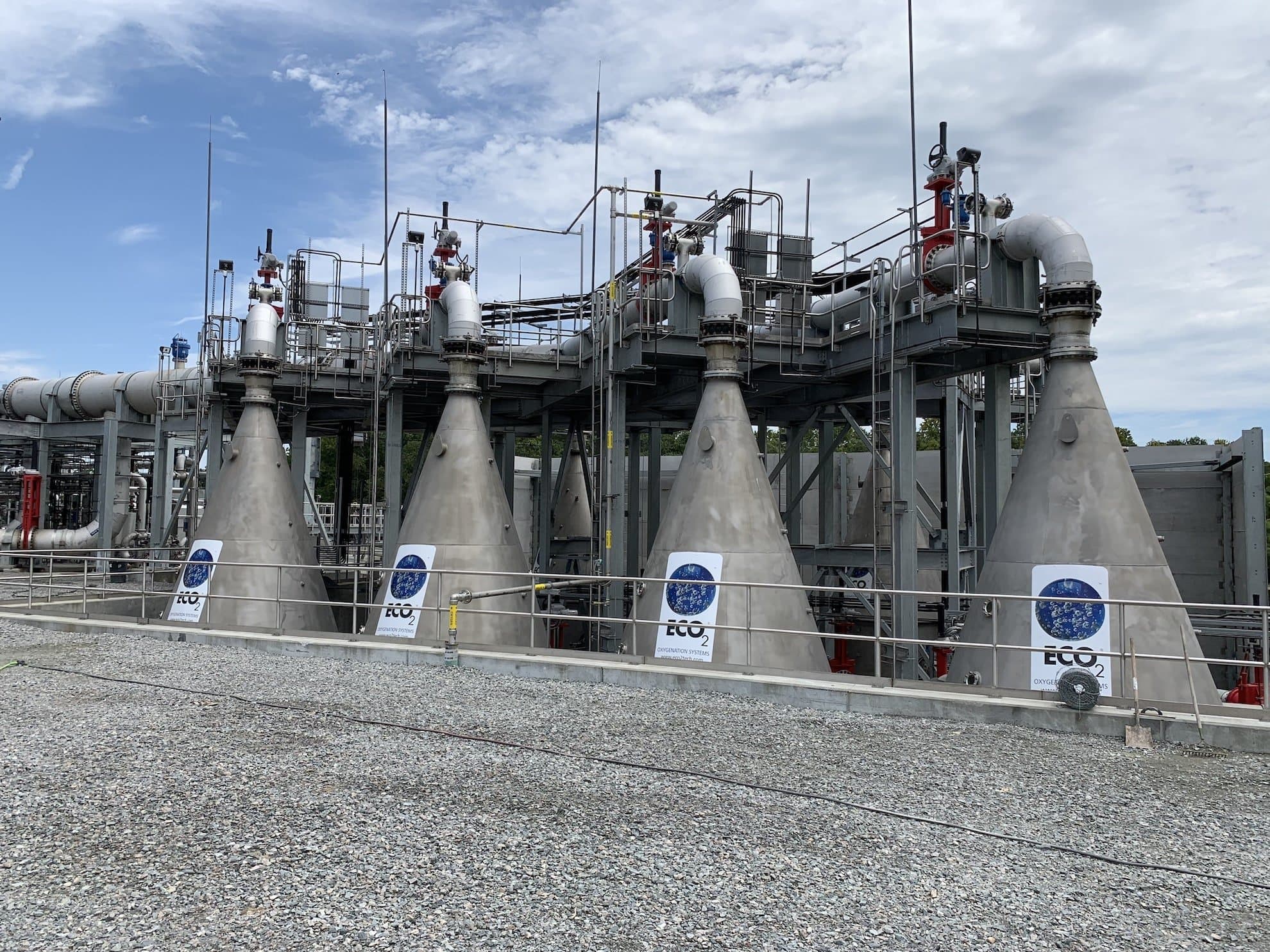
A primary clarifier is the first settling tank at a wastewater treatment plant, where solids settle out of the raw wastewater before biological treatment. ECO₂'s bulletin calls it the major odor source at many plants, because sulfide in the influent escapes as H₂S at its weirs.
Superoxygenation Glossary
Plain definitions of 38 terms in Superoxygenation, sewer odor and corrosion, treatment plants and lake oxygenation, each linked to its source paper.
- Aeration
Aeration is the transfer of oxygen into water from air, which is only 21% oxygen, by bubble diffusers or mechanical aerators. ECO₂'s technical bulletin puts field aeration at 1 to 2 lbs of oxygen per kWh with 5 to 10% of the oxygen absorbed, and finds it uneconomic to hold dissolved oxygen above 2 to 4 mg/L. Oxygenation with pure oxygen, as in Superoxygenation, reaches far higher levels with less energy and far less off-gas.
- Anoxia
Anoxia is the absence of dissolved oxygen in water. In a stratified lake or reservoir it builds up in the bottom water as settled organic matter decays, and ECO₂'s lake brochure links it to harmful algal blooms, taste and odor problems, fish kills, methylmercury in the food web, and methane and H₂S formation. In wastewater treatment, engineers usually call a zone anoxic when it has no dissolved oxygen but still has nitrate, and anaerobic when it has neither.
- Biochemical Oxygen Demand (BOD)
Biochemical oxygen demand (BOD) is the oxygen bacteria use to break down the organic matter in a water sample, usually measured over five days at 20°C and reported in mg/L. It is the standard measure of wastewater strength and of the oxygen a discharge will take from a river.
- Calcium Nitrate
Calcium nitrate is a chemical dosed into sewers for odor control: bacteria use its nitrate in place of oxygen, so they do not turn sulfate into hydrogen sulfide, and they oxidize some of the sulfide already there.
- Crown Corrosion
Crown corrosion is the decay of the top, or crown, of a concrete sewer pipe or manhole above the flow. Hydrogen sulfide gas leaves the wastewater, dissolves in the moisture on the pipe wall, and bacteria turn it into sulfuric acid, which attacks concrete and steel. Dr. Speece's Superoxygenation: Facts and Myths reports that 2 to 55 ppm of H₂S in the sewer air lets crown corrosion run at 50% of its maximum rate, so cutting odor alone may not stop corrosion.
- Detention Time
Detention time, or hydraulic retention time (HRT), is how long water stays in a pipe, tank or basin: its volume divided by the flow. The longer wastewater sits in a force main, the more sulfide forms, so ECO₂ sizes the oxygen to prevent it as the oxygen uptake rate times the detention time, and installs each system at least 30 minutes of HRT upstream of the place that needs odor control. Knoxville's 6.4-mile Forks of the River force main has 24 hours of HRT.
- Dissolved Oxygen (DO)
Dissolved oxygen (DO) is oxygen gas held in solution in water, measured in mg/L, and the oxygen that fish and aerobic bacteria live on.
- Dissolved Sulfide
Dissolved sulfide is the sulfide in solution in wastewater, as hydrogen sulfide (H₂S) and the bisulfide ion (HS⁻), measured in mg/L. Only the H₂S form can leave the water as odorous, corrosive gas, and its share grows as pH falls. ECO₂ designs on 2 mg/L of dissolved oxygen for every 1 mg/L of dissolved sulfide to remove, and the oxygen clears it within 15 to 30 minutes.
- Effluent Dissolved Oxygen
Effluent dissolved oxygen is the DO in a treatment plant's discharge, which permits often set as a minimum to protect the river or estuary that receives it. Raising it before discharge is called post-aeration, or post-oxygenation when pure oxygen is used. Since the Kennebunk Sewer District in Maine added ECO₂ Superoxygenation in 2006, its effluent has averaged 9.2 mg/L of DO in the hot summer months, when the limit had been hardest to meet.
- Epilimnion
The epilimnion is the warm, well-mixed surface layer of a stratified lake or reservoir, kept supplied with oxygen by the air and by algae. In San Pablo Reservoir, California, it is almost uniform at about 20°C down to about 30 ft and fully oxygenated, above a thermocline and an anoxic hypolimnion.
- Ferric Chloride
Ferric chloride is an iron salt dosed into sewers to bind sulfide into an iron sulfide solid, so it cannot escape as H₂S; ferrous chloride and the iron sulfates work the same way. ECO₂'s chemical cost comparison lists iron salts as hazardous and highly corrosive, needing secondary containment and freeze protection, and adding solids at the treatment plant. The same comparison gives about 0.5 mg/L of dissolved sulfide as the lowest iron salts reach.
- Force Main
A force main is a pressurized sewer pipe that carries wastewater from a lift station, running full with no air space; engineers in the UK and Australia call it a rising main. With no air to resupply oxygen and often hours of detention, the wastewater turns septic and forms hydrogen sulfide, released as odor and corrosion where the main discharges. Oxygen gas injected straight into a force main rises to the crown of the pipe within about 50 ft, so a Speece Cone dissolves it fully before it goes back into the pipe.
- Headworks
The headworks is the inlet of a wastewater treatment plant, where screens and grit removal take out rags and grit, and where sulfide arriving from the collection system is released as odor.
- Hydrogen Sulfide (H₂S)
Hydrogen sulfide (H₂S) is the toxic gas, smelling of rotten eggs, behind most sewer odor and corrosion. Bacteria in the slime layer of sewer pipes make it from sulfate once dissolved oxygen falls below about 0.5 mg/L, and it escapes wherever the flow is turbulent, such as at force main discharges, wet wells and headworks. Keeping the wastewater aerobic with dissolved oxygen stops it forming.
- Hypolimnetic Oxygenation
Hypolimnetic oxygenation adds pure oxygen to the bottom layer, or hypolimnion, of a stratified lake or reservoir without mixing it with the warm surface water, so the bottom water stays cold and the sediment stays oxygenated. A Speece Cone system draws water from the bottom, dissolves oxygen into it and returns it at the same depth, where it spreads across the bottom. At Camanche Reservoir in California, the oxygenated plume traveled 4.5 km up the reservoir in 1994.
- Hypolimnion
The hypolimnion is the cold, dense bottom layer of a stratified lake or reservoir, cut off from the air by the thermocline above it. Through the summer, decaying organic matter and the sediment use up its oxygen: in San Pablo Reservoir, California, the hypolimnion below about 40 ft is almost completely anoxic.
- Internal Loading
Internal loading is the release of phosphorus, ammonia, iron and manganese from a lake's own sediment back into the water, which keeps feeding algae even after outside inputs are cut. ECO₂'s paper on oxygen supplementation traces it to anoxic water directly above the sediment, and shows that an aerobic cap over the sediment keeps the phosphorus and iron bound there.
- Lift Station
A lift station, or pump station, pumps wastewater from a low point in a collection system up into a force main or a higher gravity sewer. It is the usual home of an ECO₂ sewer system: in Laguna Beach, California, the system and an onsite oxygen generator fit inside the existing Bluebird lift station, out of sight of the beach community.
- Liquid Oxygen (LOX)
Liquid oxygen (LOX) is oxygen separated from air by distillation, delivered by tanker and stored on site as a liquid, then turned back into gas in an evaporator as the system calls for it. LOX has no pressure limit. ECO₂'s oxygen source bulletin notes that the gas needs no compressor, that the tank is often leased and maintained by the gas supplier, and that it must stand on concrete or crushed stone, never asphalt.
- Magnesium Hydroxide
Magnesium hydroxide is a mild alkali dosed into sewers to raise pH, which keeps more of the sulfide in solution as bisulfide instead of H₂S gas. A WEF webcast in the library notes that it buffers at about pH 9 and is dosed to hold pH between 8.0 and 8.5. It controls odor without removing the sulfide. ECO₂'s chemical cost comparison gives about 0.5 mg/L of dissolved sulfide as the lowest it reaches.
- Manganese Release
Manganese release is the escape of dissolved manganese, and later iron, from lake and reservoir sediment once the bottom water loses its oxygen, which brings staining, taste problems and treatment costs to drinking water. In sediment chamber tests for San Pablo Reservoir, California, manganese was released as soon as conditions turned anoxic, while iron release lagged. Keeping the bottom water oxygenated keeps both in the sediment.
- Membrane Bioreactor (MBR)
A membrane bioreactor (MBR) is an activated sludge process that separates treated water from the biomass with membranes instead of a settling tank, so it runs at much higher mixed liquor solids. High solids cut the oxygen transfer of fine bubble diffusers; Dr. Speece's Superoxygenation: Facts and Myths notes that dissolving the oxygen before it reaches the reactor makes that loss irrelevant at the 8,000 to 18,000 mg/L of mixed liquor solids found in membrane reactors.
- Methane in Sewers
Methane forms in sewers alongside hydrogen sulfide wherever wastewater turns anaerobic, especially in force mains and deep in the slime layer on pipe walls, and it escapes to the air as a potent greenhouse gas. Because methane biodegrades very slowly once formed, Dr. Speece and David Clidence argue that preventing it with dissolved oxygen is the only practical control.
- Oxygen Saturation
Oxygen saturation is the most dissolved oxygen water can hold in balance with the gas above it; by Henry's law it rises with the oxygen's partial pressure and falls as water warms. That is why a pressurized force main can hold a high dose: Laguna Beach's Bluebird force main, with 69.2 ft of head, could hold the 60 mg/L it needed.
- Oxygen Transfer Efficiency (OTE)
Oxygen transfer efficiency (OTE) is the share of the oxygen fed to a system that actually dissolves in the water; the rest leaves as off-gas and is wasted. Bubbled air transfers only 5 to 10%, while ECO₂'s brochure gives 95% for the Speece Cone at all feed rates. In the U.S. Army Corps of Engineers' 2019 test of the Savannah Harbor system, transfer averaged 95% or better against an 80% minimum.
- Oxygen Uptake Rate (OUR)
Oxygen uptake rate (OUR) is how fast the bacteria in a water or wastewater sample use up dissolved oxygen, in mg/L per hour or per minute. ECO₂'s test brings a sample to 20 mg/L with pure oxygen, seals it in a BOD bottle with a DO probe and reads it every 5 minutes; the slope of the readings is the OUR. Raw wastewater typically runs at 5 to 15 mg/L an hour, and ECO₂ multiplies the OUR by the detention time to size the oxygen dose.
- Primary Clarifier
- PSA Oxygen Generator
A PSA (pressure swing adsorption) oxygen generator makes high-purity oxygen on site by passing compressed air through a molecular sieve, such as a zeolite, that holds back the nitrogen, then lowering the pressure to clear it. A VSA (vacuum swing adsorption) unit works the same way with a vacuum and, by ECO₂'s bulletin, can use as much as 50% less power. Making oxygen on site means no deliveries and no bulk storage.
- Sediment Oxygen Demand (SOD)
Sediment oxygen demand (SOD) is the rate at which the bed of a lake or reservoir uses oxygen from the water above it as settled organic matter decays, usually given in grams of oxygen per square meter per day. With the oxygen demand of the bottom water itself, it sets how much oxygen a hypolimnetic oxygenation system must supply: San Pablo Reservoir's system was sized at 5 tons a day for an estimated 4.75 tons a day of SOD, measured in sediment chambers.
- Septic Conditions
Septic conditions arise when wastewater runs out of dissolved oxygen and nitrate, so bacteria turn to sulfate and produce hydrogen sulfide, and methane with it. A WEF webcast in the library puts the threshold at about 0.5 mg/L of dissolved oxygen, and ECO₂'s Raymore, Missouri case study notes that sewage goes septic after about 1 hour in a force main.
- Side-Stream Pump
The side-stream pump draws part of the flow from a pipe, tank or water body through the Speece Cone and returns it; it is the only moving part in an ECO₂ system and the only part that needs routine maintenance. At the Gulf Pond pump station in Milford, Connecticut, a 5 hp side-stream pump moves 1,000 gpm through a 4 ft cone that dissolves 1,000 lbs of oxygen a day into the force main.
- Specific Oxygen Uptake Rate (SOUR)
Specific oxygen uptake rate (SOUR) is the oxygen uptake rate divided by the amount of biomass in the sample, usually measured as volatile suspended solids, giving mg of oxygen per gram of solids per hour. It shows how active the bacteria are, so samples of activated sludge or digested sludge with different solids levels can be compared.
- Speece Cone
The Speece Cone is ECO₂'s down-flow oxygen contactor, a stainless steel cone that dissolves pure oxygen into a side stream of water. Water and oxygen enter at the narrow top; as the cone widens the water slows until it matches the rise of the bubbles, which stay in contact until they dissolve, so the water leaves with 30 to 300 mg/L of dissolved oxygen and no bubbles. Dr. Richard Speece invented it.
- Stratification
Stratification is the layering of a lake or reservoir by temperature in the warm months: a warm epilimnion floats on a cold hypolimnion, with the thermocline between them blocking mixing. Lake Hodges in San Diego sets up its thermocline at about 5 to 10 m in summer, and it deepens in late fall until the lake turns over. Bubble diffusers can break stratification, while a Speece Cone adds oxygen at the bottom and keeps it.
- Superoxygenation
Superoxygenation is dissolving pure oxygen into water or wastewater at concentrations far above what aeration can reach, to prevent anoxic conditions without chemicals. ECO₂'s wastewater brochure describes it as a high-concentration dissolved oxygen technology that uses pure oxygen as an alternative to aeration or chemicals, with Speece Cone systems delivering 30 to 300 mg/L of dissolved oxygen at side-stream flows of 250 to 25,000 gpm.
- Thermocline
The thermocline is the layer of a stratified lake where temperature falls fastest with depth, between the warm epilimnion and the cold hypolimnion. In San Pablo Reservoir it drops to about 12°C over 10 ft, ending about 40 ft down, and its strong density gradient severely limits mixing and the downward movement of oxygen.
- Ultimate Oxygen Demand (UOD)
Ultimate oxygen demand (UOD) is the total oxygen a discharge will eventually take from the water that receives it: the full carbonaceous BOD plus the oxygen needed to nitrify its ammonia.
- Wet Well
A wet well is the chamber at a lift station where incoming wastewater collects until the pumps start. The turbulence as wastewater falls in releases H₂S from the sulfide it carries, so wet wells are a common source of odor and corrosion. At Fort Valley, Georgia, ECO₂'s effluent oxygenation system draws from an overflow wet well that collects plant flow above about 1.3 MGD.
The Next Step
From the Terms to Your Site
Start with your site's numbers, or ask an application engineer what these terms mean for your sewer, plant or reservoir.