DO Odor Control at Moulton Nigel in CA
How Moulton Niguel Water District stopped force main H₂S with dissolved oxygen, and showed it worked by turning the oxygen off, as a published article reports.
Details
Summary
Moulton Niguel Stops Force Main H₂S
Moulton Niguel Water District in southern Orange County replaced an air scrubber and ferric chloride with dissolved oxygen at two lift stations whose force mains meet at one gravity line. Interceptor H₂S that had peaked at 150 to 277 ppm each day held at 0 to 2 ppm once the oxygen feed was tuned (pp. 2, 3). Switching the system off for a day proved it.
Key Figures
167,000residents
People served by the Moulton Niguel Water District Source: PDF page 2 (opens in a new tab)
820gpm
Average flow pumped by the Upper Salada Pump Station Source: PDF page 2 (opens in a new tab)
60mg/L
Dissolved oxygen in the oxygenated sidestream (about) Source: PDF page 2 (opens in a new tab)
Questions
How much dissolved oxygen does a force main need to prevent H₂S?
Enough to meet the bacteria's oxygen uptake for the whole retention time. At Upper Salada the uptake rate is about 10 mg/L per hour and retention up to four hours, so 40 mg/L is needed, plus extra for sulfide already present (p. 2).
Why does H₂S spike when lift station pumps run in fill and draw cycles?
Oxygen can only be added while the force main pumps run. When they stop, wastewater sits longer in the pipe and needs more oxygen. At Lower Salada this caused short spikes of 20 to 60 ppm until the oxygen feed was adjusted (p. 3).
What happens to H₂S if the oxygen system is turned off?
It comes back. In the district's one-day shutdown test on August 2, 2010, H₂S began to build again as soon as the dissolved oxygen was used up (p. 3).
Why did Moulton Niguel stop using ferric chloride?
After a year of testing, maintenance staff were unhappy with the discoloration of the wet well and force main pumps, and surfaces the chemical touched were damaged (p. 2).
Why did Moulton Niguel Water District look for a new odor control method?
Its air scrubber left a bitter smell from the exhaust and needed frequent carbon and lamp replacement, and a year of ferric chloride dosing discolored the wet well and pumps and damaged surfaces it touched. (PDF page 2) (opens in a new tab)
How was the Upper Salada system sized?
Bacteria in the force main use oxygen at about 10 mg/L per hour, and wastewater stays in the main for up to four hours, so about 40 mg/L of dissolved oxygen is needed, plus extra to oxidize sulfides already present. The sidestream is oxygenated to about 60 mg/L and blended back into the force main. (PDF page 2) (opens in a new tab)
What happened at the Lower Salada Pump Station?
Before startup, daily H₂S peaks in the interceptor reached 150 to 277 ppm. After startup H₂S was 0 ppm most of the day, with short spikes of 20 to 60 ppm caused by the pumps running in fill and draw cycles; after the oxygen feed was adjusted, H₂S stayed at 0 to 2 ppm. (PDF page 3) (opens in a new tab)
What did the shutdown test show?
When the system was turned off for a day on Aug. 2, 2010, H₂S started building up again as soon as the dissolved oxygen was used up, showing that bacteria switch to sulfates once oxygen is gone. (PDF page 3) (opens in a new tab)
The Project
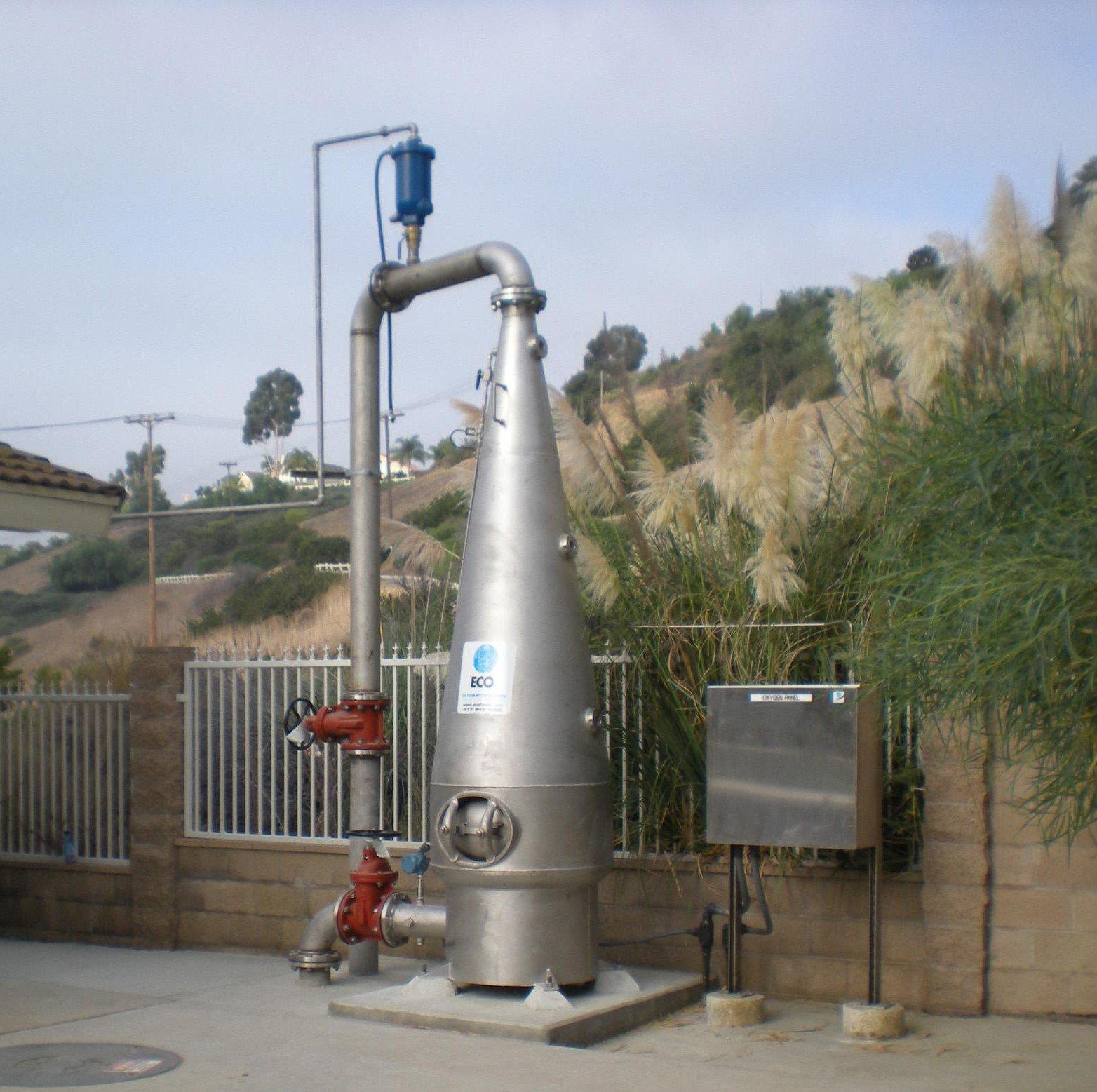
Upper Salada Lift Station
In Full
More Key Figures
12 more, each with what it measures and its PDF page.
From the PDF
| Figure | What It Measures |
|---|---|
| 40 mg/L | Dissolved oxygen needed for four hours of retention at about 10 mg/L per hour uptake (PDF page 2 (opens in a new tab)) |
| 95% efficiency | Oxygen transfer efficiency of the cone (PDF page 3 (opens in a new tab)) |
| 150 to 277 ppm | Daily H₂S peaks in the interceptor before the second system started (PDF page 3 (opens in a new tab)) |
| 0 to 2 ppm | H₂S in the interceptor after the oxygen feed was adjusted (PDF page 3 (opens in a new tab)) |
| 150 to 277 ppm H₂S | Daily peaks in the interceptor before the Lower Salada system started (PDF page 3 (opens in a new tab)) |
| 0 to 2 ppm H₂S | Interceptor H₂S after the oxygen feed was adjusted (PDF page 3 (opens in a new tab)) |
| 20 to 60 ppm H₂S | Short daily spikes at startup, from pumps running in fill and draw cycles (PDF page 3 (opens in a new tab)) |
| 10 mg/L per hour | Oxygen uptake rate in the Upper Salada force main (approximately) (PDF page 2 (opens in a new tab)) |
| 40 mg/L | Dissolved oxygen needed for four hours of retention (PDF page 2 (opens in a new tab)) |
| 60 mg/L | Dissolved oxygen in the oxygenated side stream (about) (PDF page 2 (opens in a new tab)) |
| 95% | Oxygen transfer efficiency of the Upper Salada cone (PDF page 3 (opens in a new tab)) |
| 167,000 residents | People served by Moulton Niguel Water District (PDF page 2 (opens in a new tab)) |
The Full Write-Up
The problem, the work, the results and who did it.
Two Force Mains, One Manhole & Years of Odor
Moulton Niguel Water District (MNWD) serves 167,000 residents in southern Orange County, California, with 537 miles of sewer pipelines and 17 lift stations (p. 2). Two of its force mains discharge into the same gravity line, and odor at the manhole where they meet would not go away (p. 2).
Bacteria in the slime layer on a pipe wall need oxygen to consume the wastewater's biochemical oxygen demand. Once dissolved oxygen runs out they use nitrate and then sulfate, and sulfate-reducing bacteria make sulfide. Where the force main discharges, the sulfide comes out of solution as H₂S, collects in the headspace of the gravity line and escapes through manholes and vent shafts as odor and corrosion (p. 2).
The district first pulled air from the manhole through an ultraviolet unit and a carbon scrubber. Neighbors still smelled a bitter exhaust, and the carbon and lamps needed constant replacing. Ferric chloride, tested for a year, stained the wet well and pumps and damaged the surfaces it touched (p. 2).
Oxygen Sized to the Time Wastewater Spends in the Pipe
Through the South Orange County Wastewater Authority (SOCWA), MNWD knew of a Superoxygenation system controlling odor in neighboring Laguna Beach, and chose the same approach (p. 2).
The first system went in at the Upper Salada Pump Station in the summer of 2008. The station pumps an average of 820 gpm through dual force mains over 6,700 ft to the top of a hill, where the flow runs by gravity into the interceptor. Wastewater spends up to four hours in the main (p. 2).
Bacteria in this pipeline's slime layer use about 10 mg/L of oxygen an hour, so four hours of retention needs 40 mg/L of dissolved oxygen, plus extra to oxidize sulfide already formed upstream or in the wet well. The system oxygenates a side stream to about 60 mg/L and blends it back into the force main, so positive dissolved oxygen carries through the discharge into the gravity interceptor (pp. 2, 3). The cone dissolves its oxygen at an efficiency of 95% (p. 3).
A second, similar system followed on the converging main at the Lower Salada Pump Station, which pumps 550 gpm through a 12 in, 9,420 ft force main with a calculated retention time of five hours (p. 3).
Near Nondetect, Then 0 to 2 ppm Once the Pumping Cycle Was Understood
At Upper Salada, sulfide production in the force main stopped and H₂S in the gravity line dropped to near nondetect (p. 3).
Before the Lower Salada system started, a data logger in the downstream interceptor recorded daily H₂S peaks of 150 to 277 ppm. After startup, H₂S read 0 ppm for most of the day, with short daily spikes of 20 to 60 ppm (p. 3).
The cause was the pumping. The force main pumps ran in a fill and draw cycle at low flow instead of continuously, and oxygen can only be added while the pumps run. Every pause lengthens the time wastewater sits in the pipe, so it needs more oxygen. After the oxygen feed was adjusted, H₂S in the interceptor held at 0 to 2 ppm consistently (p. 3).
On August 2, 2010 the district switched the system off for a day. H₂S began to build again as soon as the dissolved oxygen was used up, showing that bacteria turn to sulfate once oxygen is gone (p. 3).
Written by ECO₂'s Inken Mello About a District's Own Trial & Error
Inken Mello, director of sales and marketing for Eco Oxygen Technologies, wrote the article for the January 2011 issue of Water & Wastes Digest (pp. 2, 3). Moulton Niguel Water District owns and runs both pump stations and led the search for a better method. The article names no design engineer (p. 2).
What It Means for a Lift Station That Pumps in Cycles
The sizing rule here is one any utility can use: the oxygen uptake rate times the hours wastewater spends in the force main, plus enough to clear sulfide already present (p. 2). Measure the uptake rate on your own wastewater.
The Lower Salada spikes carry a second lesson. Retention time is set by how the pumps actually run, not by average flow, and a station that pumps in fill and draw cycles holds wastewater longer than planned. Logging H₂S in the interceptor before and after startup showed the problem and proved the fix (p. 3).
Written up from the published article. Every figure is as the published article prints it, with the PDF page it comes from; the authors' own words appear only in quotation marks.
How to Cite
One line to paste into a report.
Inken Mello. DO Odor Control at Moulton Nigel in CA. Water & Wastes Digest, January 2011. Project engineer: Tetra Tech. Eco Oxygen Technologies Technical Library. https://eco2tech.com/technical-library/do-odor-control-at-moulton-nigel-in-ca/
https://eco2tech.com/technical-library/do-odor-control-at-moulton-nigel-in-ca/
The Next Step
Ask an ECO₂ Engineer
Questions about this published article, or about your own water? An application engineer answers, with the figures.