Force Mains Make H₂S Because Nothing Puts Oxygen Back
Force main H₂S is controlled in two ways: stop the sulfide forming, or treat it once it has. Dissolved oxygen does both: 2 mg/L removes each 1 mg/L of dissolved sulfide within 15 to 30 minutes, and keeping the main aerobic stops new sulfide. Nitrate, iron salts, peroxide, bleach and magnesium hydroxide each fit narrower cases.
A force main runs full and under pressure, so no air replaces the oxygen bacteria use. After about 1 hour the sewage goes septic and they make sulfide from sulfate (Raymore case study, p. 1). Many mains hold their flow far longer, 24 hours in Knoxville's Forks of the River force main (Knoxville case study, p. 2), and the sulfide escapes as hydrogen sulfide where they discharge: daily spikes of 600 to 900 ppm in Raymore, Missouri (Raymore case study, p. 1).
Every Option Either Stops Sulfide Forming or Treats It After
That difference decides how far down the pipe an option works, and whether the pipe still corrodes. ECO₂'s chemical cost comparison sets out each one (ECO₂ chemical cost comparison, p. 2):
| Option | What it does | Where it fits |
|---|---|---|
| Dissolved oxygen (Superoxygenation) | Keeps the flow aerobic so no sulfide forms, and oxidizes what is there in 15 to 30 minutes. | Force mains under 10 to 20 hours of detention, gravity mains under 4 hours. |
| Calcium nitrate | Gives bacteria nitrate in place of oxygen. | Long detention times and long gravity lines. |
| Iron salts | Bind sulfide into a solid. | Long lines, gravity or force main. |
| Hydrogen peroxide | Oxidizes sulfide in 15 to 20 minutes. | Mains under 2 hours of detention, and hot spots. |
| Chlorine (bleach) | Oxidizes sulfide fast. | A known hot spot. |
| Magnesium hydroxide | Raises pH so sulfide stays dissolved; it does not remove it. | High sulfide loads at low flows. |
What to Watch with Each Option
- Dissolved oxygen: needs side-stream equipment to dissolve the gas; not intended for lines with several flows joining downstream (ECO₂ chemical cost comparison, p. 2).
- Calcium nitrate: needs 2 to 3 hours of contact before it works, adds nitrogen to the plant and may increase scum in the wet well (ECO₂ chemical cost comparison, p. 2).
- Iron salts: hazardous and corrosive to store; more solids at the plant and possible deposits in slow lines (ECO₂ chemical cost comparison, p. 2).
- Hydrogen peroxide: does not carry through long detention, and may need several feed points and special training (ECO₂ chemical cost comparison, p. 2).
- Chlorine: hazardous and corrosive, and may reduce the active biomass the plant relies on (ECO₂ chemical cost comparison, p. 2).
- Magnesium hydroxide: H₂S can come back where the flow meets low pH water (ECO₂ chemical cost comparison, p. 2).
- For corrosion, how low it goes: about 0 mg/L of dissolved sulfide with oxygen, 0.1 mg/L with peroxide and 0.5 mg/L with chlorine, iron salts or magnesium hydroxide (ECO₂ chemical cost comparison, p. 2); concrete corrodes at close to half its maximum rate at 2 to 55 ppm of H₂S in the sewer air (ECO₂ gravity sewer note, p. 1), the gravity sewer H₂S and corrosion downstream.
Gas Pumped Straight into the Pipe Mostly Escapes
At the low velocities in most force mains, injected bubbles rise to the crown within about 50 ft and collect at high points (Superoxygenation: Facts and Myths, p. 4). Gas injected into a 2-mile San Diego force main reached only 50 to 70% absorption (Superoxygenation: Facts and Myths, p. 4).
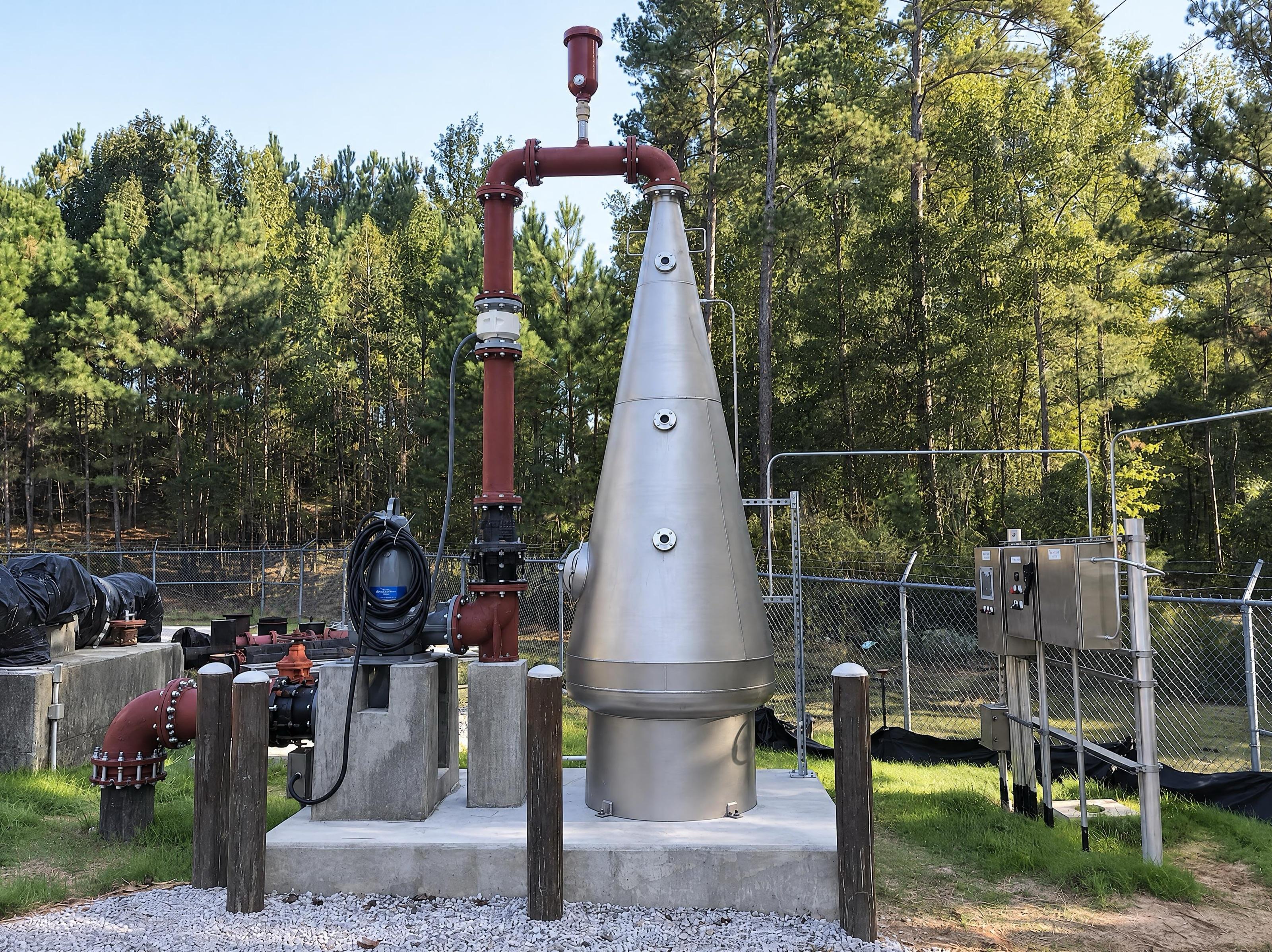
A side-stream system avoids this, and it is how ECO₂ does force main odor control: a pump draws part of the flow through a Speece Cone®, where the oxygen dissolves completely before the water rejoins the main (ECO₂ wastewater brochure, p. 2). ECO₂ guarantees more than 90% transfer, tested at start-up (ECO₂ oxygen injection paper, p. 4).
What Force Mains Measured with Oxygen
| Force main | H₂S before | H₂S with oxygen |
|---|---|---|
| Knoxville, Tennessee: 6.4 miles, 24 hours | 158 ppm average, spikes over 1,000 ppm | Under 1 ppm average (Knoxville case study, p. 2) |
| Raymore, Missouri: up to 17 hours | Daily spikes of 600 to 900 ppm | Dropped as soon as the system started (Raymore case study, pp. 1 to 2) |
| El Paso, Texas: 3.5 miles | 12 ppm average with calcium nitrate | 1 ppm average (El Paso case study, pp. 1 to 2) |
| Regina, Saskatchewan: a new subdivision's main | Over 1 mg/L expected untreated | Under 0.4 ppm in the gas phase (Regina article, pp. 1 to 2) |
Where Oxygen Fits, and Where It Does Not
- At the pump station, at least 30 minutes of flow upstream of where odor control is needed (ECO₂ oxygen demand bulletin, p. 2), as in lift station odor control.
- Twice on a very long main: Knoxville's has one system at the start and one at the midpoint (Knoxville case study, p. 2).
- Near the discharge: Bowling Green, Kentucky placed its system 1,000 ft from the end of its Veterans Memorial force main, so a smaller vapor phase system could serve the headworks.
- Not where many flows join downstream (ECO₂ chemical cost comparison, p. 2), and maybe not on long, low pressure mains (Regina article, p. 2).
How ECO₂ Sizes the Oxygen
The dose is 2 mg/L of oxygen for every 1 mg/L of dissolved sulfide, plus the oxygen uptake rate, typically 5 to 15 mg/L an hour, times the detention time (ECO₂ oxygen demand bulletin, pp. 1 to 2). So the Force Main Design Data Checklist asks for the flow, the pipe's length and diameter, the detention time, the temperature and the sulfide you measure.
The oxygen comes from a liquid oxygen tank or an onsite generator, non-hazardous and non-explosive (ECO₂ chemical cost comparison, p. 2). Utilities that weighed the options chose it: El Paso on lowest life-cycle cost (El Paso case study, p. 1), Milford for the best results at the lowest total life-cycle cost (Milford case study, p. 2).
Questions Engineers Ask
What is the best way to control hydrogen sulfide in a force main?
Keep the wastewater aerobic. Dissolved oxygen stops bacteria making sulfide and removes sulfide already there within 15 to 30 minutes, at 2 mg/L of oxygen for each 1 mg/L of sulfide. In Knoxville's 6.4-mile force main, average H₂S fell from 158 ppm to under 1 ppm with oxygen.
What are the alternatives to calcium nitrate for force main odor control?
Dissolved oxygen, iron salts, hydrogen peroxide, chlorine and magnesium hydroxide. Oxygen suits force mains under 10 to 20 hours of detention, peroxide suits short mains under 2 hours, iron salts suit long lines, and magnesium hydroxide suits high sulfide loads at low flows.
Can you inject air or oxygen gas straight into a force main?
You can, but much of it never dissolves. Bubbles rise to the crown of the pipe within about 50 ft and collect at high points. Oxygen gas injected into a 2-mile force main in San Diego reached only 50 to 70% absorption. A side-stream system dissolves the oxygen before it enters the main.
Does magnesium hydroxide remove hydrogen sulfide?
No. It raises pH so the sulfide stays dissolved instead of escaping as H₂S gas, and the sulfide reaches the plant. H₂S can be released again where the flow meets low pH water.
How long a force main can one oxygen system treat?
ECO₂'s comparison gives force mains under 10 to 20 hours of detention. Longer mains can take a second system: Knoxville's 24-hour Forks of the River force main has one at the start and one at the midpoint.
Sources
Every Paper, Case Study & Note Cited
- Raymore, MO Stops Extreme H2S Problems with OxygenCase study, ECO₂, Undated. Pages 1, 2. PDF: Raymore, MO Stops Extreme H2S Problems with Oxygen (opens in a new tab)
- Knoxville, TN Solves Odor and Corrosion Problems in Long Sewer Force MainCase study, ECO₂, Undated. Pages 1, 2. PDF: Knoxville, TN Solves Odor and Corrosion Problems in Long Sewer Force Main (opens in a new tab)
- Odor Control Chemical Cost ComparisonTechnical paper, ECO₂, Undated. Page 2. PDF: Odor Control Chemical Cost Comparison (opens in a new tab)
- Gravity Sewer Odor and Corrosion ControlApplication note, ECO₂, 2020. Page 1. PDF: Gravity Sewer Odor and Corrosion Control (opens in a new tab)
- Superoxygenation - Facts and MythsTechnical paper, ECO₂, Undated. Page 4. PDF: Superoxygenation - Facts and Myths (opens in a new tab)
- ECO₂ Wastewater OxygenationBrochure, ECO₂, May 2023. Page 2. PDF: ECO₂ Wastewater Oxygenation (opens in a new tab)
- Competitive Advantages of Oxygen Injection Technology by ECO₂Technical paper, ECO₂, Undated. Page 4. PDF: Competitive Advantages of Oxygen Injection Technology by ECO₂ (opens in a new tab)
- El Paso, TX Frontera Lift Station Replaces Chemical Feed System with OxygenCase study, ECO₂, Undated. Pages 1, 2. PDF: El Paso, TX Frontera Lift Station Replaces Chemical Feed System with Oxygen (opens in a new tab)
- Harbour Landing Wastewater Pump Station and Offline Storage TanksPublished article, Western Canada Water, Spring 2010. Pages 1, 2. PDF: Harbour Landing Wastewater Pump Station and Offline Storage Tanks (opens in a new tab)
- Tech Bulletin - Oxygen Demand and Solubility CalculationsTechnical paper, ECO₂, Undated. Pages 1, 2. PDF: Tech Bulletin - Oxygen Demand and Solubility Calculations (opens in a new tab)
- Milford, CT Force Main Odor and Corrosion ProtectionCase study, ECO₂, 2016. Pages 1, 2. PDF: Milford, CT Force Main Odor and Corrosion Protection (opens in a new tab)
- Laguna Beach, CA Stops Sewer Odor Complaints with Pure OxygenCase study, ECO₂, Undated. Pages 1, 2. PDF: Laguna Beach, CA Stops Sewer Odor Complaints with Pure Oxygen (opens in a new tab)
Cite this guide: Eco Oxygen Technologies. Hydrogen Sulfide Odor Control in Force Mains. ECO₂ Guides, November 2026. https://eco2tech.com/guides/force-main-h2s-control-options/