Reservoir Oxygenation for Cleaner Drinking Water
Manganese, iron, taste and odor start at the bottom of a stratified reservoir. Oxygen added there without mixing stops them at the source: how it works, its sizing and cost.
01The Problem
Stratification Cuts the Bottom Water off from the Air
Drinking water reservoirs lose the oxygen in their bottom layer each summer, and the sediment releases manganese, iron and the nutrients behind taste and odor. Hypolimnetic oxygenation puts the oxygen back without mixing: in tests for San Pablo Reservoir in California, manganese over the sediment fell from about 1,000 µg/L to below 60 µg/L within 12 days.
Why It Happens
Once a lake stratifies, the thermocline cuts the cold hypolimnion off from the air. Bacteria in the sediment use up its oxygen, and anoxic conditions typically start a few days after stratification and last all summer. With no oxygen at the sediment surface, phosphorus, iron and manganese dissolve into the water and hydrogen sulfide forms.
Sources: Mello, Environmental Science & Engineering; ECO₂, oxygen supplementation strategy
Anoxic Sediment Releases Manganese First, Then Iron
A treatment plant that draws from the bottom layer gets the metals.
Why It Happens
Without oxygen at the sediment surface, manganese and iron dissolve into the bottom water: manganese release. In the San Pablo sediment chamber tests, manganese was released as soon as conditions turned anoxic, with peak fluxes of 40 to 60 mg/m² a day, while iron release lagged.
At Wolf Creek Reservoir in Barberton, Ohio, the bottom layer was anoxic most of the time. Quarterly averages of total manganese ran from 0.092 to 0.168 mg/L, and in early spring and early fall manganese rose above 0.200 mg/L for weeks at a time. Manganese had been plugging the plant's membrane filters, and at those levels they could not run.
Sources: San Pablo Reservoir final report, 2017; ECO₂, Wolf Creek Reservoir case study
Stratification Feeds the Taste & Odor Cycle
Anoxic sediment releases the nutrients that feed algae, and makes hydrogen sulfide of its own.
Why It Happens
At San Pablo Reservoir, strong stratification cut off oxygen to the bottom water 6 to 8 months a year. The anoxic sediment released manganese, ammonium and phosphate, the recycled nutrients fed the algae, and geosmin reached 460 ng/L in summer 2015, enough to overwhelm the 60 MGD treatment plant the reservoir supplies. Sulfate turns to hydrogen sulfide too, and at fall turnover geosmin, MIB and hydrogen sulfide are carried to the surface.
Plants that draw from the bottom layer get it all. At Marston Reservoir in Denver, the single low intake sent anoxic water to the plant in the peak summer months, with taste and odor, organics, manganese and algal blooms.
Sources: San Pablo Reservoir final report, 2017; ECO₂, oxygen supplementation strategy; Mello, Environmental Science & Engineering; ECO₂, Marston Reservoir case study
02How It Works
Oxygen Goes Where the Problem Starts: The Bottom Layer
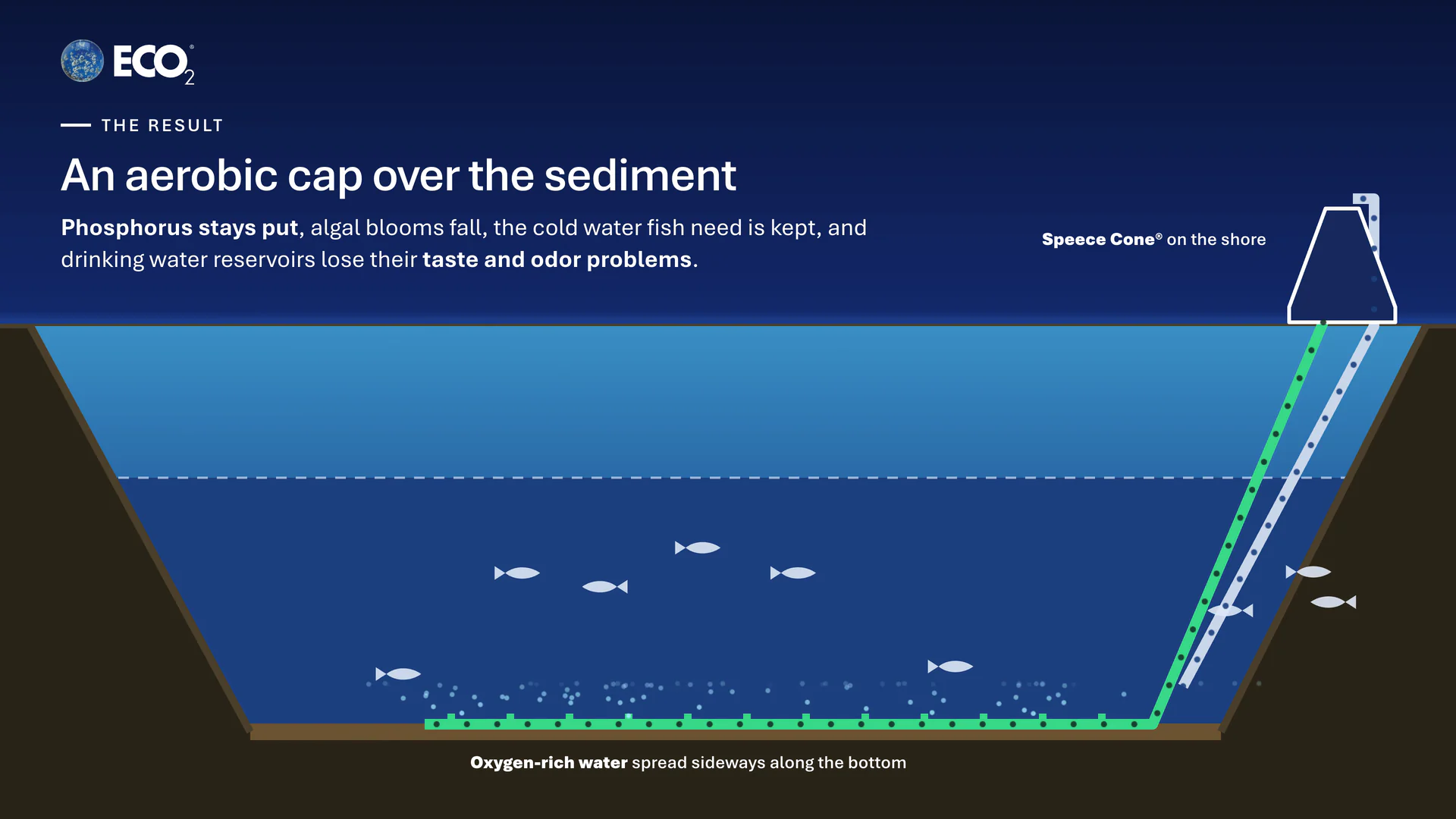
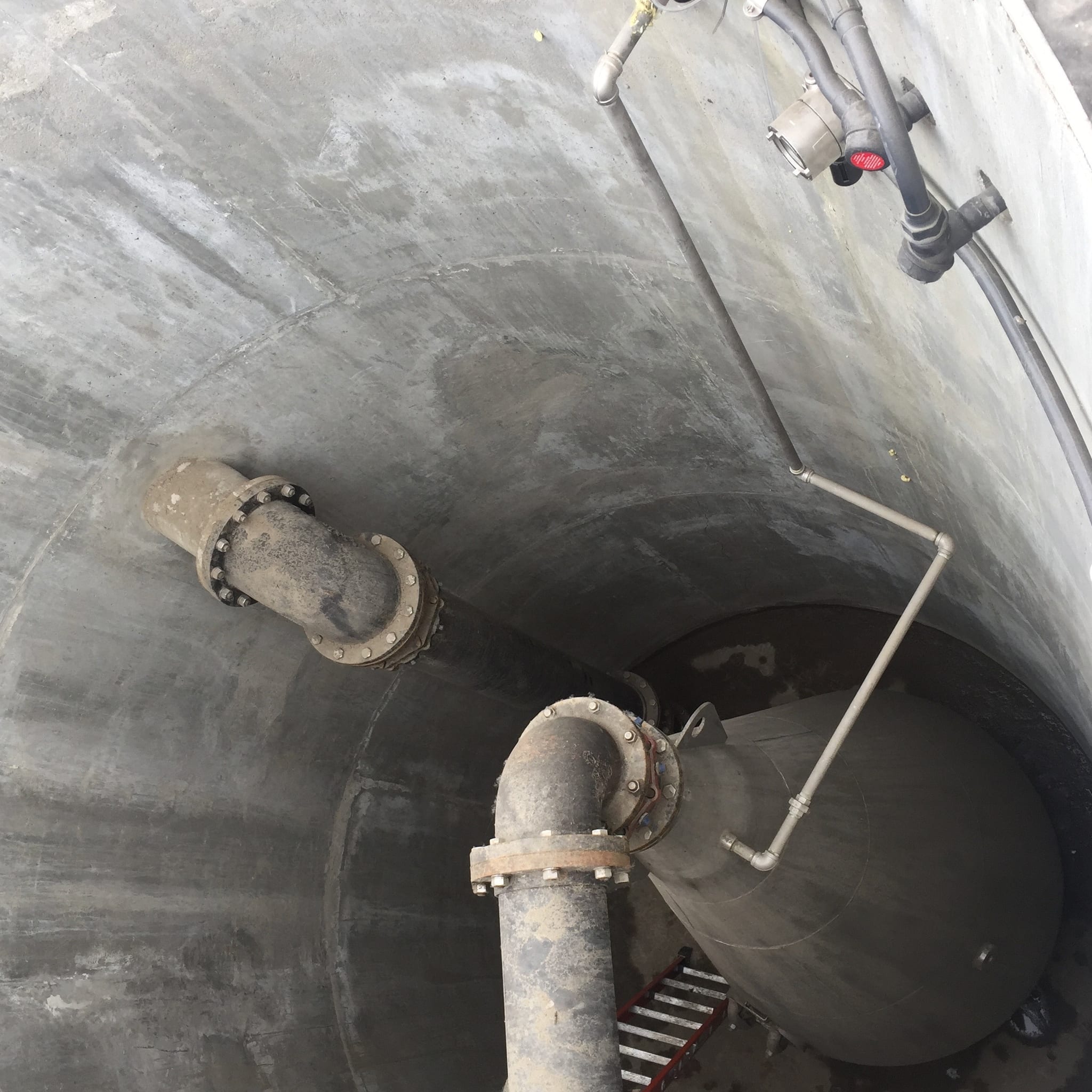
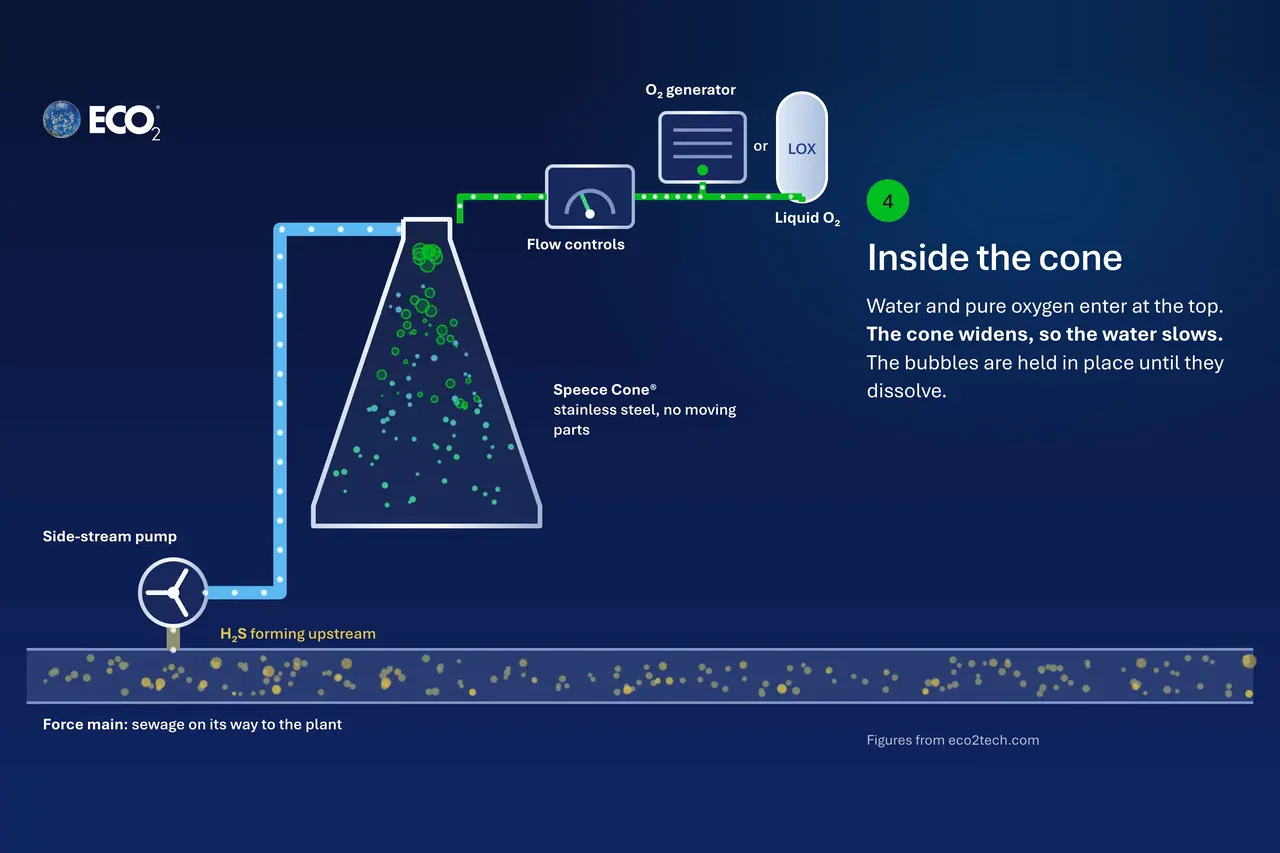
A hypolimnetic oxygenation system takes a side stream from the bottom layer, dissolves pure oxygen into it and returns it horizontally at the same depth and temperature. Because the water has the same density as the layer around it, it stays there and spreads over the sediment as an aerobic cap, and the lake stays stratified.
The System in Detail
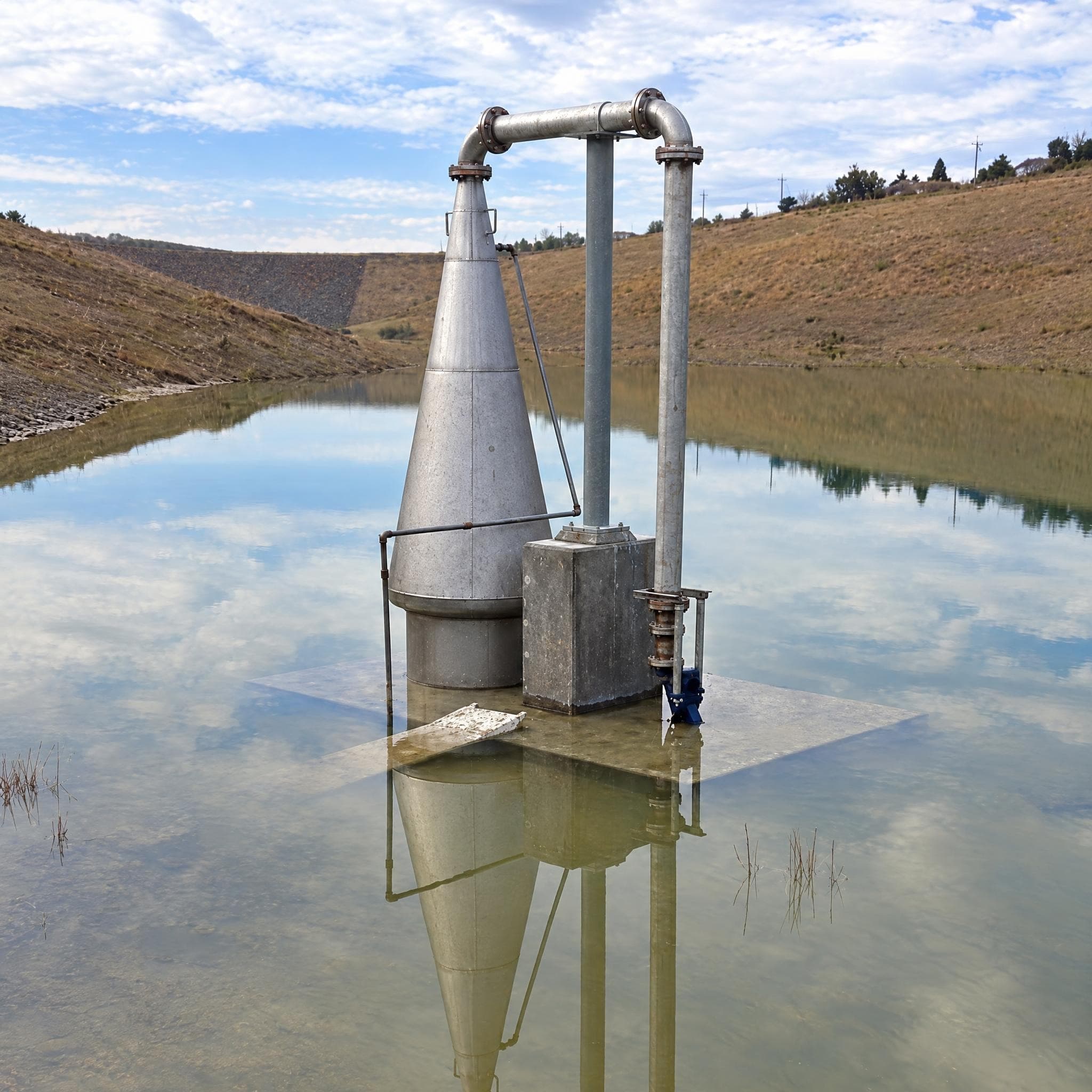
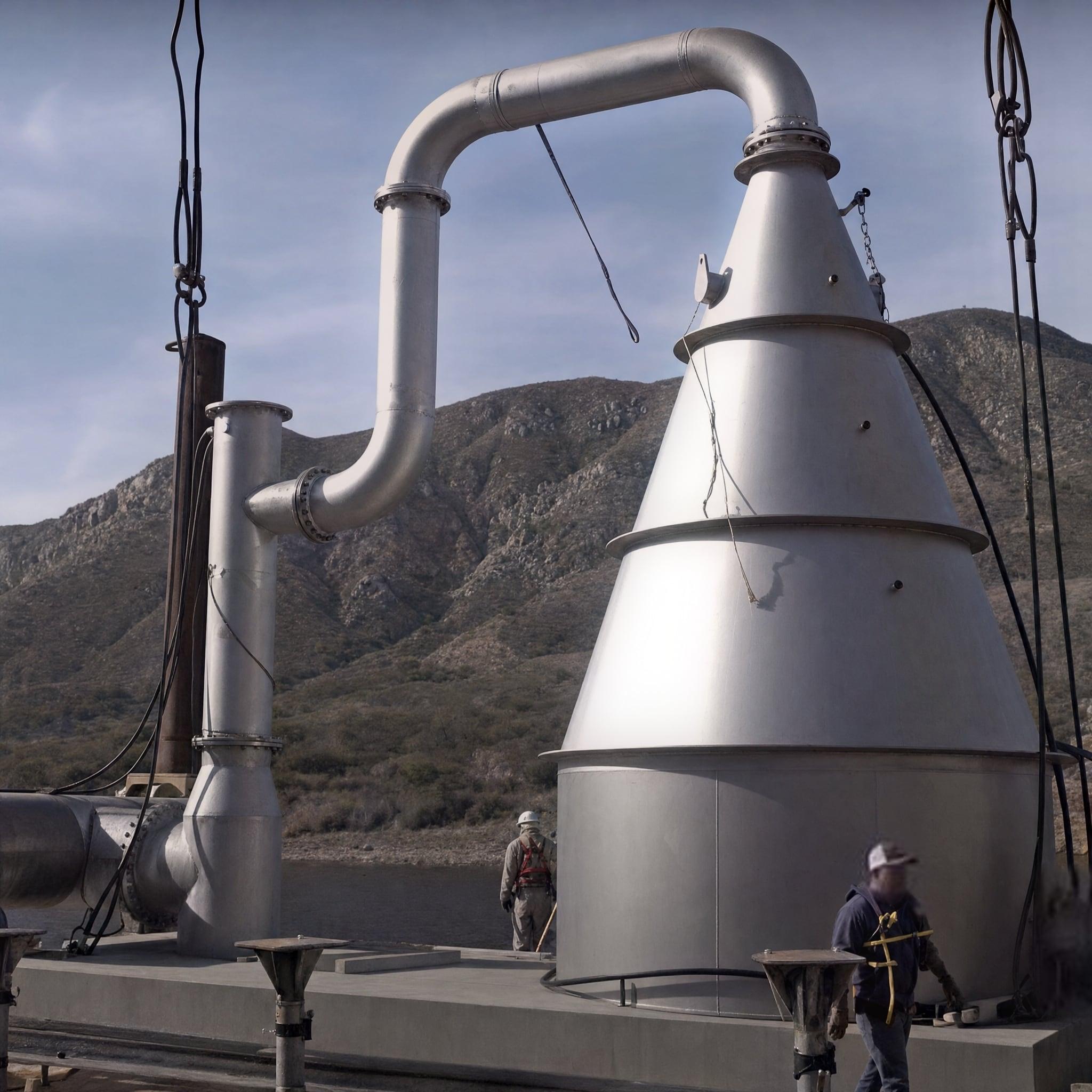
Inside the Speece Cone®, the incoming water breaks the oxygen into a dense swarm of bubbles, and the widening cone holds them until they dissolve. ECO₂ reports 95% oxygen transfer efficiency at any depth.
Size the oxygenated zone for the intake, and run it continuously. Hydrogen sulfide, iron and manganese take 24 to 48 hours to oxidize in clean lake water, so the aerobic zone around the intake should hold at least 48 hours of retention. In a study of Carvins Cove Reservoir, soluble manganese in the bottom layer rose substantially the summer the oxygen system was turned off for a month.
Sources: ECO₂, oxygen supplementation strategy; ECO₂ Lakes and Rivers brochure; Gantzer, Bryant and Little 2009 (opens in a new tab)
Size It from the Oxygen the Bottom Water Loses
The design number is the oxygen demand of the bottom layer in tons or pounds a day, plus a safety factor.
The total demand is the sediment oxygen demand plus the demand of the water itself. The best measure of both is how fast dissolved oxygen falls after the lake stratifies. Measure the sediment, not just the water: in the 2014 Lake Hodges study, a sediment oxygen demand of 3 to 6 g/m² a day matched the observed data, far above the 0.2 g/m² a day used for preliminary sizing.
Worked example: how the San Pablo Reservoir system was sized, from the final report of December 2017
| Step | Result |
|---|---|
| First estimateSan Pablo Reservoir final report, 2017 | Up to 6 tons of oxygen a day, from dissolved oxygen profiles and literature values |
| Sediment chamber testsSan Pablo Reservoir final report, 2017 | A design sediment oxygen demand of 1.0 g/m² a day |
| Oxygen demand of the bottom layerSan Pablo Reservoir final report, 2017 | About 4.75 tons a day |
| System chosenSan Pablo Reservoir final report, 2017 | A standard Speece Cone rated at 5 tons (10,000 lbs) of oxygen a day |
| Measure of successSan Pablo Reservoir final report, 2017 | Soluble manganese at or below 0.01 mg/L |
Sources: ECO₂, oxygen supplementation strategy; Lake Hodges assessment study, 2014
Pure Oxygen Comes from a Tank or a Generator on Site
Oxygen is most of the running cost, so the supply is worth choosing with care.
Every system runs on pure oxygen from a liquid oxygen (LOX) tank refilled by truck, or from onsite generation by pressure or vacuum swing adsorption (PSA or VSA). The site can decide it: at Lake Hodges, truck deliveries of liquid oxygen near the dam were judged neither feasible nor acceptable to neighbors, so the design used onsite generation. More on oxygen supply.
Cost of 1 ton of oxygen a day by supply, with the equipment paid off at 8% over 10 years and power at $0.10 a kWh
| Oxygen supply | Cost per ton of oxygen |
|---|---|
| VSA generatorECO₂, oxygen source bulletin | $102.07 |
| Liquid oxygen (LOX)ECO₂, oxygen source bulletin | $113.56 |
| PSA generatorECO₂, oxygen source bulletin | $116.19 |
Oxygen and power prices vary by region and year. Ask ECO₂ for a comparison at your local prices.
Sources: ECO₂ Lakes and Rivers brochure; Lake Hodges assessment study, 2014
What Oxygen Does & Does Not Do for Taste & Odor
Oxygen works on the causes in the reservoir. It does not treat the water at the plant.
- It stops hydrogen sulfide forming. The Lake Hodges study says even about 0.5 mg/L of dissolved oxygen would prevent the sulfate reduction that makes sulfide and methylmercury.
- It cuts the nutrients that feed blooms. At Camanche Reservoir, cyanobacteria fell more than 95% and average chlorophyll a fell 79%. Eutrophication and algae.
- It keeps manganese and iron in the sediment, where the intake does not draw them.
- It does not break down geosmin or MIB already in the water. It works on the supply of nutrients that feeds the algae, so the benefit builds over seasons. Keep plant treatment ready until it does.
Sources: Lake Hodges assessment study, 2014; Horne and Beutel 2019
03The Proof
Measured: Cleaner Water at the Bottom & the Intake
Results with oxygen at the sediment, from the Camanche Reservoir papers, the San Pablo tests and an independent study of a water-supply reservoir.
Every Result in One Table
Reservoir water before and after oxygen at the sediment, as measured
Reservoir water before and after oxygen at the sediment, as measured
| Measure | Without oxygen | With oxygen |
|---|---|---|
| Camanche Reservoir, CA: bottom waterHorne et al. 2019 | Under 2 mg/L dissolved oxygen, H₂S odors | 3 to 7 mg/L dissolved oxygen, no H₂S odors |
| Camanche Reservoir, CA: soluble iron in the tailwaterHorne and Faisst 2022 (opens in a new tab) | 7,800 µg/L | 200 µg/L |
| Camanche Reservoir, CA: water released to the river and hatcheryHorne and Faisst 2022 (opens in a new tab) | Before oxygenation | 73% less manganese and 96% less iron |
| Carvins Cove Reservoir, VA: average soluble manganese in the bulk hypolimnionGantzer, Bryant and Little 2009 (opens in a new tab) | Before oxygenation | Down by up to 97% with continuous operation |
| San Pablo Reservoir, CA: sediment chamber testsSan Pablo Reservoir final report, 2017 | About 1,000 µg/L manganese in the water over the sediment | Below 60 µg/L within 12 days |
| Camanche Reservoir, CA: average chlorophyll a, growth seasonHorne and Beutel 2019 | 14.6 µg/L | 3.1 µg/L |
| Camanche Reservoir, CA: average Secchi depthHorne and Beutel 2019 | 0.47 m (1.5 ft) | 4.9 m (16 ft) |
Horne and Beutel describe Camanche's water quality change as the result of oxygenation used with no other management.
8tons/day
The Camanche Reservoir Speece Cone can transfer 8 tons of oxygen a day. 75%
After 11 years, Camanche needed 75% less oxygen, from 8 to 2 tons a day, as the sediment's demand fell.
What It Costs: Published Numbers, with Their Basis
Cost follows the oxygen demand, the depth, the oxygen supply and the year. These are the published figures, each with its basis. Compare them side by side; do not average them.
Published capital and operating costs of hypolimnetic oxygenation systems
| Source | Size | Capital | Operating | Basis |
|---|---|---|---|---|
| Rule of thumb, 2002 | 5 tons of oxygen a day, for a mesotrophic to eutrophic reservoir of about 50,000 acre-feet | About $1 million | About $850 a day for a submerged contact chamber; $850 to $3,000 a day across the systems reviewed | Liquid oxygen at $150 a metric ton, power at $0.10 a kWh |
| Lake Hodges concept, 2014 | 3 tons of oxygen a day | $2,897,000 total project cost, $2,315,000 of it construction | $232,000 a year | Order-of-magnitude planning estimate, with onsite oxygen generation |
| Canyon Lake recommendation | 0.25 to 2 tons of oxygen a day, sized by analogy | $250,000 to $500,000 | $20,000 to $50,000 a year | Preliminary estimate for a small Southern California reservoir |
At Camanche Reservoir, oxygenation removed iron at $0.0005 per kg, and manganese at less than the $9 per kg of conventional methods, while it also cut phosphorus, ammonium and hydrogen sulfide.
How Utilities Chose Oxygen
Two screened 17 lake management methods, and a third chose after 15 years of studies.
For San Pablo Reservoir, four of 17 in-reservoir methods were rated against 15 weighted criteria. Hypolimnetic oxygenation ranked highest at 93 out of 100, ahead of algaecides at 58, because it addresses the root causes of both problems: internal nutrient loading and anoxia at the sediment-water interface.
For Lake Hodges, a workshop in June 2013 screened 17 methods and combined the best into a phased plan: a Speece Cone system in the deepest water near the dam first, then vigorous mixing of the surface layer in the mid-lake shallows, a 25-acre algae-filtering wetland and carp removal, with algaecides for emergencies only. Marston Reservoir's owner chose a Speece Cone after 15 years of studies, for its performance, silent operation and cost.
Sources: San Pablo Reservoir final report, 2017; Lake Hodges assessment study, 2014; ECO₂, Marston Reservoir case study
How It Compares with Other Methods
Mixing the whole reservoir brings surface oxygen down, but it warms the bottom water and removes the choice of withdrawal depth. Air-lift aerators have low transfer efficiency, and bubble plumes and line diffusers dissolve oxygen as the bubbles rise, so they need depth: Horne puts a free bubble plume at over 80 ft of water. Algaecides knock down a bloom but leave the sediment as it was, and plant treatment removes only what arrives. A downflow contact oxygenator dissolves the oxygen before it leaves the cone and spreads it over the sediment, where the manganese and the nutrients come from.
Sources: Beutel 2002; ECO₂, oxygen supplementation strategy; Horne, triple threat slides; San Pablo Reservoir final report, 2017; Lake Hodges assessment study, 2014; Gantzer, Bryant and Little 2009 (opens in a new tab)
Where ECO₂ Systems Work on This Problem
04For Engineers
Read the Papers
Questions Lake Managers Ask
How much does a hypolimnetic oxygenation system cost?
Published figures range with size, depth and year. A 2002 rule of thumb put a 5 ton a day system at about $1 million to build and about $850 a day to run. A 2014 concept for 3 tons a day at Lake Hodges came to $2,897,000, with $232,000 a year to operate. A small-reservoir recommendation gave $250,000 to $500,000.
How long does it take to work?
Days for oxygen, weeks for nutrients and metals, years for algae. At Camanche Reservoir, bottom oxygen near the cone rose from 3.5 to 5.8 mg/L within 2 days of start-up and large drops in phosphate and ammonium appeared within 4 weeks. In the San Pablo sediment tests, manganese fell from about 1,000 µg/L to below 60 µg/L within 12 days.
Does hypolimnetic oxygenation destratify the reservoir?
No. At Camanche Reservoir there was no early destratification, and the plume's mixing stayed in the lower 10 to 12 m. The bottom water warmed slightly: 16.8 °C was projected at overturn, against 14.8 °C before.
Why not just treat manganese at the plant?
Plants can, but only for the water that arrives, and peaks can stop a process. At Wolf Creek Reservoir in Ohio, manganese above 0.200 mg/L for weeks at a time ruled out running the membrane filters. Keeping manganese in the sediment protects the plant before the water reaches it.
Can oxygenation reduce geosmin and MIB?
Indirectly. Oxygen at the sediment cuts the nutrients that feed the algae, and at Camanche Reservoir cyanobacteria fell more than 95%. It does not break down geosmin or MIB already in the water, so keep plant treatment ready while the benefit builds.
What happens if the oxygen system stops?
Manganese comes back. In a study of Carvins Cove Reservoir in Virginia, soluble manganese in the bottom layer rose substantially when oxygenation was turned off for a month. Run the system continuously through stratification.
What records should we send for a first look?
Dissolved oxygen and temperature profiles from stratification to turnover, soluble and total manganese and iron at the intake depth, and the last three seasons of taste and odor complaints with geosmin and MIB results. Sediment oxygen demand measured in cores helps: the Lake Hodges study found 3 to 6 g/m² a day, far above the value used for preliminary sizing.
Other Lake & River Water Quality Problems

Eutrophication & Algae
Stop internal phosphorus loading and the blooms it feeds.
See How It Is Solved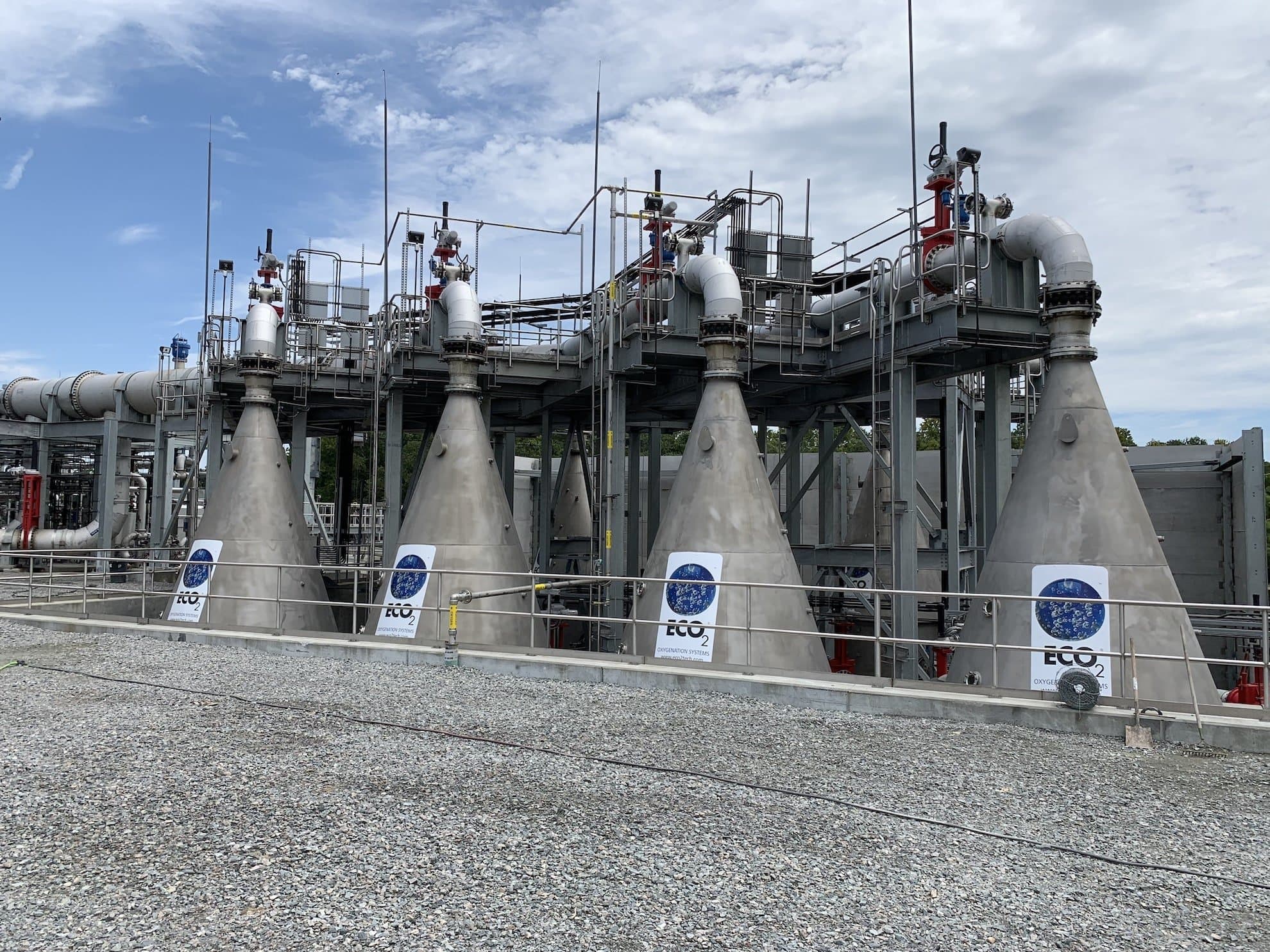
Rivers, Harbors & Canals
Oxygen added from the bank to a harbor, a tidal canal or a city's canals.
See How It Is Solved
Hydropower & Fisheries
Oxygen for water released through a dam, and for the cold-water fish above and below it.
See How It Is Solved
05The Next Step
Send Us Your Reservoir's Numbers
Surface area, volume, depth, your bottom oxygen in late summer and a season of manganese and taste and odor results at the intake are enough for a first look at the oxygen demand and the system. ECO₂'s engineers check the data for a technical fit, then send a system design with its estimated capital and annual operating costs, and can visit your site to confirm the data.