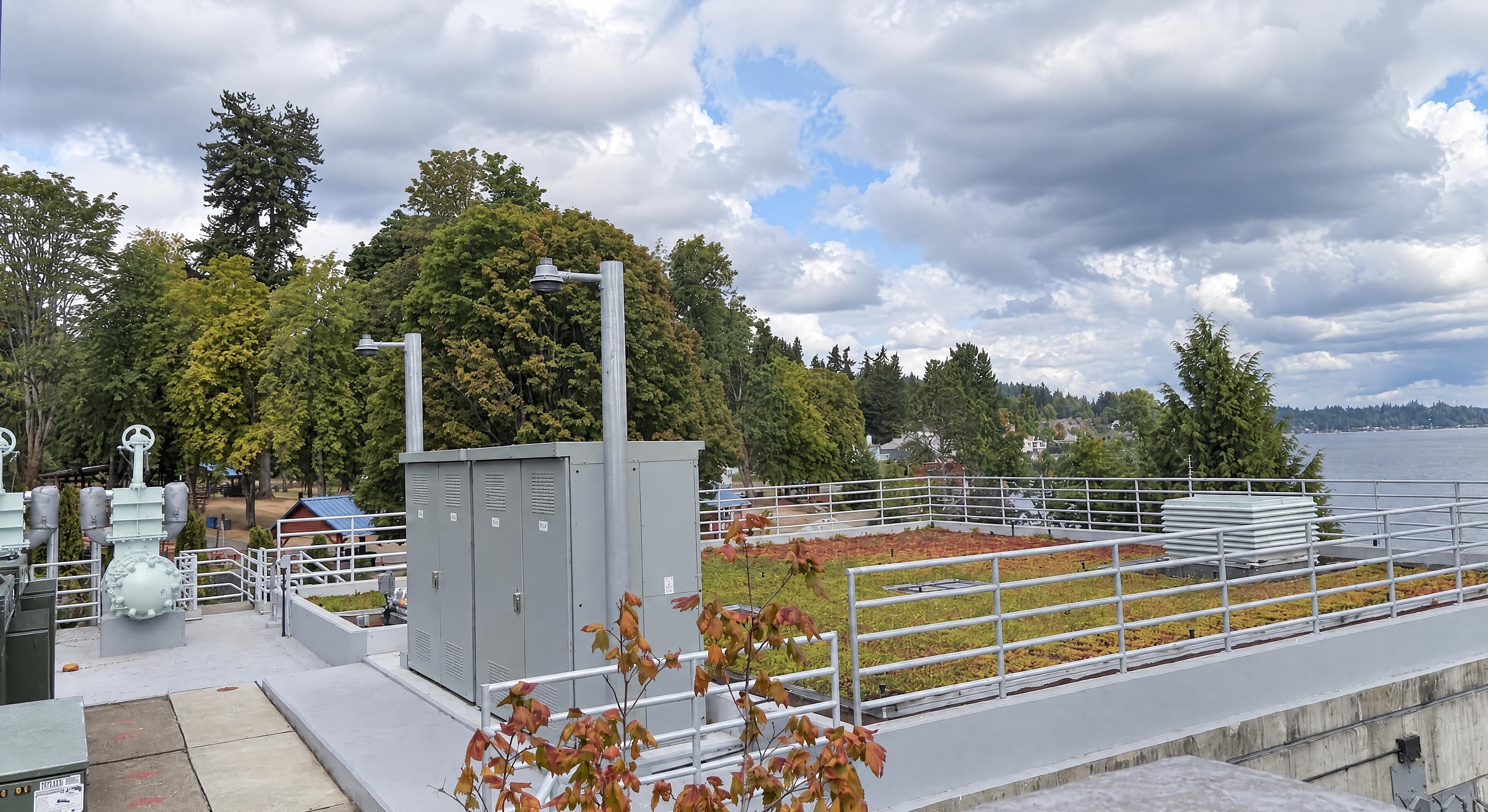
Harbour Landing Wastewater Pump Station and Offline Storage Tanks
How a new pump station in Regina, Saskatchewan was designed to serve a growing suburb, with storage for storm peaks and a Speece Cone® against H₂S in its force main.
Details
Summary
Regina's New Pump Station Adds Oxygen
Stantec designed the Harbour Landing pump station in Regina, Saskatchewan to pump a growing suburb's wastewater, hold storm peaks in a 3,400 cubic meter tank and stop hydrogen sulfide in its force main. A Speece Cone raises a side stream to 50 mg/L of dissolved oxygen, aiming to keep 0.2 to 1.0 mg/L at the discharge (pp. 1, 2).
Key Figures
50mg/L
Dissolved oxygen the Speece cone adds at the pump station Source: PDF page 2 (opens in a new tab)
0.2 to 1.0mg/L
Dissolved oxygen maintained at the forcemain discharge Source: PDF page 1 (opens in a new tab)
0.4ppm
H₂S in the gas phase with Superoxygenation (less than) Source: PDF page 2 (opens in a new tab)
Questions
Why does the Harbour Landing pump station have a storage tank?
The trunk sewer downstream lacks capacity for peak and wet weather flows. The station diverts them into an underground tank of about 3,400 cubic meters, sized for a 1:25 year storm over 14 hours, and drains it back when there is room (pp. 1, 2).
How much dissolved oxygen should reach the end of a force main?
At Harbour Landing, Stantec designed for 0.2 to 1.0 mg/L at the discharge point, from oxygen injected at 50 mg/L at the station. Without it, H₂S in the main would have exceeded 1 mg/L (p. 1).
Can dissolved oxygen take H₂S lower than chemical salts?
The article says Superoxygenation reduces H₂S formation to less than 0.4 ppm in the gas phase, which injection of chemical salts cannot achieve (p. 2).
Does a Speece Cone clog with rags?
The article notes the cone is hollow, with no internal baffle or static mixer that could collect rags or string (p. 2).
Why was Superoxygenation needed?
Because of the forcemain's length and the long time flow spends there under anaerobic conditions, hydrogen sulfide would build above 1 mg/L. Injecting oxygen at 50 mg/L at the station keeps 0.2 to 1.0 mg/L of dissolved oxygen at the discharge. (PDF page 1) (opens in a new tab)
What advantages did the authors see in Superoxygenation?
H₂S below 0.4 ppm in the gas phase, which chemical salts cannot achieve, no building expansion, no chemical safety and handling issues, limited staff time, the lowest operating and life cycle cost, and a small footprint. (PDF page 2) (opens in a new tab)
Where does the oxygen come from?
It is generated on site by an OGSI pressure swing adsorption system, which separates oxygen from compressed air using a molecular sieve that adsorbs nitrogen. (PDF page 2) (opens in a new tab)
Is Superoxygenation right for every forcemain?
The authors say it suits Harbour Landing because the forcemain is relatively short, and that for longer forcemains operating at low pressure it may not be the preferable option. (PDF page 2) (opens in a new tab)
In Full
More Key Figures
Nine more, each with what it measures and its PDF page.
From the PDF
| Figure | What It Measures |
|---|---|
| 450 L/s | Maximum pump station capacity (PDF page 1 (opens in a new tab)) |
| 3,400 m³ | Offline storage volume for peak and wet weather flows (PDF page 1 (opens in a new tab)) |
| 10,000 people | Planned population of Harbour Landing (approximately) (PDF page 1 (opens in a new tab)) |
| 50 mg/L | Dissolved oxygen the Speece Cone adds to the sewage at the pump station (PDF page 2 (opens in a new tab)) |
| 0.2 to 1.0 mg/L | Dissolved oxygen designed to remain at the force main discharge (PDF page 1 (opens in a new tab)) |
| Less than 0.4 ppm | H₂S in the gas phase with Superoxygenation, as the designers list it (PDF page 2 (opens in a new tab)) |
| Above 1 mg/L | Hydrogen sulfide the force main would generate without treatment (PDF page 1 (opens in a new tab)) |
| 3,400 m³ | Offline storage for peak and wet weather flows (approximately) (PDF page 2 (opens in a new tab)) |
| 3.6 km | Force main length at full build-out (PDF page 2 (opens in a new tab)) |
The Full Write-Up
The problem, the work, the results and who did it.
A Fast-Growing Suburb, a Full Sewer & a Long Force Main
Harbour Landing is a new community on 323 hectares (798 acres) in southwest Regina, Saskatchewan, planned as home for about 10,000 people. Housing trends in 2007 and 2008 set a build-out of 7 to 10 years (p. 1).
The existing sewers could not take everything the subdivision would send them. The trunk sewer downstream lacked capacity for peak and wet weather flows. The connection points lay at the north end of the site while the land slopes south, and they were shallow, with little grade for capacity or cleansing velocity (pp. 1, 2).
Pumping solved the grade, but it created a second problem. The force main to the trunk sewer was long enough, and held flow under anaerobic conditions long enough, that hydrogen sulfide would build to more than 1 mg/L (p. 1). The station also sits next to homes, so it carries an activated carbon scrubber for odor at the station itself (p. 1).
Storage for the Storm Peaks, Oxygen for the Force Main
Stantec ran the management, design and construction services for the whole development, starting concept planning in 2005 (p. 1). With the City of Regina it settled on a station that stores peak and wet weather flows and releases them when the trunk sewer has room. Flow levels in the trunk sewer are radioed back, and the station's controls send flow to the force main or, through actuated pinch valves, to an underground tank (p. 1).
The station has a maximum capacity of 450 L/s and normally pumps up to 200 L/s, with variable frequency drives matching the incoming flow (p. 1). The tank holds about 3,400 cubic meters, enough for the wet weather flows of a 1:25 year storm over 14 hours (pp. 1, 2).
For the sulfide, part of the pumped flow goes from the pipe header to a Superoxygenation system from Eco Oxygen Technologies. Its Speece Cone, a downflow bubble contactor, raises the dissolved oxygen of the sewage to 50 mg/L, and the oxygen gas dissolves completely before the stream leaves the cone (p. 2). Oxygen is made on site by pressure swing adsorption, in which a molecular sieve takes nitrogen out of compressed air. The oxygenated stream is pumped back into the force main (p. 2).
Design Figures: Oxygen All the Way to the Discharge
The article gives design figures, not measurements. Stantec set the oxygen dose at 50 mg/L at the station so that 0.2 to 1.0 mg/L of dissolved oxygen would still be in the wastewater at the force main's discharge (p. 1).
The designers list what they gained. H₂S formation falls to less than 0.4 ppm in the gas phase, which they say chemical salts cannot achieve. No building expansion was needed. Chemical safety and handling issues are gone, though oxygen is a fire risk. Staff time is limited to maintenance, and they rate the method lowest in operating and life cycle cost (p. 2).
The station was completed in the fall of 2009, after construction from May 2008 through one of the coldest winters in Regina's history (p. 2).
Designed by Stantec for the City of Regina
George Tsougrianis of Stantec wrote the article for the Spring 2010 issue of Western Canada Water (p. 1). Harbour Landing is a subdivision of Dundee Developments, and Stantec ran the services for the whole development. The City of Regina reviewed the options with Stantec and runs the station under its operating permits, with approval from the Saskatchewan Ministry of Environment. Graham Construction was the general contractor, and Eco Oxygen Technologies supplied the Superoxygenation system (pp. 1, 2).
What It Means for a Growing Community with a Long Force Main
Harbour Landing shows two controls working side by side. Storage answers the lack of capacity downstream, and dissolved oxygen answers the sulfide a long pumping run creates. As flows rise, the author expects only a longer force main and new control settings, with a 1,300 m extension of the 500 mm main for later phases (p. 2).
The author is also plain about limits. Oxygen suits this force main because it is relatively short, 3.6 km at its ultimate length. For longer force mains operating at low pressure, he writes, Superoxygenation may not be the preferable option (p. 2). If you are weighing it for your own main, start with its length and pressure, the flow, and how long wastewater sits in the pipe.
Written up from the published article. Every figure is as the published article prints it, with the PDF page it comes from; the authors' own words appear only in quotation marks.
How to Cite
One line to paste into a report.
Western Canada Water. Harbour Landing Wastewater Pump Station and Offline Storage Tanks. Western Canada Water, 2010. Project engineer: Stantec. Eco Oxygen Technologies Technical Library. https://eco2tech.com/technical-library/harbour-landing-wastewater-pump-station-and-offline-storage-tanks/
https://eco2tech.com/technical-library/harbour-landing-wastewater-pump-station-and-offline-storage-tanks/
The Next Step
Ask an ECO₂ Engineer
Questions about this published article, or about your own water? An application engineer answers, with the figures.