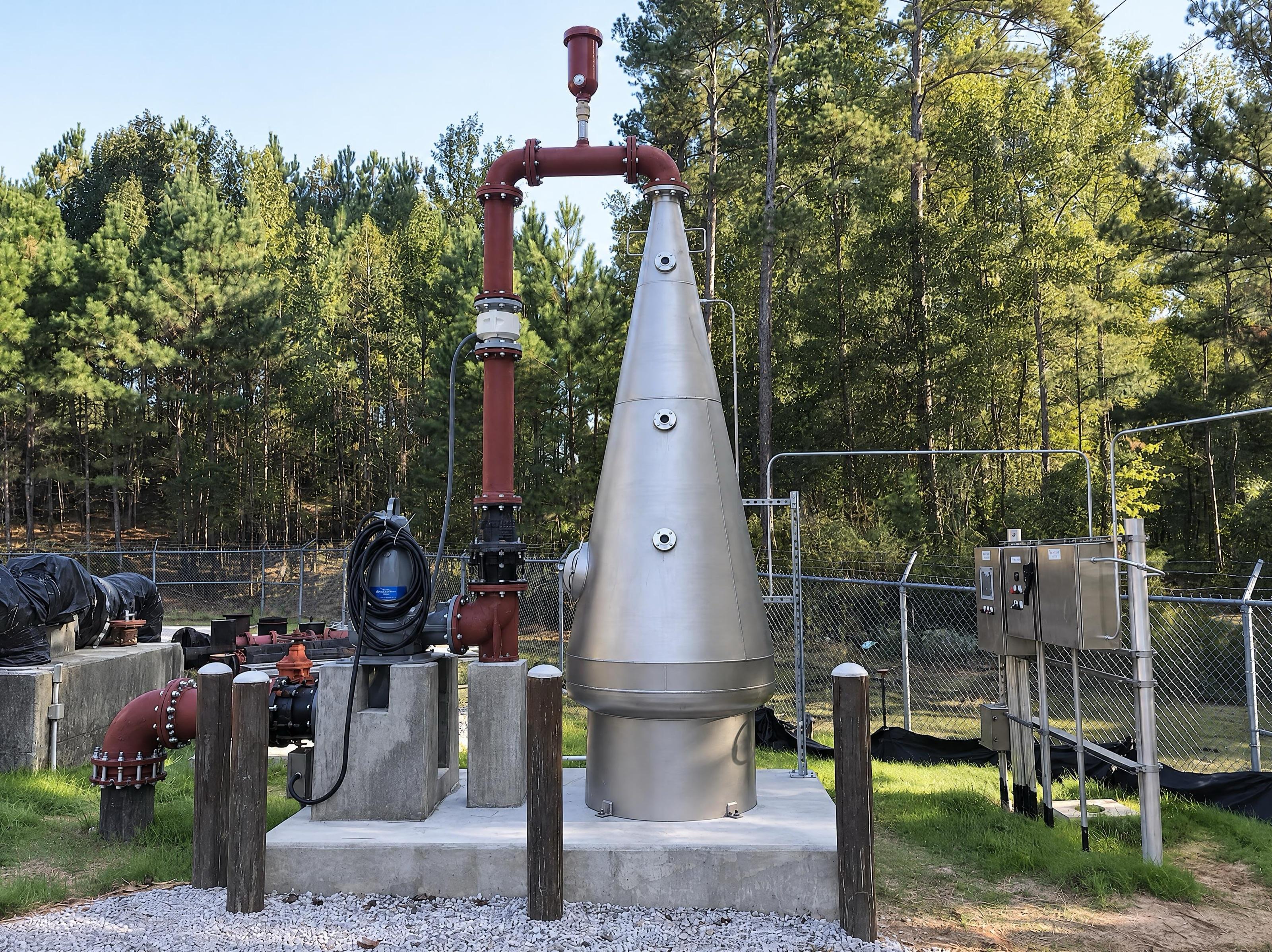
A Force Main Is a Sewer Pipe Under Pressure
Most sewers run by gravity, partly full, with air above the flow. Where the ground rises or the next sewer is too far away, a lift station pumps the wastewater into a force main: a pipe that runs completely full, under pressure, uphill if it has to.
Engineers also write forcemain or say pressure main; in the UK and Australia it is a rising main.
| Force main | Gravity sewer | |
|---|---|---|
| What moves the water | Pumps at a lift station | The slope of the pipe |
| How full the pipe runs | Completely full, under pressure | Partly full, with air above the flow |
| Can it run uphill? | Yes | No: it must slope down all the way |
| Oxygen from the air | None: a full pipe has no air space (Superoxygenation: Facts and Myths, p. 9) | Some, across the water surface |
| Where H₂S shows up | Where the main discharges, and at high points | In manholes and at the crown of the pipe |
From Lift Station to Plant, Step by Step
- 01Gravity Sewers Collect the FlowPipes from homes and businesses slope downhill to a low point.
- 02The Lift Station's Wet Well FillsWastewater collects in the wet well until the level starts a pump.
- 03Pumps Push It into the Force MainThe pump raises the pressure enough to drive the flow through the whole pipe.
- 04The Force Main Runs FullAir release valves at high points let trapped gas out.
- 05It Discharges to a Gravity Sewer or the PlantThe flow drops into a manhole, or enters the plant's headworks.
A fill and draw station empties the wet well in cycles, and the main sits still between them; a continuous station pumps with the flow. Either way, the longest time wastewater spends in the main sets the odor risk (ECO₂ force main checklist (opens in a new tab)).
Why Wastewater Turns Septic in the Pipe
Bacteria keep using oxygen, and a full pipe has no air to replace it. Then they turn to sulfate and make sulfide: sewage goes septic after about 1 hour in a force main (Raymore case study, p. 1). Mains built for growth hold today's flow far longer: up to 17 hours in Raymore, Missouri's main (Raymore case study, p. 1), and 24 hours in Knoxville's Forks of the River force main (Knoxville case study, p. 2). See detention time.
Force Mains from ECO₂'s Case Studies
| Place | Diameter | Length | Flow and detention |
|---|---|---|---|
| St. Petersburg, Florida: from Lift Station 85 (St. Petersburg case study, p. 2) | 30 in. | 7 miles | Not given |
| Knoxville, Tennessee: Forks of the River (Knoxville case study, p. 2) | 24 in. | About 6.4 miles | Just over 1 MGD, 24 hours |
| El Paso, Texas: Frontera, a dual force main (El Paso case study, p. 1) | Not given | 3.5 miles | Over 12 hours at times |
| Raymore, Missouri: Owen Good (Raymore case study, p. 1) | 24 in. | Not given | Under 1 MGD, up to 17 hours |
| St. Petersburg, Florida: from Lift Station 28 (St. Petersburg case study, p. 1) | 20 in. | 3 miles | Not given |
| Milford, Connecticut: Gulf Pond (Milford case study, p. 1) | Not given | About 13,200 ft | 3 MGD average |
The Sulfide Comes Out as Odor & Corrosion
Where the main discharges, turbulence releases the sulfide as hydrogen sulfide gas. At the end of Raymore's main, H₂S spiked to 600 to 900 ppm every day (Raymore case study, p. 1); Knoxville's averaged 158 ppm, with spikes over 1,000 ppm (Knoxville case study, p. 2).
The same gas destroys pipes: bacteria turn it into sulfuric acid, and concrete corrodes at close to half its maximum rate whenever the sewer air holds 2 to 55 ppm of H₂S (ECO₂ gravity sewer note, p. 1). In Milford, Connecticut, H₂S over 900 ppm had badly deteriorated every manhole on the interceptor the Gulf Pond force main feeds (Milford case study, p. 1). See crown corrosion and gravity sewer H₂S and corrosion.
How Utilities Keep a Force Main from Turning Septic
The surest force main odor control keeps oxygen in the water for the whole trip: a side-stream system at the lift station draws part of the flow from the main, dissolves pure oxygen into it and returns it, sized to the oxygen the flow uses over its longest detention time (ECO₂ oxygen demand bulletin, pp. 1 to 2).
With oxygen, average H₂S at the end of Knoxville's main fell from 158 ppm to under 1 ppm (Knoxville case study, p. 2). Calcium nitrate, iron salts and magnesium hydroxide are the other options: compare them in hydrogen sulfide odor control in force mains.
Questions Engineers Ask
What is the difference between a force main and a gravity sewer?
A gravity sewer slopes downhill and flows partly full, with air above the water. A force main is pumped: it runs completely full and under pressure, so it can carry wastewater uphill or over long distances.
What is another name for a force main?
Forcemain, pressure main or, in the UK and Australia, rising main. A sanitary force main is one that carries sewage.
Why does a force main smell like rotten eggs?
A full pipe has no air to replace the oxygen bacteria use. Sewage goes septic after about 1 hour in a force main, and bacteria then make sulfide, which escapes as hydrogen sulfide gas where the main discharges.
How long does wastewater stay in a force main?
It depends on the flow and the pipe. In Raymore, Missouri, wastewater sits in a force main for up to 17 hours; Knoxville's 6.4-mile Forks of the River force main holds it for 24 hours.
How do you stop H₂S in a force main?
Keep oxygen in the water for the whole trip, or dose a chemical. Dissolved oxygen added to the main cut average H₂S at the end of Knoxville's force main from 158 ppm to under 1 ppm.
Sources
Every Paper, Case Study & Note Cited
- Superoxygenation - Facts and MythsTechnical paper, ECO₂, Undated. Page 9. PDF: Superoxygenation - Facts and Myths (opens in a new tab)
- Force Main Design Data Checklist (opens in a new tab)ECO₂, Undated. Page 1
- Raymore, MO Stops Extreme H2S Problems with OxygenCase study, ECO₂, Undated. Page 1. PDF: Raymore, MO Stops Extreme H2S Problems with Oxygen (opens in a new tab)
- Knoxville, TN Solves Odor and Corrosion Problems in Long Sewer Force MainCase study, ECO₂, Undated. Page 2. PDF: Knoxville, TN Solves Odor and Corrosion Problems in Long Sewer Force Main (opens in a new tab)
- St. Petersburg, FL Lift Stations Odor and Corrosion ControlCase study, ECO₂, April 2025. Pages 1, 2. PDF: St. Petersburg, FL Lift Stations Odor and Corrosion Control (opens in a new tab)
- El Paso, TX Frontera Lift Station Replaces Chemical Feed System with OxygenCase study, ECO₂, Undated. Page 1. PDF: El Paso, TX Frontera Lift Station Replaces Chemical Feed System with Oxygen (opens in a new tab)
- Milford, CT Force Main Odor and Corrosion ProtectionCase study, ECO₂, 2016. Page 1. PDF: Milford, CT Force Main Odor and Corrosion Protection (opens in a new tab)
- Gravity Sewer Odor and Corrosion ControlApplication note, ECO₂, 2020. Page 1. PDF: Gravity Sewer Odor and Corrosion Control (opens in a new tab)
- Tech Bulletin - Oxygen Demand and Solubility CalculationsTechnical paper, ECO₂, Undated. Pages 1, 2. PDF: Tech Bulletin - Oxygen Demand and Solubility Calculations (opens in a new tab)
Cite this guide: Eco Oxygen Technologies. What Is a Force Main?. ECO₂ Guides, November 2026. https://eco2tech.com/guides/what-is-a-force-main/