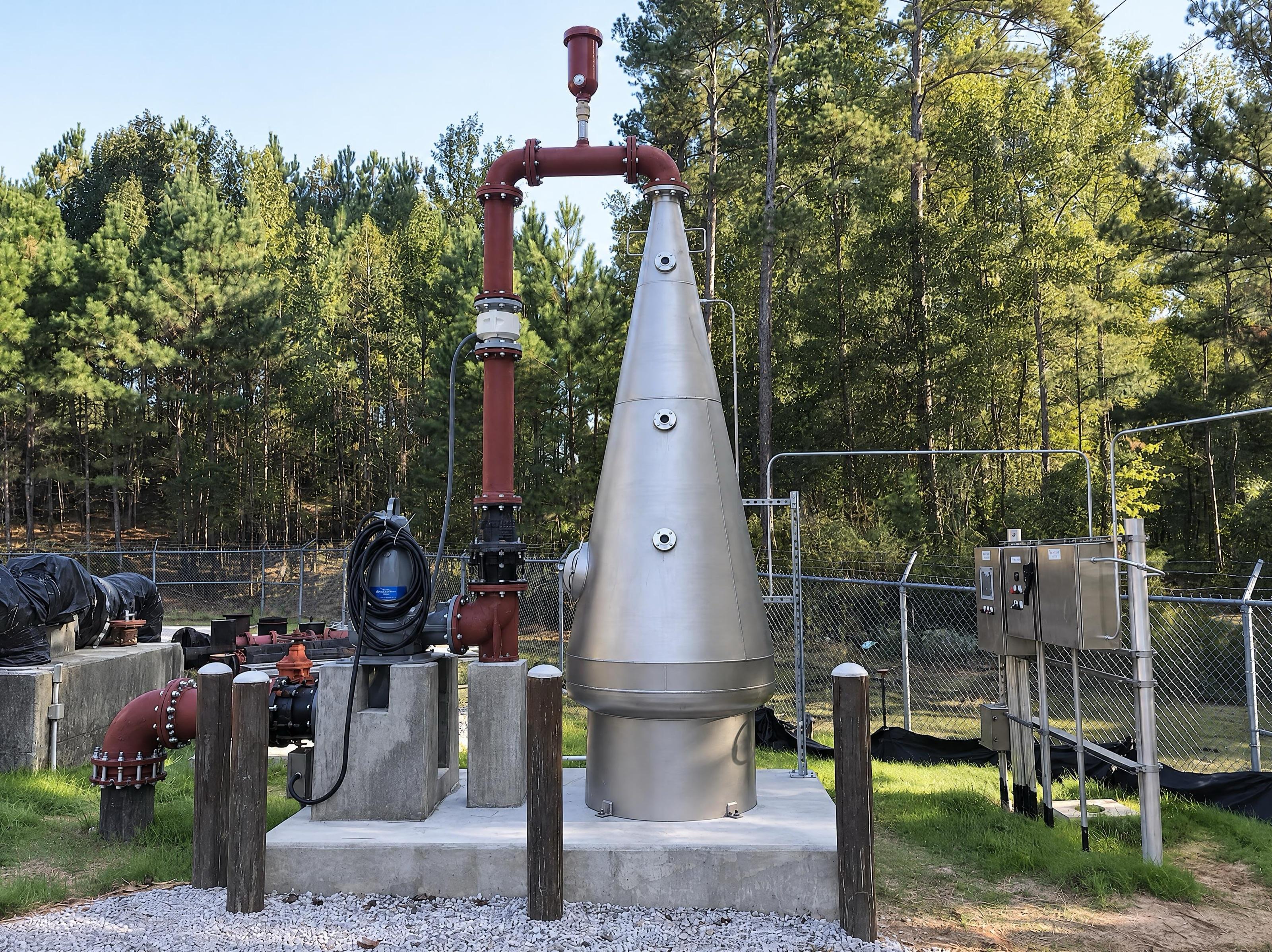
A Lift Station Lifts Sewage Where Gravity Cannot
Sewers run by gravity for as long as they can. Where the ground rises, or a gravity sewer would run too deep, the flow collects at a low point and a lift station pumps it up through a pressurized pipe, a force main, to a higher sewer or the treatment plant.
Lift station and pump station mean the same thing; some utilities say pumping station. A city can run dozens: the Knoxville Utilities Board runs 61 (Knoxville case study, p. 1).
What Is Inside a Lift Station
| Part | What it does |
|---|---|
| Wet well | The chamber where incoming wastewater collects until the pumps start. |
| Pumps | Raise the wastewater into the force main; usually two or more, so one can be serviced. |
| Level controls | Start and stop the pumps as the wet well fills and empties. |
| Valves | Check valves stop the force main draining back; isolation valves take a pump out of service. |
| Controls and alarms | Run the pumps and call the operator on a high level or a fault. |
| Odor control, where fitted | Treats the wastewater, or the air from the wet well, so the station does not release H₂S. |
One Pumping Cycle, Step by Step
- 01Gravity Sewers Bring the Flow InWastewater runs downhill to the station.
- 02The Wet Well FillsThe flow collects, and the level rises.
- 03A Pump StartsAt the start point, a level control switches a pump on.
- 04The Pump Fills the Force MainThe wastewater goes into a pipe that runs full and under pressure.
- 05The Pump Stops and the Cycle RepeatsThe flow in the force main waits for the next cycle.
Other stations pump continuously and follow the flow. For odor, what matters in both is the longest time the wastewater sits (ECO₂ force main checklist (opens in a new tab)).
Why Lift Stations Smell of Rotten Eggs
Wastewater in a full force main, with no air space above it, runs out of oxygen; bacteria make sulfide, and it escapes as hydrogen sulfide wherever the flow is stirred up. Sewage goes septic after about 1 hour in a force main (Raymore case study, p. 1). Raymore's Owen Good station, built for over 7 MGD, pumps less than 1 MGD, so wastewater sits in its main for up to 17 hours, and H₂S at the discharge spiked to 600 to 900 ppm every day (Raymore case study, p. 1).
Neighbors notice: in Fishers, Indiana, odor from the headworks and a nearby lift station drew frequent complaints (Fishers case study, p. 1). The gas corrodes concrete at close to half its maximum rate whenever the sewer air holds 2 to 55 ppm of H₂S (ECO₂ gravity sewer note, p. 1), the gravity sewer H₂S and corrosion downstream of the station.
Lift Station Odor Control Without Chemicals
Everything downstream starts at the station. For lift station odor control, a side-stream oxygen system there draws part of the flow from the force main, dissolves pure oxygen into it and returns it to the main, so the wastewater stays aerobic all the way through.
| Place | What changed |
|---|---|
| Laguna Beach, California: the Bluebird lift station | The whole system, with an onsite oxygen generator, fits inside the existing station. |
| Fishers, Indiana: three lift stations | All plant flow arrives with about 5 mg/L of dissolved oxygen; the systems have run for over 15 years (Fishers case study, pp. 1 to 2). |
| St. Petersburg, Florida: Lift Stations 85 and 28 | 3,300 and 1,100 lbs of oxygen a day, in place of odor control chemicals (St. Petersburg case study, pp. 1 to 2). |
| Raymore, Missouri: Owen Good | H₂S at the discharge dropped as soon as the system started (Raymore case study, p. 2). |
Questions Engineers Ask
What is the difference between a lift station and a pump station?
None in practice: both pump wastewater from a low point up into a force main or a higher sewer. Some utilities say pumping station or sewage pumping station.
What is a wet well?
The chamber at a lift station where incoming wastewater collects until the level starts a pump.
Why does a lift station smell like rotten eggs?
Wastewater in the force main, a full pipe with no air space, runs out of oxygen, and bacteria make sulfide. It escapes as hydrogen sulfide gas where the flow is stirred up. Sewage goes septic after about 1 hour in a force main.
How do you stop lift station odor without chemicals?
Dissolve oxygen into a side stream on the force main so the wastewater stays aerobic.
Sources
Every Paper, Case Study & Note Cited
- Knoxville, TN Solves Odor and Corrosion Problems in Long Sewer Force MainCase study, ECO₂, Undated. Page 1. PDF: Knoxville, TN Solves Odor and Corrosion Problems in Long Sewer Force Main (opens in a new tab)
- Force Main Design Data Checklist (opens in a new tab)ECO₂, Undated. Page 1
- Raymore, MO Stops Extreme H2S Problems with OxygenCase study, ECO₂, Undated. Pages 1, 2. PDF: Raymore, MO Stops Extreme H2S Problems with Oxygen (opens in a new tab)
- Fishers, IN Odor and Corrosion Control for Collections and Plant HeadworksCase study, ECO₂, Undated. Pages 1, 2. PDF: Fishers, IN Odor and Corrosion Control for Collections and Plant Headworks (opens in a new tab)
- Gravity Sewer Odor and Corrosion ControlApplication note, ECO₂, 2020. Page 1. PDF: Gravity Sewer Odor and Corrosion Control (opens in a new tab)
- St. Petersburg, FL Lift Stations Odor and Corrosion ControlCase study, ECO₂, April 2025. Pages 1, 2. PDF: St. Petersburg, FL Lift Stations Odor and Corrosion Control (opens in a new tab)
- Laguna Beach, CA Stops Sewer Odor Complaints with Pure OxygenCase study, ECO₂, Undated. Pages 1, 2. PDF: Laguna Beach, CA Stops Sewer Odor Complaints with Pure Oxygen (opens in a new tab)
Cite this guide: Eco Oxygen Technologies. What Is a Lift Station?. ECO₂ Guides, November 2026. https://eco2tech.com/guides/what-is-a-lift-station/