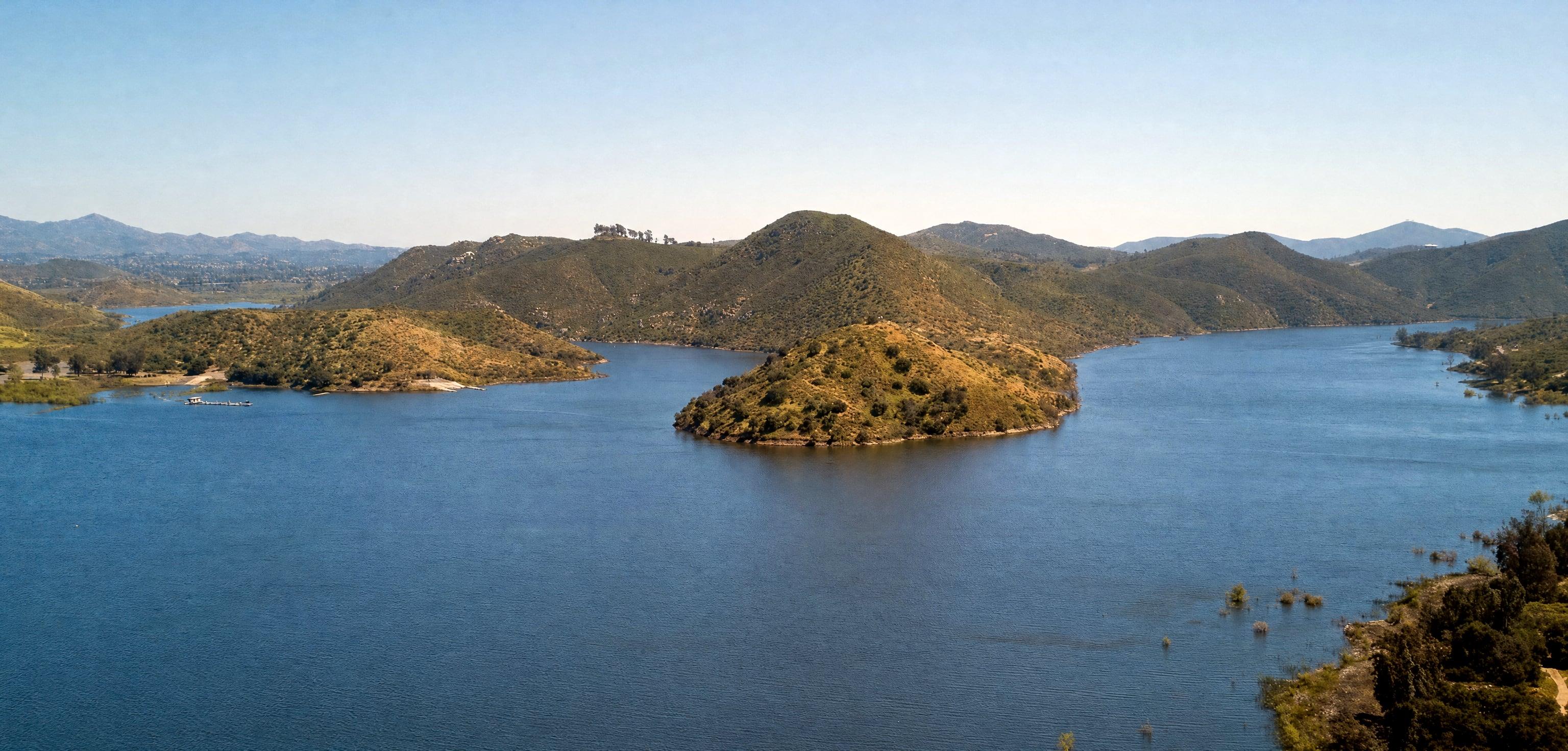
Hypolimnetic Oxygenation 2: Oxygen Dynamics in a Large Reservoir with Submerged Down-Flow Contact Oxygenation (Speece Cone®)
A paper on how oxygen from one submerged Speece Cone® spread through Camanche Reservoir's bottom water, carried by natural currents, while the reservoir stayed stratified.
Details
Summary
The cone turned anoxic, sulfide-producing bottom water into oxygenated water without breaking thermal stratification, and natural currents carried the oxygen 4.5 km up the reservoir, so no long pipelines were needed.
Key Figures
8tons of oxygen a day
Oxygen transfer capacity of the Camanche Speece Cone Source: PDF page 6 (opens in a new tab)
80mg/L
Dissolved oxygen in water leaving the cone, diluted to about 8 mg/L by the manifold jets Source: PDF page 7 (opens in a new tab)
4.5km
Distance the oxygenated plume traveled up the reservoir in 24 days of operation (1994) Source: PDF page 12 (opens in a new tab)
Questions
How much oxygen did the Camanche Speece Cone deliver?
The cone was built for a maximum of 8 tons of oxygen a day. In the first 2 years operators added 6 to 8 tons a day; the supply was then reduced step by step, and in 2014 only 2 tons a day gave results much like the early years. (PDF page 10) (opens in a new tab)
Why was a Speece Cone chosen over aeration or a bubble plume?
Aeration by mixing would destratify the reservoir and warm the bottom water, losing the cold-water fishery and hatchery supply. A rising bubble plume entrains warmer water and settles at mid-depth, while the Speece Cone's bubble-free plume stays dense and cool, hugs the bottom and oxygenates the sediments directly, where H₂S forms. (PDF page 5) (opens in a new tab)
How far did the oxygenated plume travel, and what moved it?
The plume moved 4.5 km up the reservoir at about 0.12 cm/s. Hydrodynamic calculations had predicted the pumping energy would be spent within 300 m of the manifold, so natural wind-driven circulation must have carried it, which means long pipe runs may not be needed. (PDF page 13) (opens in a new tab)
Did oxygenation disturb thermal stratification at Camanche Reservoir?
No. No early destratification occurred and the plume's mixing stayed in the lower 10 to 12 m of the hypolimnion. Bottom water warmed slightly, projected to 16.8 °C at overturn instead of 14.8 °C, and brief summer shutdowns moderated the warming. (PDF page 13) (opens in a new tab)
What happens when the oxygenation system is switched off?
In a 1994 test, bottom DO near the dam fell from 5.9 to 4.9 mg/L in 1 day and by 0.23 mg/L a day over 12 days, 2.3 times the demand before oxygenation. After a long shutdown, several weeks of renewed oxygenation were needed to restore redox above 300 mV 5 km upstream. (PDF page 9) (opens in a new tab)
When should reservoir managers run hypolimnetic oxygenation?
The authors recommend oxygenating continuously over summer and fall, starting before bottom DO falls below 5 mg/L and redox below 300 mV. Letting bottom DO fall to 2 mg/L leaves about 20 days of margin at a decline of 0.1 mg/L a day. (PDF page 14) (opens in a new tab)
In Full
More of the Summary
Two more paragraphs of our summary.
The cone is 7 m high and 3.7 m wide at the base. A 127 kW, 0.9 m³/s Flygt pump draws water from 5 m above the sediments to the top of the cone, where pure oxygen dissolves in the downflow. Water leaves at 80 mg/L through a 45 m manifold with 90 jets that dilute it to about 8 mg/L, safe for fish. Placing the cone on the bottom near the dam doubled oxygen solubility.
Bottom water went from under 2 mg/L dissolved oxygen, redox of 18 to 100 mV and H₂S odors to 3 to 7 mg/L and over 300 mV. Within 2 days of start-up, DO near the cone rose from 3.5 to 5.8 mg/L. Switching the system off in 1994 revealed an induced oxygen demand of 0.23 mg/L a day, against 0.1 before oxygenation. About 18% of the bottom layer passed through the cone, and entrainment reached 1.8 times its volume. As algae declined, the oxygen feed fell from 8 to 2 tons a day with similar results.
More Key Figures
Three more, each with what it measures and its PDF page.
From the PDF
| Figure | What It Measures |
|---|---|
| 0.23 mg/L a day | DO decline with the HOS switched off in 1994 (induced oxygen demand), against 0.1 before oxygenation (PDF page 9 (opens in a new tab)) |
| 18% | Share of the bottom hypolimnion oxygenated directly inside the cone each season (PDF page 12 (opens in a new tab)) |
| 75% | Cut in oxygen supply over 11 years of operation, from 8 to 2 tons a day (PDF page 14 (opens in a new tab)) |
How to Cite
One line to paste into a report.
Alex J. Horne, Rodney Jung, Hubert Lai et al. Hypolimnetic Oxygenation 2: Oxygen Dynamics in a Large Reservoir with Submerged Down-Flow Contact Oxygenation (Speece Cone®). Lake and Reservoir Management, August 2019. https://doi.org/10.1080/10402381.2019.1648612 Project engineer: Brown and Caldwell, Ford Construction, Pan Marine Construction, R.E. Speece. Eco Oxygen Technologies Technical Library. https://eco2tech.com/technical-library/hypolimnetic-oxygenation-2-oxygen-dynamics-in-a-large-reservoir-with-submerged-down-flow-contact-oxygenation-speece-cone/
https://eco2tech.com/technical-library/hypolimnetic-oxygenation-2-oxygen-dynamics-in-a-large-reservoir-with-submerged-down-flow-contact-oxygenation-speece-cone/
The Next Step
Ask an ECO₂ Engineer
Questions about this technical paper, or about your own water? An application engineer answers, with the figures.