Oxygen Transfer Efficiency Test Report Summary for Savannah Harbor Expansion
The U.S. Army Corps of Engineers tested the Hutchinson Island dissolved oxygen plant on the Savannah River for 60 days and reported that it beat all three success criteria.
Details
Summary
Savannah's Oxygen Plant Passes Its Test
It delivered 13,385 lbs of oxygen a day against a 12,000 lbs/day target, and the oxygenated water spread farther up and down the river than expected (pp. 1, 2).
Key Figures
13,385lbs/day
Oxygen delivered to the river during the test, against a 12,000 lbs/day criterion Source: PDF page 1 (opens in a new tab)
95%
Average oxygen transfer efficiency ("95% or better"), against an 80% criterion Source: PDF page 1 (opens in a new tab)
60days
Test period, March 14 to May 12, across two complete lunar cycles Source: PDF page 2 (opens in a new tab)
Questions
Did the Savannah Harbor dissolved oxygen system pass its test?
Yes. The Corps of Engineers reported that the Hutchinson Island plant exceeded all three success criteria needed to proceed with deepening the inner harbor, and the district's commander called it a remarkable success (pp. 1, 2).
How much oxygen does the Hutchinson Island plant add to the Savannah River?
During the test it delivered 13,385 lbs/day of oxygen, against a requirement of 12,000 pounds a day (p. 1).
How long was the Savannah River dissolved oxygen test?
60 days, from March 14 to May 12, covering two complete lunar cycles and so every tidal condition in that period. It produced 24 million data points (p. 2).
How far does injected oxygen spread in a tidal river?
At Savannah the dissolved oxygen mixed well through the water column and stayed detectable for days, farther upstream and downstream than expected. Dye tests showed fast mixing from top to bottom and along the river (pp. 1, 3).
Why does the Savannah River need oxygen injection?
Deepening the harbor from 42 feet to 47 feet costs the river oxygen. The added oxygen protects fish, in particular the endangered shortnose sturgeon and the Atlantic sturgeon (p. 3).
Did the Savannah Harbor dissolved oxygen injection system pass its test?
Yes. The Corps reported it exceeded all three success criteria and called it "a remarkable success", which allowed deepening of the inner harbor to proceed. (PDF page 2) (opens in a new tab)
How much oxygen does the Hutchinson Island system deliver to the Savannah River?
13,385 lbs of oxygen a day during the 2019 tests, against a requirement of 12,000 pounds a day. (PDF page 1) (opens in a new tab)
What oxygen transfer efficiency did the Savannah Harbor Speece Cones® reach?
An average of 95% or better during the test period, against a minimum of 80%. (PDF page 1) (opens in a new tab)
How far does the oxygenated water spread in the Savannah River?
It mixed well through the water column and stayed detectable for days further up and down the river than expected; dye tests confirmed rapid vertical and longitudinal mixing. (PDF page 3) (opens in a new tab)
Why does the Savannah Harbor Expansion Project need oxygen injection?
Deepening the harbor from 42 to 47 feet would lower dissolved oxygen in the river, so Superoxygenated water is injected to protect fish such as the endangered shortnose sturgeon and the Atlantic sturgeon. (PDF page 3) (opens in a new tab)
The Project
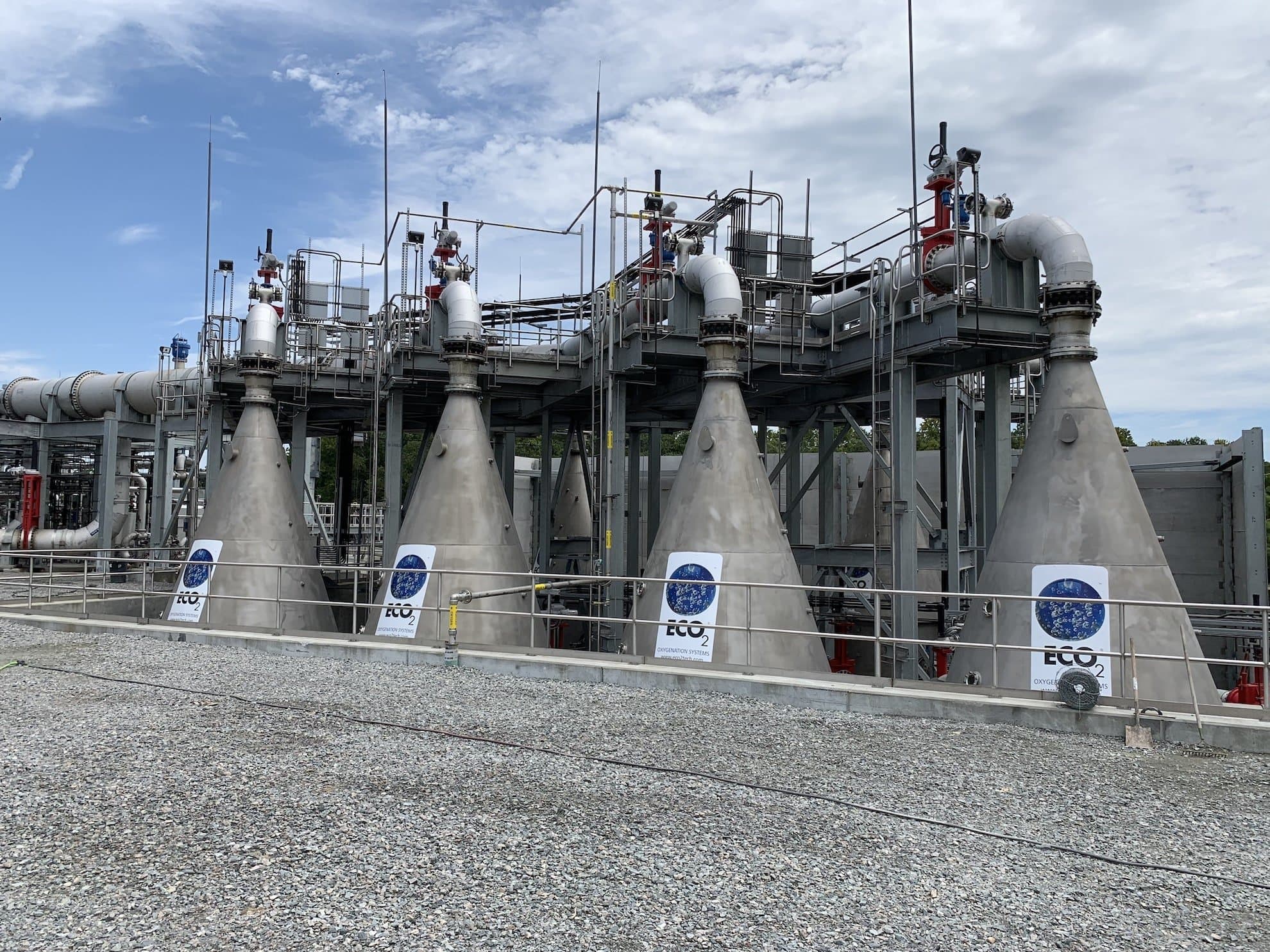
Savannah Harbor Expansion
In Full
More Key Figures
10 more, each with what it measures and its PDF page.
From the PDF
| Figure | What It Measures |
|---|---|
| 24 million data points | Data collected during the test, with an acceptance rate of 97.4% (PDF page 2 (opens in a new tab)) |
| 42 to 47 feet | Harbor depth before and after deepening, the impact the oxygen system mitigates (PDF page 3 (opens in a new tab)) |
| 7.3 to 1 | Benefit to the U.S. economy for each dollar spent on deepening (a net $282 million a year) (PDF page 3 (opens in a new tab)) |
| 13,385 lbs/day | Oxygen delivered to the river during the test (PDF page 1 (opens in a new tab)) |
| 12,000 lbs/day | Oxygen the plant had to produce and deliver (success criterion) (PDF page 1 (opens in a new tab)) |
| 80% | Minimum oxygen transfer efficiency required (success criterion) (PDF page 1 (opens in a new tab)) |
| 60 days | Test period, across two complete lunar cycles (PDF page 2 (opens in a new tab)) |
| 24 million data points | Data collected during the test (PDF page 2 (opens in a new tab)) |
| 97.4% | Acceptance rate of the data (PDF page 2 (opens in a new tab)) |
| 42 to 47 feet | Harbor depth before and after deepening (PDF page 3 (opens in a new tab)) |
The Full Write-Up
The problem, the work, the results and who did it.
Deepening the Inner Harbor Had to Wait on a Working Oxygen Plant
The Savannah Harbor Expansion Project deepens the harbor from 42 feet to 47 feet, so modern container ships can enter and leave the port with greater loads and fewer tidal restrictions (p. 3).
Deepening costs the river dissolved oxygen, and the river's fish need it. The Corps names the endangered shortnose sturgeon and the Atlantic sturgeon, which pass through the harbor on their way upstream and back to the Atlantic Ocean (p. 3). The plant will run mostly in the hot summer months, when oxygen in the river is naturally lower (p. 4).
The Hutchinson Island plant is the project's downstream dissolved oxygen plant, an environmental mitigation feature (pp. 1, 2). Proving it worked was a condition: dredging of the inner harbor could not begin until the plant had passed its test (p. 4).
Three Criteria, Two Lunar Cycles & 24 Million Data Points
The test asked whether the plant could make up for the oxygen the deeper inner harbor would cost, and measured success in three areas (p. 1). The plant had to produce and deliver 12,000 pounds of oxygen a day into the river. It had to transfer at least 80% of its oxygen into the water. And the injected oxygen had to spread adequately through the river (p. 1).
The test ran for 60 days, from March 14 to May 12. The Corps set the schedule in lunar cycles, two complete ones, to see how each tidal condition in the period would move the Superoxygenated water (p. 2). Over the period it collected 24 million data points, with an acceptance rate of 97.4% (p. 2). The team compared days with the system running against days with it shut down, and used dye to see where the water leaving the plant goes (pp. 2, 3).
The plant uses Speece cones, large steel cones in which river water and pure oxygen mix at high pressure, and returns the water to the river for the tides to spread. It extracts its pure oxygen from the air on site and runs automatically (pp. 3, 4).
More Oxygen than Required, Spread Farther than Expected
The Corps reports that the plant exceeded all three criteria needed to go ahead with deepening the inner harbor (p. 1). It delivered 13,385 lbs/day of oxygen against the 12,000 pounds a day required. It met the transfer efficiency criterion. And the dissolved oxygen mixed well in the water column and stayed detectable for days, farther upstream and downstream than expected (p. 1).
Beth Williams, who led the district's Hydraulics and Hydrology Section, said the data showed more oxygen on the days the system ran than on the days it was shut down, a difference as plain as flipping a light switch (pp. 2, 3). The dye tests showed the water leaving the plant mixing quickly from top to bottom and well upstream and downstream, and staying in the river for several days (p. 3). The district's commander, Col. Daniel Hibner, called the system "a remarkable success" (p. 2).
Reported by the Corps' Savannah District
The U.S. Army Corps of Engineers Savannah District posted this summary on August 23, 2019, written by Russell Wicke of its Corporate Communications Office (pp. 1, 4). The full test report and its appendices were published separately; the post links to them (p. 3).
The people it names are Col. Daniel Hibner, commander of the Savannah District, and Beth Williams of its Hydraulics and Hydrology Section. A photo shows Bryan Robinson, a hydraulic engineer with the district, testing from a boat with Emily Johnson of Tetra Tech and Hayley DiGiano of LG2 Environmental Solutions (pp. 1, 2).
The post does not say who designed or built the plant; the other Savannah entries in this library do.
Why It Matters for a River or Harbor Short of Oxygen
This result comes from the agency that owns the plant, not from its maker, with criteria set before the test and 24 million data points behind it (pp. 1, 2).
For an engineer facing a dissolved oxygen limit on a river, harbor or estuary, it shows a shore-based plant delivering more than its required oxygen, with tides carrying it well beyond the outfall (p. 1). It also shows how to test one: write down the criteria first (oxygen delivered, transfer efficiency, distribution), run long enough to cover the tides, compare days on and off, and use dye to see where the water goes.
Written up from the published article. Every figure is as the published article prints it, with the PDF page it comes from; the authors' own words appear only in quotation marks.
How to Cite
One line to paste into a report.
Russell Wicke. Oxygen Transfer Efficiency Test Report Summary for Savannah Harbor Expansion. U.S. Army Corps of Engineers, August 2019. Project engineer: U.S. Army Corps of Engineers. Eco Oxygen Technologies Technical Library. https://eco2tech.com/technical-library/oxygen-transfer-efficiency-test-report-summary-for-savannah-harbor-expansion/
https://eco2tech.com/technical-library/oxygen-transfer-efficiency-test-report-summary-for-savannah-harbor-expansion/
The Next Step
Ask an ECO₂ Engineer
Questions about this published article, or about your own water? An application engineer answers, with the figures.