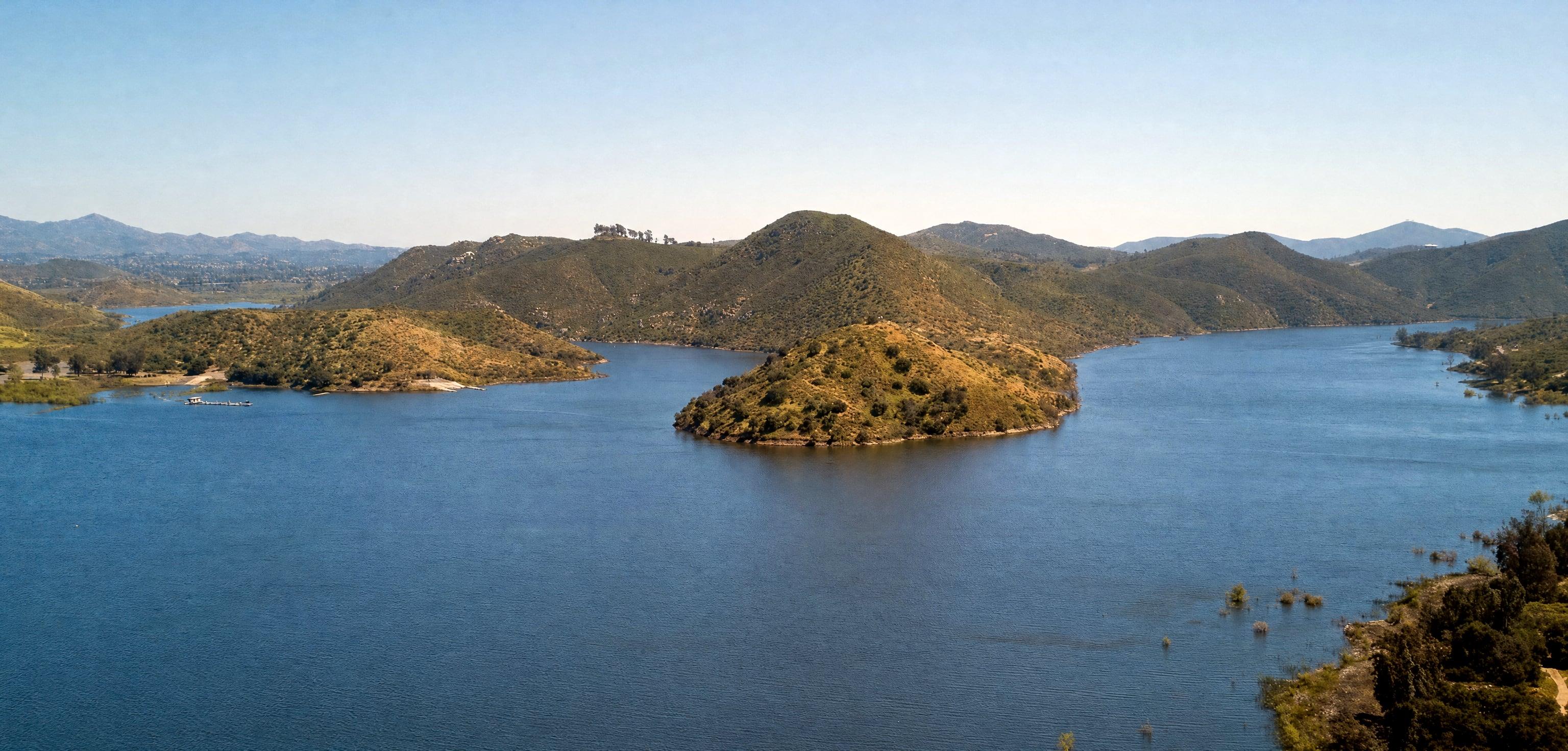
Restoring Canyon Lake: Sustainable Water Quality Solutions with Modern Innovations
Limnologist Alex Horne's plan for Canyon Lake in southern California: oxygen at the bottom of the reservoir and phased dredging, which would also protect Lake Elsinore.
Details
Summary
A Plan to Restore Canyon Lake
In a 2002 report to the Santa Ana Watershed Project Authority, limnologist Alex Horne recommends two main fixes for Canyon Lake, a eutrophic drinking water reservoir in southern California: a submerged downflow contact oxygenator such as a Speece Cone®, and phased dredging of its silted East Bay. The lake also traps phosphorus bound for Lake Elsinore (pp. 1, 20).
Key Figures
90%of inflow
Share of Lake Elsinore's inflow that passes through Canyon Lake (over) Source: PDF page 2 (opens in a new tab)
25.1tons/yr
Total phosphorus Canyon Lake intercepts before it reaches Lake Elsinore Source: PDF page 2 (opens in a new tab)
56%of external load
Share of Lake Elsinore's external phosphorus load retained in Canyon Lake Source: PDF page 2 (opens in a new tab)
Questions
How can Canyon Lake's water quality be improved?
The report's two main steps are a hypolimnetic oxygenation system and phased dredging of the shallow East Bay. Spring and fall mixing, algae-filtering wetlands and biomanipulation are smaller additions (pp. 3, 20).
Why does Canyon Lake matter to Lake Elsinore?
Over 90% of Lake Elsinore's inflow passes through Canyon Lake, which traps an estimated 25.1 tons of total phosphorus a year (p. 2).
How much does hypolimnetic oxygenation cost for a small reservoir?
For Canyon Lake the 2002 estimate was $250,000 to $500,000 to build and $20,000 to $50,000 a year to operate (pp. 1, 4).
Why not destratify the lake in summer?
Summer mixing would likely increase algae and odors, and the climate is too warm for it to be energy efficient. Horne recommends hypolimnetic oxygenation instead (p. 19).
Does hypolimnetic oxygenation reduce phosphorus release from sediment?
The report says it cuts internal loading of nitrogen and phosphorus by an average of about 50%, and phosphate by as much as 95% in some lakes (p. 15).
What are Canyon Lake's main water quality problems?
Nuisance algae, an anoxic hypolimnion with high ammonia, phosphate, iron and manganese, taste and odor in the drinking water supply, and rapid silting of the shallow East Bay. (PDF page 2) (opens in a new tab)
What does the report recommend first?
A pilot dredge of about 20,000 cubic yards, design and installation of a hypolimnetic oxygenation device, and independent checks of the recent sediment phosphorus data. (PDF page 4) (opens in a new tab)
How would oxygenation work in Canyon Lake?
Water from the deepest part of the lake is pumped into a cone on the lakebed where pure oxygen dissolves under pressure, and the oxygenated water is jetted horizontally over the sediment to suppress nutrient release. (PDF page 20) (opens in a new tab)
What would oxygenation cost?
A preliminary $250,000 to $500,000 to build and $20,000 to $50,000 a year to operate, for an estimated 0.25 to 2 tons of oxygen a day. (PDF page 4) (opens in a new tab)
In Full
More Key Figures
10 more, each with what it measures and its PDF page.
From the PDF
| Figure | What It Measures |
|---|---|
| 60 times a normal lake | Sedimentation rate in the East Bay, 2 to 3 inches a year (over) (PDF page 3 (opens in a new tab)) |
| 0.2 mg/L | Dissolved oxygen measured at 42 feet in September (PDF page 11 (opens in a new tab)) |
| $250,000 to $500,000 USD | Estimated construction cost of hypolimnetic oxygenation (PDF page 4 (opens in a new tab)) |
| 50% reduction | Average cut in internal nitrogen and phosphorus loading reported for hypolimnetic oxygenation (PDF page 15 (opens in a new tab)) |
| 0.25 to 2 tons/day | Oxygen the report expects Canyon Lake to need, sized by analogy (PDF page 21 (opens in a new tab)) |
| $250,000 to $500,000 | Preliminary construction cost of the oxygenation system (PDF page 21 (opens in a new tab)) |
| 50% | Average cut in internal nitrogen and phosphorus loading reported for hypolimnetic oxygenation (about) (PDF page 15 (opens in a new tab)) |
| 0.2 mg/L | Dissolved oxygen at 42 feet in September, against 2 to 7 desirable (PDF page 11 (opens in a new tab)) |
| 25.1 tons/y | Total phosphorus Canyon Lake intercepts before it reaches Lake Elsinore (PDF page 2 (opens in a new tab)) |
| 2 to 3 inches a year | Sediment build-up in the East Bay, over 60 times a normal lake (PDF page 3 (opens in a new tab)) |
The Full Write-Up
The problem, the work, the results and who did it.
A Small Reservoir with an Anoxic Bottom & a Filling East Bay
Canyon Lake is a small reservoir of about 10,000 acre-feet on the main inflow to the much larger natural Lake Elsinore. Over 90% of the water flowing into Lake Elsinore passes through it (p. 2). Built in 1927, it is lined with homes and supplies the Elsinore Valley Municipal Water District (p. 6).
The lake shows the signs of eutrophication: nuisance algae blooms, an anoxic hypolimnion, high ammonia and phosphate in the bottom water, soluble iron and manganese, and Secchi depth under 2 m with chlorophyll a over 35 µg/L (p. 2). In one record, dissolved oxygen was 0.2 mg/L at 42 feet in September, against a desirable 2 to 7 mg/L (p. 11). For drinking water that means iron, manganese, turbidity, taste and odor, and possible blue-green algal toxins (p. 2).
Sediment also fills the shallow East Bay at 2 to 3 inches a year, over 60 times the rate for a normal lake (p. 3).
Oxygen for the Deep Water, Dredging for the Shallows
Cutting nutrients in the watershed through the regional TMDL process is the ideal answer, but it will take so long that in-lake solutions are needed for at least the next 15 to 30 years (p. 3). Horne reviews 17 in-lake methods and rejects summer destratification, which would likely increase algae (pp. 18, 19).
His first recommendation is hypolimnetic oxygenation with a submerged downflow contact oxygenator, the most cost-effective way to improve the lake's drinking water. Water from the deepest part of the lake is pumped into the top of a small steel cone, about 10 feet high for Canyon Lake, on a concrete base on the lake bottom (p. 20). The water flows down against rising bubbles of pure oxygen, which dissolve with none escaping, and leaves through a manifold just above the lakebed. Within a few feet it entrains about 10 times its own volume (p. 21).
The cone belongs in the deepest water near the dam, where pressure raises oxygen solubility, fed from a liquid oxygen tank on shore or oxygen made on site (p. 21).
The second recommendation is phased dredging of the East Bay, starting with a pilot of about 20,000 cubic yards (p. 4). Spring and fall mixing, algae-filtering wetlands and biomanipulation are smaller additions (p. 3).
What Oxygen Should Do, & What the Lake Already Does Downstream
This is a recommendation, not a record of results. Hypolimnetic oxygenation has been shown to cut internal loading of nitrogen and phosphorus by an average of about 50%, and by as much as 95% for phosphate in some lakes (p. 15). In Canyon Lake it would reduce the soluble phosphate of about 0.6 mg/L that is exported to Lake Elsinore, about 2 tons a year, as well as dissolved organic carbon, turbidity, iron, manganese and sulfide (p. 3).
At 18 feet near the dam there was only 0.2 mg/L in September 2000, so zooplankton had no deep refuge. A hypolimnion at about 5 mg/L would let large Daphnia hide from fish by day and graze algae (pp. 24, 25).
The report puts the oxygen need at 0.25 to 2 tons a day, by analogy with other reservoirs, and the cost at $250,000 to $500,000 to build and $20,000 to $50,000 a year to run (pp. 4, 21). Canyon Lake meanwhile intercepts 25.1 tons a year of total phosphorus, 56% of the external load bound for Lake Elsinore (p. 2).
Alex Horne's Report to the Santa Ana Watershed Project Authority
Alex J. Horne of Alex Horne Associates, El Cerrito, California, wrote the report for the Santa Ana Watershed Project Authority. It is dated 31 January 2001, with a final revision of 23 January 2002 (p. 1).
Horne advises asking Professor Speece of Vanderbilt University, or other experts in oxygenation, to help design the system, because aeration and oxygenation expertise is not the same (p. 20).
Treat the Bottom Water While the Watershed Catches Up
Many reservoirs have a watershed that will take decades to fix and a water supply that needs help now. Horne's answer is to work with the stratification, not against it. Oxygen in the hypolimnion curbs what the sediment releases each summer, while dredging removes the sediment itself (pp. 3, 20, 23).
The lake's oxygen demand was not known, so the system was sized from similar ones elsewhere, and he says the real one should be designed for the lake's own shape and depth (p. 20). Measure your own reservoir's oxygen demand before you size a cone.
Written up from the technical paper. Every figure is as the technical paper prints it, with the PDF page it comes from; the authors' own words appear only in quotation marks.
How to Cite
One line to paste into a report.
Alex J. Horne. Restoring Canyon Lake: Sustainable Water Quality Solutions with Modern Innovations. Santa Ana Watershed Project Authority (SAWPA), January 2002. Eco Oxygen Technologies Technical Library. https://eco2tech.com/technical-library/restoring-canyon-lake-sustainable-water-quality-solutions-with-modern-innovations/
https://eco2tech.com/technical-library/restoring-canyon-lake-sustainable-water-quality-solutions-with-modern-innovations/
The Next Step
Ask an ECO₂ Engineer
Questions about this technical paper, or about your own water? An application engineer answers, with the figures.