Diffuser Design for Speece Cone® Discharge into San Pablo Reservoir
A design memo on how the San Pablo Reservoir oxygenation system should discharge its oxygenated water so that it spreads through the reservoir's whole bottom layer.
Details
Summary
A design memorandum by Dr. Philip J. W. Roberts to Brown and Caldwell on the diffuser that discharges Superoxygenated water from the Speece Cone® into San Pablo Reservoir, California. It recommends three nozzles at the rim of the reservoir's deep hole, about 100 ft down, angled so the oxygenated water fills the whole hypolimnion up to the thermocline.
Key Figures
5tons of oxygen a day
Mass flow of oxygen from the Speece Cone into the hypolimnion Source: PDF page 1 (opens in a new tab)
100ft
Recommended diffuser depth, at the rim of the reservoir's deep hole Source: PDF page 6 (opens in a new tab)
16ft/s
Jet velocity of the three nozzles in the recommended design Source: PDF page 6 (opens in a new tab)
Questions
Where should the San Pablo Reservoir oxygenation diffuser be placed?
At the top rim of the deep hole near the dam, at a depth of about 100 ft, where gentler bottom slopes allow flatter nozzle angles and more horizontal momentum. (PDF page 6) (opens in a new tab)
Why can't horizontal jets alone oxygenate the San Pablo hypolimnion?
Even the weak stratification in the hypolimnion, about 2°C over its depth, makes the jets collapse and limits the vertical extent of the oxygenated layer, so angled nozzles are needed to fill it. (PDF page 6) (opens in a new tab)
What nozzle design was recommended for the San Pablo diffuser?
Three nozzles in a vertical line pointing upstream: 5.9 inches horizontal, 5.9 inches up at 17 degrees and 6.8 inches up at 35 degrees, all at a jet velocity of 16 ft/s. (PDF page 6) (opens in a new tab)
Will Superoxygenated water effervesce when it leaves the diffuser?
The memo finds dilution of 10:1 to 20:1 occurs within a few feet of the nozzles, which is sufficient to prevent rapid release of dissolved oxygen. (PDF page 4) (opens in a new tab)
The Project
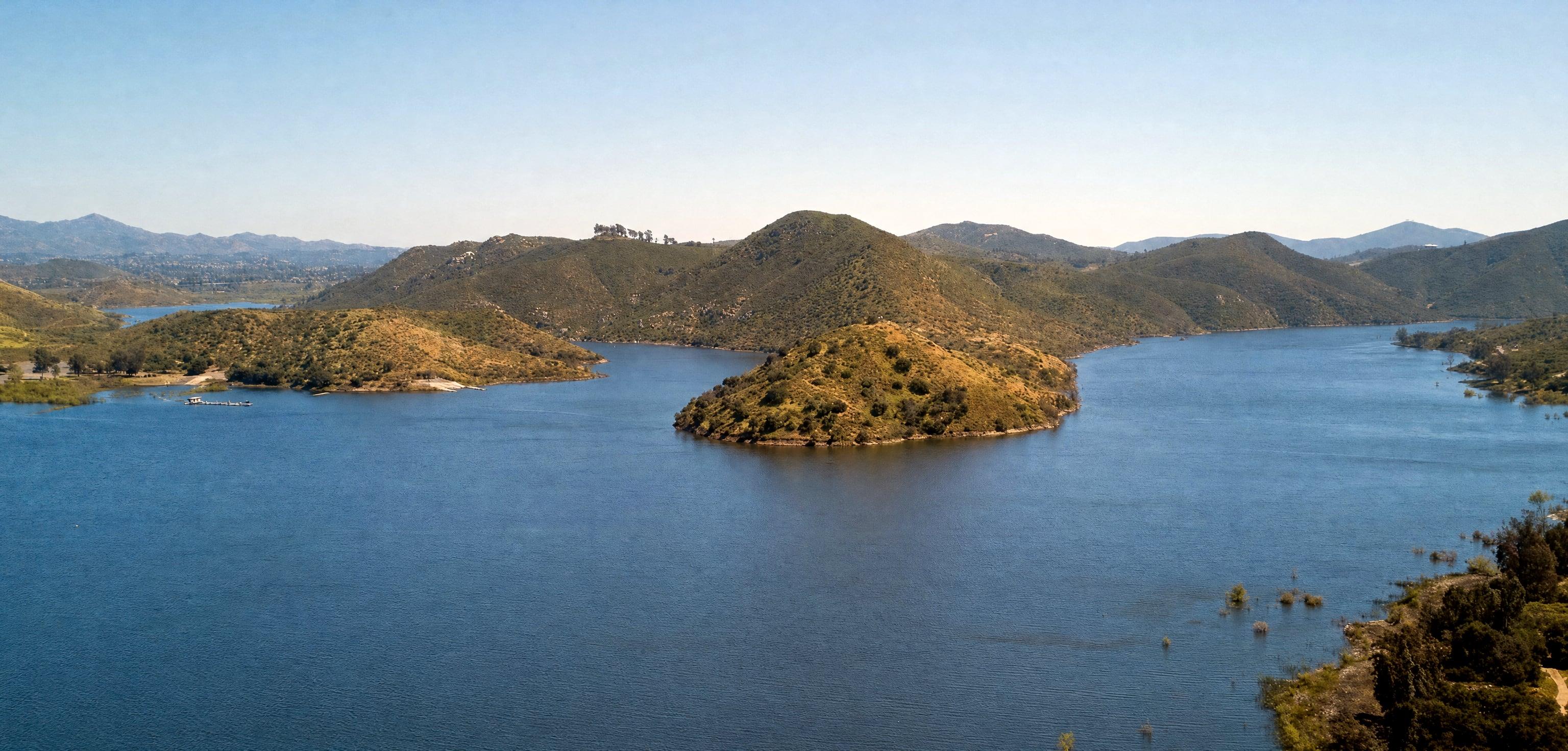
San Pablo Reservoir
In Full
More of the Summary
Two more paragraphs of our summary.
In summer it stratifies strongly: below about 40 ft the hypolimnion is almost completely anoxic.
Roberts analyzed temperature profiles from 2010, 2014, 2015 and 2019 and found that even the weak stratification in the hypolimnion caps how far a horizontal jet can rise, so horizontal jets alone cannot fill it. Using stratified-jet equations and the UM3 plume model, he settled on nozzles of 5.9, 5.9 and 6.8 inches pointing horizontally, up at 17 degrees and up at 35 degrees, all at 16 ft/s. Each makes a layer about 27 to 30 ft thick, and the layers overlap for a fairly even oxygen distribution. Dilution of 10:1 to 20:1 within a few feet of the nozzles is enough to prevent effervescence.
More Key Figures
Two more, each with what it measures and its PDF page.
From the PDF
| Figure | What It Measures |
|---|---|
| 27 to 30 ft | Thickness of the oxygenated layer each nozzle produces (PDF page 7 (opens in a new tab)) |
| 10:1 to 20:1 | Dilution within a few feet of the nozzles, enough to prevent effervescence (PDF page 4 (opens in a new tab)) |
How to Cite
One line to paste into a report.
Philip J. W. Roberts. Diffuser Design for Speece Cone® Discharge into San Pablo Reservoir. Brown and Caldwell, July 2019. Project engineer: Bill Faisst, Brown and Caldwell, Philip J.W. Roberts. Eco Oxygen Technologies Technical Library. https://eco2tech.com/technical-library/diffuser-design-for-speece-cone-discharge-into-san-pablo-reservoir/
https://eco2tech.com/technical-library/diffuser-design-for-speece-cone-discharge-into-san-pablo-reservoir/
The Next Step
Ask an ECO₂ Engineer
Questions about this technical paper, or about your own water? An application engineer answers, with the figures.