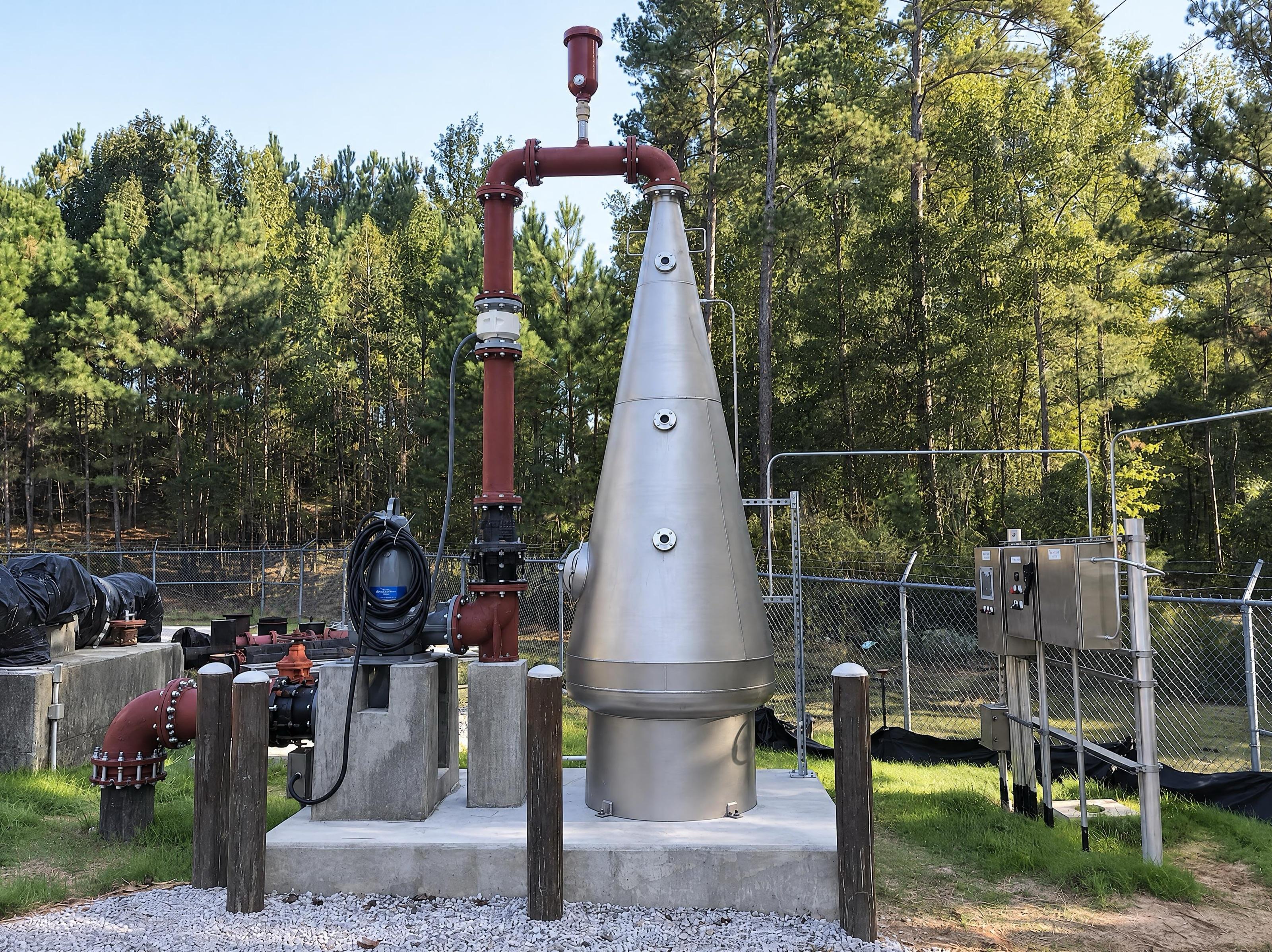
Tech Bulletin - Comparing Aeration and Oxygenation
An ECO₂ tech bulletin weighing aeration against oxygenation: the electricity each uses, the odorous gases each strips, and what each costs per ton of oxygen.
Details
Summary
ECO₂'s technical bulletin comparing aeration (oxygen from air) with oxygenation (high purity oxygen). At $0.06 to $0.12/kWh, the bulletin's cost table puts oxygenation at $75 to $123 per ton of oxygen against $94 to $172 for aeration.
Key Figures
1 to 2lbs O₂ per kWh
Oxygen transferred by many field aeration systems (coarse bubble diffusers, mechanical aerators) Source: PDF page 1 (opens in a new tab)
800kWh per ton O₂
Electricity to produce and dissolve high purity oxygen with PSA, against 1300 kWh/ton for aeration Source: PDF page 2 (opens in a new tab)
75$ per ton O₂
Total cost of oxygenation at $0.06/kWh, against $94 for aeration Source: PDF page 2 (opens in a new tab)
Questions
Is oxygenation with pure oxygen cheaper than aeration?
In the bulletin's table for 1 ton of oxygen a day, oxygenation costs $75, $99 and $123 per ton at $0.06, $0.09 and $0.12 per kWh, against $94, $133 and $172 for aeration. (PDF page 2) (opens in a new tab)
How much electricity does aeration use per ton of oxygen?
Many field aeration systems transfer only 1 to 2 lbs of oxygen per kWh, which is 1000 to 2000 kWh per ton of oxygen absorbed. (PDF page 1) (opens in a new tab)
Why does aeration cause odors that oxygenation avoids?
Aeration absorbs only 5 to 10% of the oxygen in the air, so 98 to 99 ft³ of off-gas leaves for every 100 ft³ injected, stripping volatiles. Oxygenation reduces off-gas stripping by about 2 orders of magnitude. (PDF page 2) (opens in a new tab)
Why does oxygen absorption efficiency matter so much?
Over its life the oxygen costs far more than the equipment: at $100/ton, 1 ton/day absorbed costs $449,000 over the life cycle, plus $135,000 for oxygen not absorbed at 70% efficiency. (PDF page 3) (opens in a new tab)
Does an oxygenation system also need to strip CO₂ and mix the tank?
Mixing and CO₂ stripping can be separated from oxygen transfer: large, slow impellers mix more efficiently, and a small surface splasher strips CO₂ with little energy. Weak wastewater with alkalinity above 150 mg/L needs no CO₂ stripping for pH control. (PDF page 3) (opens in a new tab)
In Full
More Key Figures
Four more, each with what it measures and its PDF page.
From the PDF
| Figure | What It Measures |
|---|---|
| 123 $ per ton O₂ | Total cost of oxygenation at $0.12/kWh, against $172 for aeration (PDF page 2 (opens in a new tab)) |
| 5 to 10% | Oxygen absorption efficiency of conventional aeration with air (PDF page 2 (opens in a new tab)) |
| 50 to 100 mg/L | Dissolved oxygen oxygenation can economically reach, for odor control in force mains and primary clarifiers (PDF page 1 (opens in a new tab)) |
| $135,000 | Life cycle cost of oxygen not absorbed at 70% efficiency, for 1 ton/day at $100/ton (on top of $449,000 absorbed) (PDF page 3 (opens in a new tab)) |
Full Text as Published
The text as its authors wrote it.
Comparing aeration and oxygenation
Introduction
In many situations, high purity oxygen (HPO - 90 to 99% O₂), can be generated and dissolved into water for about half as much electricity consumption and comparable total cost compared to that required to dissolve the same amount of oxygen from "free" air. (For purposes of this paper, aeration will be the term used to describe transfer of oxygen into water from air, while oxygenation will be the term used to describe transfer of oxygen into water using HPO.)
It is no surprise that electricity costs have risen dramatically in the last several decades. The underlying assumption that gave rise to the almost universal use of aeration for oxygen transfer in water quality management was that the high-energy consumption by the process was offset by low electricity costs. Since relatively low electricity rates are now a thing of the past, this occasions an opportunity to re-examine the economical advantage of aeration vs. oxygenation. Furthermore technology for generation of HPO on-site having total costs of approximately $70/ton has come into common usage.
This changing scene favoring oxygenation opens up unique opportunities to solve water quality problems that were not possible using conventional aeration. Off-gas stripping is reduced by about 2 orders of magnitude in oxygenation vs. aeration. This has great significance in odor generation and activated sludge treatment of industrial wastewaters containing volatile and/or hazardous air pollutants (HAP), as found in the pharmaceutical as well as pulp and paper industries. Because the D.O. can economically and efficiently be increased to 50 to 100 mg/L, oxygenation also makes possible a completely different approach to odor elimination in force mains and primary clarifiers.
Higher environmental standards, increased energy costs, improved oxygen dissolution techniques, ready availability of commercial oxygen, implementation of better safety measures for commercial oxygen use, and the critical need for strict odor and other noxious gas containment all dramatically affect the wastewater treatment choice of today's water quality management professionals.
Limits of aeration
Under field conditions today many aeration systems, composed of coarse bubble diffusers and mechanical aerators, transfer only 1 to 2 lbs. O₂/kwhr. This low rate translates into 1000 to 2000 kwhr/ton of oxygen absorbed. Several decades ago when electricity was only $0.02/kwhr, operating costs totaled only $20 to $40/ton O₂ dissolved. Now that electricity costs in many parts of the Northeast and California exceed $0.12/kwhr, this price hike translates into $120 to $240 /ton O₂ dissolved just for the electricity costs. Furthermore, it is economically disadvantageous to maintain D.O. concentrations above 2 to 4 mg/L.
Dissolved nitrogen gas stripping
An unfortunate oversight in the development of past technology to dissolve HPO into water was the fact that N₂, already dissolved in the water was significantly stripped into the gas phase. This was especially pronounced when the oxygen transfer took place at ambient pressure – which was often the case. The bottom line of the impact of dissolved nitrogen stripping is firstly to increase the unit energy consumption to dissolve a ton of oxygen, because the D.O. deficit is markedly reduced. Secondly it severely limits the maximum D.O. concentration that can be added to a side stream. A proper oxygenation system must minimize nitrogen gas stripping.
Off-gas stripping
Unfortunately conventional methods of dissolving oxygen into water utilizing air as the oxygen source are quite inefficient – achieving only 5 to 10 % oxygen absorption efficiency. This means that for every 100 ft³ of air bubbled through the water, only 1 to 2 ft³ of oxygen is dissolved at 5 - 10% absorption efficiency. This results in 98 to 99 ft³ of off-gas per 100 ft³ of air injected. The same would also be true of surface aeration, which is even more effective at air stripping volatiles from the water.
Costs for aeration vs. oxygenation
The total cost of dissolving 1 ton of oxygen per day from air as compared to that using HPO is shown in the following table:
| Aeration (1.5 lb O₂/kwhr) | Oxygenation | |
|---|---|---|
| Capital cost | $40,000 | PSA oxygen generator + air compressor: $70,000 |
| Electricity consumed | 1300 kwhr/ton O₂ | Produce O₂: 400 kwhr/ton; dissolution & mixing: 400 kwhr/ton; total: 800 kwhr/ton |
Amortization at 8% over 10 years (0.15/yr):
| Electricity ($/kwhr) | Aeration operating ($/ton) | Aeration amort. ($/ton) | Aeration total ($/ton) | Oxygenation operating ($/ton) | Oxygenation amort. ($/ton) | Oxygenation total ($/ton) |
|---|---|---|---|---|---|---|
| 0.06 | 78 | 16 | 94 | 48 | 27* | 75 |
| 0.09 | 117 | 16 | 133 | 72 | 27* | 99 |
| 0.12 | 156 | 16 | 172 | 96 | 27* | 123 |
* Amortization only of PSA and its air compressor
Life cycle cost of oxygen not absorbed
The life cycle cost of electricity to operate a pump dwarfs the initial cost of the pump and therefore dictates that the pump is selected to operate at high efficiency. So also the life cycle cost of oxygen dwarfs the initial cost of an oxygenation system and therefore dictates that high oxygen absorption efficiency be realized in a proper oxygenation system design. At $100/ton for oxygen, the life cycle cost for 1 ton/day oxygen absorbed comes to $449,000 plus $135,000 for the oxygen NOT absorbed at 70% oxygen absorption efficiency.
Mixing and CO₂ stripping
In wastewater treatment applications involving activated sludge and aerated lagoons, mixing to maintain the bacteria in suspension and CO₂ stripping are often accomplished simultaneously with oxygen transfer by the same device. The system is then sized in horsepower by whichever function predominates, resulting in the system being oversized for the non-controlling functions. Mixing and CO₂ stripping do not have to be accomplished together with oxygen transfer by the same piece of equipment. These objectives can and are separated to advantage.
Although such a traditional practice may be an appropriate solution in some cases, in the majority of cases it may be more energy and cost efficient to uncouple the mixing from the oxygen transfer function. Mixing is much more efficiently achieved with large diameter low speed impellers. Many such mixing systems are presently in operation. Likewise, CO₂ stripping can economically be achieved with a small surface splasher because the dissolved CO₂ deficit is so high e.g. 100 mg/L CO₂ for approximately 200 mg/L BOD5 removed. For weak BOD5 wastewater having alkalinity >150 mg/L, no CO₂ stripping is required for pH control. Dissolved CO₂ stripping assumes greater significance for pH control with strong wastewaters.
The CO₂ that results from microbial metabolism is quite soluble in water. For the high BOD concentrations found in some industrial wastewaters, there will be correspondingly high CO₂ generation. Removal of this CO₂ to a concentration commensurate with the alkalinity is required. For example with an alkalinity of 500 mg/L as CaCO₃, an ionic strength of 0.2 and 5% CO₂ in the gas phase (100 mg/L CO₂ in aqueous phase) will result in a pH of 7.0. Under this condition it requires only about 1/14 as much HP-hr to strip one pound of CO₂ at 100 mg/L as it does to dissolve one pound of oxygen at 2 mg/L D.O. e.g. D.O. deficit of 7 mg/L. With 1000 mg/L of alkalinity, the CO₂ concentration could be twice as high to maintain a pH of 7.0 and the stripping would require only 1/28 as much energy. Therefore CO₂ is easily stripped with low energy consumption by a small surface aerator.
For assistance with your specific needs in this application, please contact your Eco Oxygen Technologies systems engineer.
How to Cite
One line to paste into a report.
Tech Bulletin - Comparing Aeration and Oxygenation. ECO₂. Eco Oxygen Technologies Technical Library. https://eco2tech.com/technical-library/tech-bulletin-comparing-aeration-and-oxygenation/
https://eco2tech.com/technical-library/tech-bulletin-comparing-aeration-and-oxygenation/
The Next Step
Ask an ECO₂ Engineer
Questions about this technical paper, or about your own water? An application engineer answers, with the figures.