Denver Water's Marston Reservoir Receives Supplemental Dissolved Oxygen System to Resolve Seasonal Water Quality Issues
ECO₂'s case study of Marston Reservoir, whose thin bottom layer went anoxic each summer, and the Speece Cone® Denver Water chose to put oxygen back into it.
Details
Summary
Marston Reservoir, which feeds Denver Water's Marston treatment plant, has a thin 20 to 30 foot hypolimnion that went anoxic every summer, sending water with organics, taste and odor, manganese and algae to the plant through its single low intake.
Key Figures
66feet
Reservoir depth, leaving a thin 20 to 30 foot hypolimnion Source: PDF page 1 (opens in a new tab)
15years
Period of studies before oxygenation was selected Source: PDF page 1 (opens in a new tab)
1 millionpeople
People Denver Water supplies with drinking water ("over 1 million") Source: PDF page 1 (opens in a new tab)
Questions
What water quality problems did Marston Reservoir cause at Denver Water's treatment plant?
The thin hypolimnion went anoxic for months each summer, and the single low level intake sent that water to the plant, with elevated organics, taste and odor, elevated manganese and algal blooms. (PDF page 1) (opens in a new tab)
Why did Denver Water choose a Speece Cone for Marston Reservoir?
It produces and maintains high dissolved oxygen with little effect on the hypolimnion's temperature gradient, transfers oxygen efficiently even at Denver's altitude, has a small footprint and silent operation, and keeps a low-turbulence horizontal flow over the sediments. (PDF page 2) (opens in a new tab)
Who evaluated the oxygenation options for Marston Reservoir?
Denver Water, working with Alex Horne Associates and CDM, analyzed hypolimnetic treatment options over a period of 15 years of studies. (PDF page 2) (opens in a new tab)
The Project
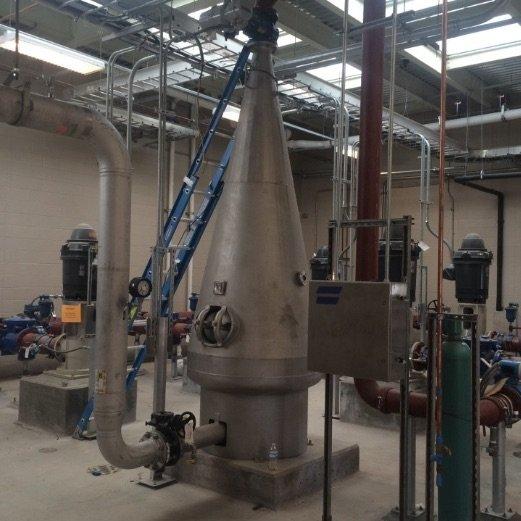
Marston Reservoir
In Full
Full Text as Published
The text as its authors wrote it.
Denver Water's Marston Reservoir receives supplemental dissolved oxygen system
Denver Water supplies drinking water to over 1 million people using water from multiple locations including Marston Reservoir. The reservoir, constructed over 115 years ago, stores 250 million gallons of water diverted from the South Platte River. The water is piped 12 miles to the reservoir, followed by treatment at the Marston Water Treatment Plant (WTP).
The reservoir's 66 foot depth results in a thin 20 to 30 foot hypolimnion which becomes anoxic (depleted of dissolved oxygen, D.O.) for several months after stratification occurs each summer.
The reservoir has only one low level intake which results in anoxic water being piped to the Marston WTP during the peak summer water usage months. During those months, water quality issues included elevated organics, taste and odors, elevated manganese levels, and algal blooms.
Denver Water takes pride in the high-quality drinking water provided to their customers and began evaluating strategies to improve water quality and reduce nutrient loadings on the WTP. After studies conducted over a period of 15 years, oxygenation using ECO₂'s Speece Cone was selected based on performance efficiencies, silent operations, and economic considerations.
Photo in the PDF: aerial view of Marston Reservoir, Denver, CO (photo credit: Wikimapia.org).
ECO₂ system selection
Denver Water, working with Alex Horne Associates and CDM, conducted an analysis of hypolimnetic treatment options that would fit the specific conditions of the Marston Reservoir.
Oxygenation, using the Speece Cone, developed by ECO₂, was selected based on the following:
- Produce and maintain high D.O.
- Little effect on temperature gradient in the hypolimnion
- Efficient oxygen transfer, even at the high Denver altitude
- Small footprint, few pipelines
- Silent operations
- Ability to continue horizontal water flow over the sediments with a low turbulence method.
Results
The ECO₂ SuperOxygenation System is sized for a maximum oxygen feed rate of 2,000 lbs/day, and runs from May, prior to the first turnover, through the fall. The System is attached to a concrete pad, and set on a base of rock and gravel at the reservoir bottom.
The graph in the PDF shows the D.O. readings taken at the reservoir bottom. Note the difference between the Summer 2008, prior to oxygenation, and the Summer 2009 with the ECO₂ System in use.
Chart in the PDF: Marston Reservoir bottom dissolved oxygen, 2008 vs. 2009.
How to Cite
One line to paste into a report.
Denver Water's Marston Reservoir Receives Supplemental Dissolved Oxygen System to Resolve Seasonal Water Quality Issues. ECO₂. Project engineer: CDM. Eco Oxygen Technologies Technical Library. https://eco2tech.com/technical-library/denver-waters-marston-reservoir-receives-supplemental-dissolved-oxygen-system-to-resolve-seasonal-water-qulity-issues/
https://eco2tech.com/technical-library/denver-waters-marston-reservoir-receives-supplemental-dissolved-oxygen-system-to-resolve-seasonal-water-qulity-issues/
The Next Step
Ask an ECO₂ Engineer
Questions about this case study, or about your own water? An application engineer answers, with the figures.