Webcast Presentation - Primary Clarifier Odor Control
Why primary clarifiers are often a plant's worst odor source, and how keeping oxygen in the water stops the problem at its start, from ECO₂'s own team.
Details
Summary
Stopping Odor at the Primary Clarifier
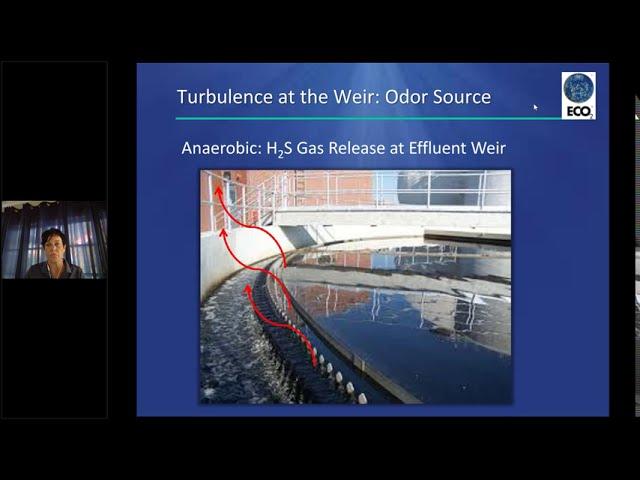
In this ECO₂ webcast, Ali Trollier and Dr. Richard Speece explain why the effluent weirs of primary clarifiers are often a plant's worst odor source, and how keeping dissolved oxygen in the water stops hydrogen sulfide from forming. With oxygen, sulfide is gone in about 20 to 30 minutes (14:36). Covers and chemicals only capture or slow it.
Key Figures
50%
Corrosion rate at five parts per million of H₂S in the gas phase, against the maximum rate, as reported in the literature (about; said at 10:59) Source: The video (opens in a new tab)
20%
Nitrate's sulfide oxidation rate, compared with dissolved oxygen's (about; said at 14:18) Source: The video (opens in a new tab)
20 to 30minutes
Time dissolved oxygen takes to eliminate hydrogen sulfide, against about a couple of hours with nitrate (said at 14:36) Source: The video (opens in a new tab)
Questions
Why do primary clarifier weirs release so much hydrogen sulfide?
The clarifier holds raw wastewater with no dissolved oxygen, little nitrate and plenty of sulfate, so bacteria make sulfide. At the weirs the water falls freely and the gas escapes fast (6:44).
Is nitrate as fast as dissolved oxygen at removing sulfide?
Does adding oxygen to a primary clarifier affect settling?
Not in the webcast's example. The oxygen is fully dissolved and kept below saturation, so no bubbles come out, and the tank's flow characteristics and quiet surface stayed the same (22:01).
How is the oxygen dose for a primary clarifier sized?
Multiply the retention time by the oxygen uptake rate, a standard 10 mg/L per hour, and by the flow (25:23).
Does oxygen also remove mercaptans and other organic sulfur odors?
Dr. Speece says yes: in a study he describes, mercaptans and other odorous compounds were oxidized once dissolved oxygen became positive, as were skatoles and indoles (34:57).
Where should oxygen be added to protect a plant's headworks?
Upstream, at a pump station, so the oxygen has about 30 minutes of contact before the flow reaches the headworks (32:11).
Why do primary clarifiers smell of hydrogen sulfide?
Raw wastewater in a primary clarifier has no dissolved oxygen, essentially no nitrate, plenty of bacteria and food, and sulfate: everything sulfate-reducing bacteria need to make hydrogen sulfide. On the quiet surface little gas escapes, but at the effluent weirs the water falls freely and the H₂S comes out of the liquid fast.
What are the options for primary clarifier odor control?
Let the odor form and capture it, by covering the tank or just the weirs and sending the air to a scrubber; feed a chemical, such as nitrate to support bacteria that oxidize sulfide or iron salts to precipitate it; or add dissolved oxygen so the hydrogen sulfide never forms. Dr. Speece notes that covers make the clarifier a confined space for maintenance.
Why use dissolved oxygen instead of nitrate for clarifier odor control?
Nitrate cannot oxidize sulfide chemically and supports microbial oxidation at about 20% of the rate of dissolved oxygen, so it takes about a couple of hours to work. With dissolved oxygen, chemical and bacterial oxidation together eliminate the hydrogen sulfide in about 20 to 30 minutes.
Does adding oxygen to a primary clarifier disturb settling?
No, according to the webcast. The oxygen is fully dissolved and kept below saturation, so no bubbles come out; at Madison the flow characteristics in the tank stayed the same and the clarifier surface stayed quiescent.
The Project
Paper Mill Primary Clarifier
In Full
More Key Figures
Seven more, each with what it measures.
From the Video
| Figure | What It Measures |
|---|---|
| 10 mg/L per hour | Standard oxygen uptake rate used to size the oxygen dose (said at 25:23) |
| 30 minutes | Contact time allowed between an oxygenated upstream pump station and the headworks (said at 32:11) |
| 20 to 30 minutes | Time dissolved oxygen takes to eliminate hydrogen sulfide (about), against about a couple of hours with nitrate (The video (opens in a new tab), 14:36) |
| 20% | Nitrate's rate of sulfide oxidation compared with dissolved oxygen's (about) (The video (opens in a new tab), 14:18) |
| 50% | Corrosion rate at five parts per million of H₂S in the gas, against the maximum (about, as reported in the literature) (The video (opens in a new tab), 10:59) |
| 10 mg/L per hour | Standard oxygen uptake rate used to size the dose (The video (opens in a new tab), 25:23) |
| 30 minutes | Contact time allowed between an oxygenated upstream pump station and the headworks (The video (opens in a new tab), 32:11) |
The Full Write-Up
The problem, the work, the results and who did it.
The Clarifier Makes the Gas & the Weirs Release It
Raw wastewater in a primary clarifier has no dissolved oxygen, essentially no nitrate, plenty of bacteria, plenty of food and sulfate. That is everything sulfate-reducing bacteria need to make hydrogen sulfide (7:31).
On the quiet surface of the tank little gas escapes. At the effluent weirs the water falls freely, and the hydrogen sulfide leaves the liquid fast. That is why, as Dr. Speece puts it, the weirs are commonly the major odor source in the whole plant, and a neighborhood problem (6:52).
The gas also corrodes the mechanisms, handrails and other steel around the clarifier. Dr. Speece cites literature reporting that even at five parts per million of hydrogen sulfide in the gas, corrosion runs at about 50% of its maximum rate. So the aim is to stop it, not slow it (10:59).
Three Ways to Control It, & Why Oxygen Prevents It
Dr. Speece sets out two philosophies: let the odor form, then capture and scrub it, or stop it forming at all (11:22).
Capturing means covers, over the whole tank or just around the weirs, with the air drawn to a scrubber. Covers work, but a plant manager he quotes found the cost easier to accept than the result: a confined space every time the mechanism needs maintenance (9:39).
Chemicals slow the problem. Nitrate cannot oxidize sulfide chemically; it supports bacteria that do, at about 20% of the rate with dissolved oxygen (14:18). That takes about a couple of hours, against about 20 to 30 minutes with dissolved oxygen, where chemical and bacterial oxidation work together (14:36).
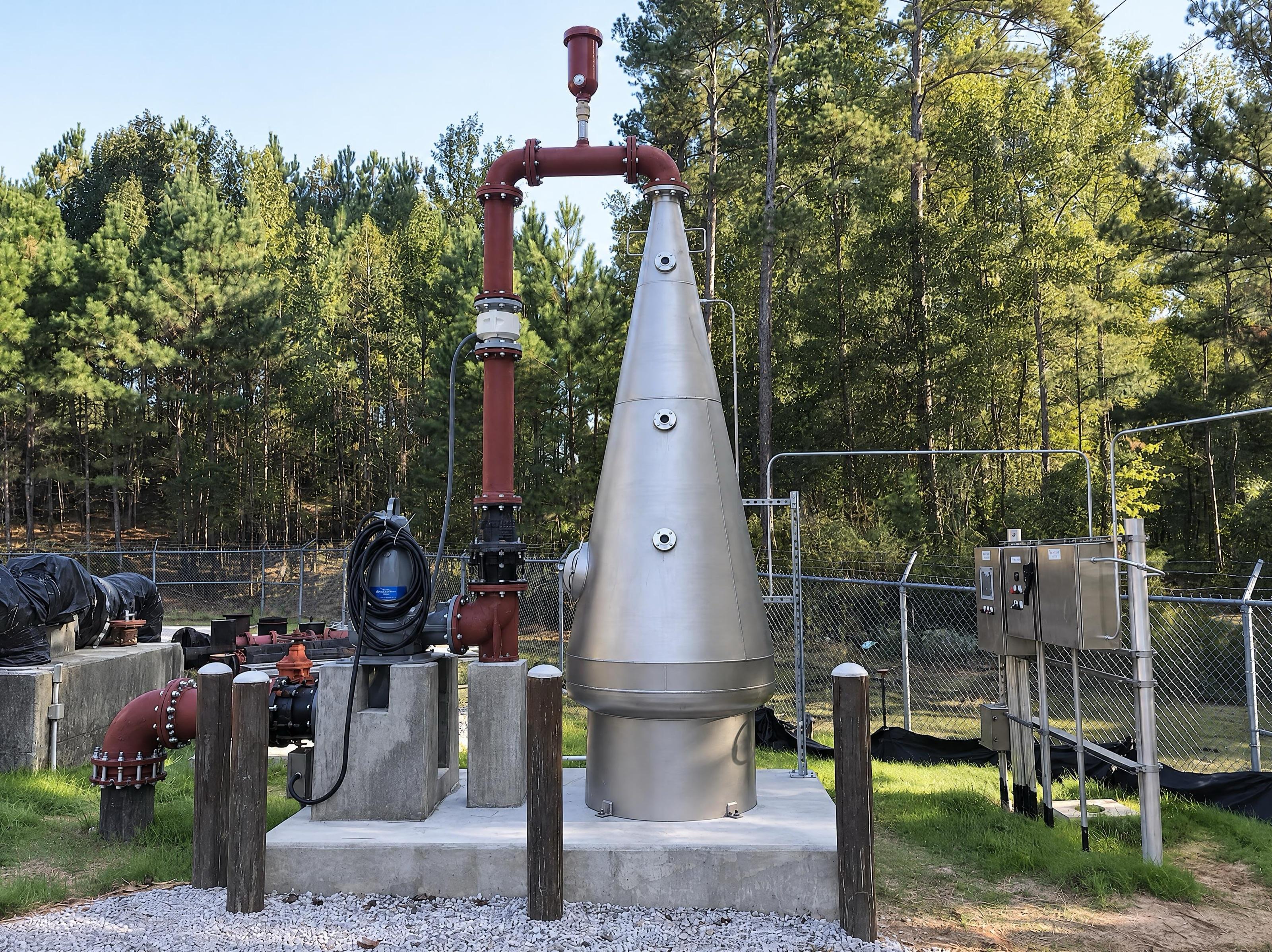
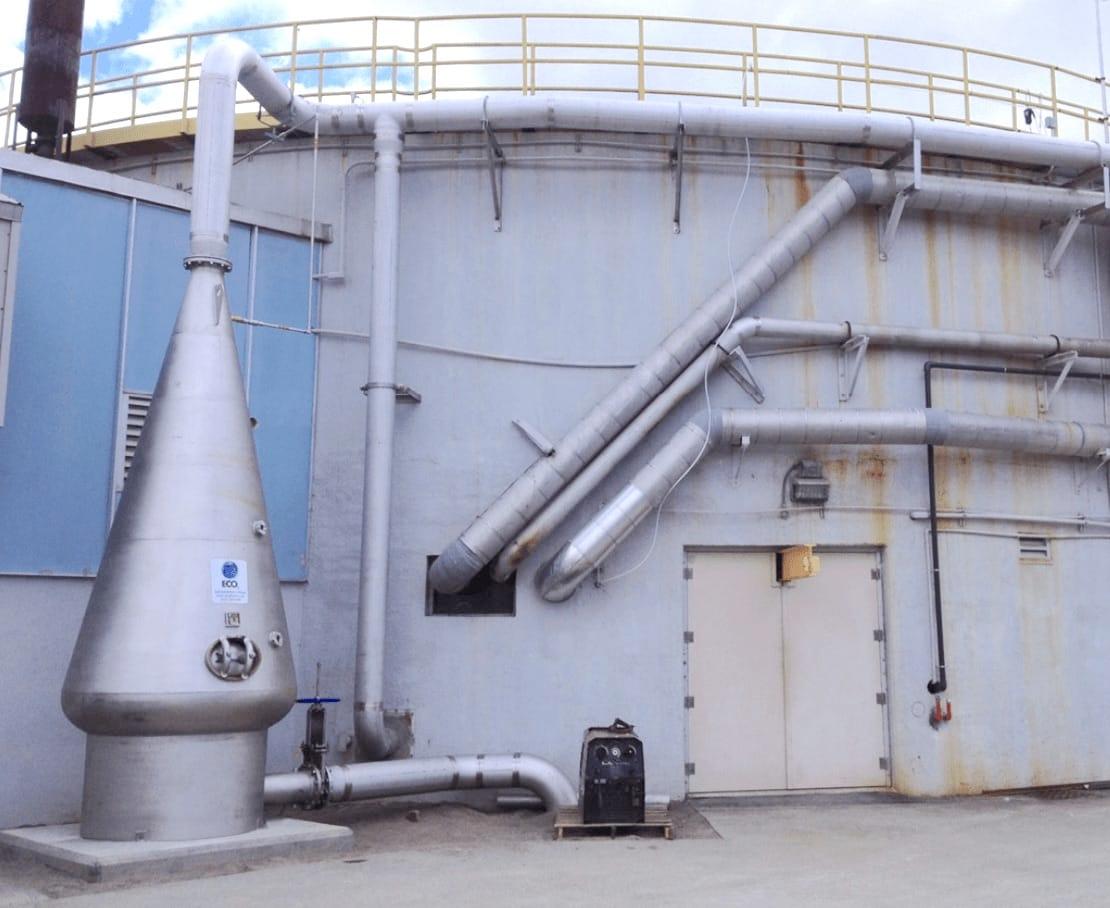
Superoxygenation takes a side stream off the clarifier influent line, pumps it through a Speece Cone® where pure oxygen dissolves, and returns it to the line (2:17). The oxygen stays below saturation, so no bubbles form in the tank (0:35).
In Maine, Oxygen Replaced a Chemical Feed Without Upsetting the Clarifier
Ali Trollier's main example is a Woodard & Curran operated plant in Madison, Maine, with an above-ground primary clarifier and a lot of odor complaints. It had used a chemical feed; it now runs a Speece Cone beside the clarifier at grade, fed by the existing influent pumps, with oxygen made on site by generators (22:50).
She reports that the clarifier stays aerobic through to the effluent weir, its surface stays quiescent, and its flow characteristics did not change. Less oxygen is now needed in the aeration basin, so the plant turned its blowers down (26:50).
She also shows how to size a system. The oxygen dose is the retention time, times the oxygen uptake rate (a standard 10 mg/L per hour), times the flow (25:23). As flow rises the retention time falls, so the dose stays fairly steady from low to peak flow.
For oxygen supply a plant can make its own with generators, or lease a liquid oxygen tank from a gas supplier: no capital cost, no noise, but trucks need access (24:23).
Presented by Ali Trollier of ECO₂ and Dr. Richard Speece
Ali Trollier of ECO₂ hosts and presents the examples. Dr. Richard Speece, who invented the Speece Cone and has been a professor at Vanderbilt University, explains the chemistry and answers listeners' questions (5:07).
The Maine plant is operated by Woodard & Curran, which also designed the upgrade; Ali Trollier thanks its manager, Dale Clark, for the data and photographs, and ECO₂'s engineering director, Kevin Jacobs, for preparing the material. Certificates of completion for continuing education credit are available on request.
What It Means for a Plant with Clarifier Odor
If your primary clarifier weirs smell, the webcast's case is that stopping the odor forming beats capturing it. Covers bring a scrubber and a confined space, nitrate leaves sulfide behind, and oxygen can be added through a small loop on the clarifier feed line without changing how the tank settles.
The questions at the end add two points. Oxygen also clears mercaptans and other organic sulfur odors, which can be worse than hydrogen sulfide. And to protect the headworks, oxygen goes in at an upstream pump station, so it has about 30 minutes of contact before the flow arrives (32:11).
Written up from the presentation. Every figure is as the video's speakers give it or its YouTube description prints it, with the moment it comes from; the speakers' own words appear only in quotation marks.
Transcript
Every word of the video, set for reading.
Primary clarifier odor control: an ECO₂ webcast
A transcript of the video, edited from its YouTube captions for reading. Presented by Ali Trollier of ECO₂ and Dr. Richard Speece; uploaded September 2020.
Introduction
Ali Trollier, ECO₂: Thanks again, everyone, for joining, and let's get into our next session on updating your toolbox for odor control, specifically for primary clarifiers.
What Superoxygenation is
Now, Superoxygenation is technology that's developed by ECO₂, and what it is, is increasing the dissolved oxygen using pure oxygen, not air. So what we're doing is we're increasing the D.O., but we're not producing any bubbles. We're making sure that all of that oxygen gas is dissolved and we're staying below 100% saturation level. So we're keeping all that oxygen dissolved in the liquid, not in gas form, in bubbles.
Now historically, the use of pure oxygen and the benefits of it have been known, and oxygen is inexpensive and highly effective, but it is difficult to dissolve. In the past, folks have tried to use different techniques and devices to make the most out of pure oxygen and its benefits, like spargers, or a venturi, or a U-tube, pressure tanks, nozzles, different things like that. But they all have really fairly low efficiency and poor performance when it comes to using this with raw wastewater. And then in the '90s Dr. Speece invented the Speece Cone, and it's got a very high transfer efficiency and was built for handling raw wastewater, so there aren't any things that are going to get clogged in this, like nozzles or venturis. And it also has been proven. The Speece Cone became a company called ECO₂ in the year 2000, so we're celebrating 20 years in operation this year, and now we've got over 100 installations across the world. Most of them are here in the U.S.
And the photograph on the right is a diagram of what this process looks like. We're taking a side stream off of a conveyance pipeline, sometimes if it's a force main in a collection system, or here we're going to be talking about actually the clarifier influent line. So we take a side stream off of that line, go through a small pump, just to add enough pressure to overcome the system losses, and back into the line. So this water then flows up to the top of the cone, where it meets the oxygen gas. That gas is then dissolved into the liquid, and then it's put right back into the pipe. So before the side stream you've got liquid with a very low D.O., and then afterwards you've got that liquid with a high D.O.
Where else it is used
Now, this technology is used in several different applications in water and wastewater quality, so I'd like to just briefly mention a couple that we talked about earlier. This summer, in June, we talked about odor and corrosion control in collection systems and at wastewater plant headworks systems. Then the month after that we did secondary clarifier oxygenation, which is a little bit different. It's not for odor control, but it was actually to increase the BOD removal capacity of a plant, by allowing the sludge in clarifiers to be oxic and act as an oxic bioreactor. This month, of course, we're going to talk about primary clarifiers and odor control.
We've got a few other applications that I'd like to just mention, and if these spark your interest, give us a call. We've got some applications where we're adding oxygen to the effluent of a wastewater plant to meet an effluent D.O. permit. And the photograph you see there in the lower right is a large installation on the Savannah River, where we're improving the environmental water quality of the harbor by adding dissolved oxygen to that river while they're doing a dredging and expansion of the harbor. So it was low quality before, and then they were going to dredge, and that water quality was going to get even worse, and so the Army Corps of Engineers selected ECO₂ and the Speece Cone process to add 40,000 pounds per day of oxygen to the Savannah River harbor. That's the photograph of that installation. We also do some applications in drinking water, and other gases, like carbon dioxide, for lime softening or pH adjustment.
And so now this is where I was going to turn it over to Dr. Speece, but I don't believe that I have him here with me. So, you are there? Can you hear me?
Dr. Richard Speece: I can hear you.
Ali Trollier: Wonderful. Okay, well, thanks, Dick, for joining us. I appreciate that... it posed some technological challenges having you be with us today, but I really do appreciate that. To all of our guests: this is a photograph of Dr. Speece, here on the left, with the Speece Cone. He's been a professor at Vanderbilt University, and he was in engineering. He's also an author, an inventor, a father, a husband, an all-around amazing person, and I'd like to pass it over now to him to discuss primary clarifiers. So without further ado, I'd like to introduce the one and only Dr. Speece. Please take it over.
Why primary clarifiers smell
Dr. Richard Speece: Ali, thank you so much. I appreciate that, and we appreciate each one of you who are looking in. We're looking at a system that we feel like is a very good fit for our technology, because we're looking at how can we prevent odors at a treatment plant, primarily in the primary clarifier.
So as we look at the treatment plant, we see commonly the major odor source in the entire treatment plant is the weirs of the primary clarifiers, which of course have the worst quality of water: the most BOD, the least D.O. And so consequently these are quite a problem, and if the primary clarifier odor can be eliminated, we go a long way to making the plant a good neighbor.
So in this slide here we see we've got a quiescent condition on top of the clarifier, so the rate of emission of hydrogen sulfide gas is not so much here. But if you get over to the effluent weirs, now we have a free fall. We've got a lot of gas exchange, and it's at these places here that this odor, which comes out at a slow rate here, now comes out at a very high rate. And so the hydrogen sulfide that used to be in the liquid now becomes the hydrogen sulfide that goes to the gas, and so consequently we have a neighborhood problem. Next slide.
So if we look at the primary clarifier, we see here that we've got zero D.O., we have essentially no nitrates, we've got a lot of bacteria because it's raw wastewater, and we've got a lot of food because it's raw wastewater also. We have the sulfate present, and so consequently we have everything that a sulfate-reducing bacteria would ever want in order to produce a lot of hydrogen sulfide. So in the liquid phase we have the sulfate, the BOD, that gets converted to sulfide in the liquid phase, and then consequently this gets transferred to the gas, transferred to the atmosphere at the effluent weirs. Next slide.
So this happens to be a slide of the vapor phase hydrogen sulfide at a wastewater treatment plant in Maine that Ali is going to describe a little later on. So we're looking here at the parts per million of hydrogen sulfide in the proximity of the weir at a treatment plant. And so we see here... keep in mind, a hundred parts per million, if you're exposed to that for very long, you lose your sense of smell, and then these concentrations here are lethal. So the amount of hydrogen sulfide that is existing in the proximity of the clarifier in this case is huge, and you can imagine the neighborhood reaction. Next slide.
Covers, chemicals or oxygen
So one alternative is to cover the primary clarifier, and I want you to notice this manhole over here. So if you cover the primary clarifier, then you have shielded it from the atmosphere, but now you have to pull the gases from underneath the clarifier and go to a scrubber. And I recall listening to a manager at a wastewater treatment plant say once: "I don't mind the cost of installing the cover, as high as that may be. The thing that bothers me most is it now is a confined space, and if I have to do any maintenance on this mechanism inside, I'm dealing with trying to find someone who's willing to go into that space and do the maintenance requirement." So the fact that it's covered solved the odor problem, but the fact that it's covered now creates what he calls an intolerable maintenance problem, by covering the primary clarifier. Next slide.
So if you look at the proximity of the primary clarifier, everything that's steel starts to corrode: the mechanisms in the primary clarifier corrode, the handrailing, anything that's steel outside gets corroded. It's a very corrosive gas. So next slide, please.
The thing about hydrogen sulfide is the rate of corrosion compared to the maximum rate. If you have a very high concentration here, and we plot the rate of corrosion as that concentration decreases, there is reported in the literature that even at five parts per million of hydrogen sulfide in the gas phase, the rate of corrosion going on is about 50% of the maximum, even at these low concentrations here. So what we would like to do is to stop the rate of corrosion, rather than slow it down. So, next slide.
So we look at several methods. There are two philosophies of treating odor. One is you let the odor form, then you capture it, and then you scrub it. The other one is to prevent the odor from forming altogether. So in the tank, cover and scrub: you've got tank covers, and then you need to have some way of scrubbing that. When we look at chemicals, you could add nitrates, which would support the bacterial growth of oxidizing the sulfide, or you could have iron salts, which precipitate that. And the issue we're going to suggest here is putting in dissolved oxygen, so that the hydrogen sulfide never forms, and we prevent its formation altogether. Next slide.
So here are some slides. One alternative is to just cover the circumference of the primary clarifier, where the weirs are, and then to suck the gas out underneath these covers here, so that the main part of the tank is left open, but most of the odor, which is formed here, gets sucked out and goes to some kind of a scrubber. Here's a scrubber, not for the primary clarifier but for another section of the plant. So the gases go in, and either you have a caustic scrubber or some chemical to oxidize or precipitate the sulfide. Here would be a view in which they've got a domed cover, an entrance inside, and then the gases get pulled out and sent to some kind of a scrubber. Next slide.
What each method costs
So we look at the cost of alternatives. We can use pure oxygen, we can raise the pH using caustic, we could put in hydrogen peroxide, we could put in chlorine, we could put in iron or magnesium oxide, or we could put in nitrates. So the point here: oxygen is low in cost, but it requires expensive equipment to dissolve it. And so we'll look at the next slide.
If you take nitrate, for instance: nitrate is not nearly as oxidizing as dissolved oxygen, and so nitrate cannot chemically oxidize sulfide, but it can support microbial oxidation of the sulfide. Nitrate has a relatively low sulfide oxidation rate, about 20% of that of dissolved oxygen, and that gets translated into the fact that it requires about a couple hours after you put in the nitrate before the bacteria eat much of the sulfide, versus it takes about 20 to 30 minutes if you raise the dissolved oxygen, for the combination of chemical oxidation plus bacterial oxidation to eliminate that hydrogen sulfide.
Likewise, it's not economical to achieve a dissolved sulfide concentration less than about 0.5 milligrams per liter, and so the 0.5 milligram per liter is able to support corrosion, and it has a significant odor potential. So nitrates will reduce the odor and reduce the corrosion, but we're looking at dissolved oxygen to actually eliminate the hydrogen sulfide. Next slide. Now I'll turn it over to Ali on the cost comparison in these examples. Thank you.
Covering and scrubbing: an example
Ali Trollier: All right, thank you so much, Dr. Speece. Again, it's just really a pleasure to have you with us and to get your insight. Some of those things that you were telling me about the covers, I really didn't have any idea. I hadn't thought about confined space and the intolerable maintenance, so thank you very much.
I'm going to take over and talk about a few examples of these three control methods that Dr. Speece just laid out. And the first one is a newspaper article that I found, and it's from the Bowery wastewater treatment plant, which is up in New York, around New York City, in the town of Astoria. And so I found this article where they spent three million dollars for a project to cover four tanks that were about 85 feet in diameter. They also used dual bed carbon filters. This was a slightly different application, but the cost is going to be pretty relative. So I divided that capital cost and got the number of 825,000 as the cost to cover and scrub one tank. So three million for four tanks, so that's per tank. Plus you've got an operation and maintenance expense that is ongoing. It wasn't identified or laid out clearly here, but I'm sure there is an expense for maintaining those carbon filters, as well as a limited life expectancy for the tank. And then, again, the confined space. So there's an example of covering and scrubbing.
A chemical feed at Madison, Maine
And I also would like to show you an example of a chemical feed. So this is the chemical analysis of what was used at that same application we're going to talk about in Maine, where they do have the Superoxygenation, so it's going to be a direct comparison for financial analysis. So Madison, Maine did a trial for [a calcium nitrate product] when they were contemplating different options for controlling odors. They've got this above-ground primary clarifier that you can see in that upper left-hand corner. It's 90 feet in diameter. Their flow through the plant is about 4 MGD, just to give you a little perspective of size. This is a Woodard & Curran operated plant, and they also were doing the design for the upgrade. And they had really high H₂S at the effluent weir, just like Dr. Speece was saying, and they live in this adorable little community in Maine, so they had a lot of odor complaints and they needed to do something.
So they started feeding [a calcium nitrate product], and they estimated a dosage of 200 gallons per day. Well, that was not effective, and so the actual dose was over 350 gallons per day. So when you take the cost of this, it was [a calcium nitrate product] at about $2.50 per gallon, so that was 325,000 per year to do the best job that they could, which was effective odor control, but we still weren't able to get to zero dissolved sulfides. Now, there was not a capital expense required with this, but this is an ongoing expense that really you can never expect to go down. So it's 325,000 a year for this option.
The oxygen system at Madison
Now let's compare that with what the oxygen system looks like. I'm sorry, I think I misspoke: 325 for [a calcium nitrate product] feed. Now, alternatively, this is what the oxygen costs are. So they had to run up a capital project and install this Speece Cone and the oxygenation system, but oxygen is very inexpensive to buy, or to make it on site, and it's about five cents a pound. It's about a tenth the cost of calcium nitrate. So we calculated the dose of dissolved oxygen that we needed to put in to maintain aerobic conditions throughout the hydraulic retention time of the clarifier, and it was 35 milligrams per liter of D.O. was required, and that calculates out to 1,250 pounds per day of oxygen. So the cost to operate this oxygenation system is only 20,000 per year, and that includes the electricity to run the pump, the electricity to make the oxygen, the maintenance and operation of the system. It's only $20,000 a year, compared to $325,000 with calcium nitrate.
But again, oxygen is great and cheap, but it's a little difficult to install. So that's where ECO₂ comes in, and we just worked with Woodard & Curran to design a system, and with engineering, installation and equipment it all came to $800,000 total project installed. So with the same parameters that I just described for [a calcium nitrate product] use, they're saving $300,000 a year, which was a two point [inaudible] year payback, which was sufficient for Woodard & Curran to move forward quickly. And also they are getting much better results. They're getting zero H₂S at the effluent weir, as shown on that OdaLogger in the bottom photograph.
And when we put that oxygenation system in, we were taking a side stream off that primary influent and going through the cone and picking up the dissolved oxygen. And this is a photograph of that dissolved oxygen meter on the effluent of that cone. So the raw water was coming in and coming out with 62 milligrams per liter of oxygen at the cone discharge, and then that was blending with the rest of the primary clarifier influent flow and making its way through the retention time of the clarifier, and then going over the weir. And at the weir, the D.O. measurement is 12.4 milligrams per liter, so we still have aerobic conditions at the effluent weir.
And the next photograph there is again just showing that you've got zero H₂S at the effluent weir. I would show you a graph, but it's hard to graph consistent zero; it's just a flat line at the bottom of the chart. So hopefully this photographic representation will just kind of show you: you boost the D.O. at the beginning, but you stay under saturation, so there are no bubbles that come out, and the flow characteristics in the tank were exactly the same, and they established aerobic conditions throughout the entire clarifier.
So this is a drawing of the project plans. So here in the bottom right corner of this diagram you can see they have the headworks influent chamber and pump station, so they're able to pump this flow with the existing pumps shown here in the upper left. They pump that flow through the cone, pick up the oxygen, come back, blend and go into the clarifier for its natural settling process. So we've just added a small loop on this feed line to increase the dissolved oxygen level, and there's the Speece Cone, sitting next to the primary clarifier at grade. And so they were able to use the existing pumps for the primary clarifier influent and just raise the head enough to get through this system and back into the line.
Now, this photograph here is a picture of their oxygen generators, which were purchased by a company called PCI. So this was a little bit separate from the Speece Cone part of the scope of supply, if you will. Now, there's two options of getting the oxygen supply, and they decided to make the oxygen on site, as opposed to having a tank and taking bulk deliveries. I'll show you what that looks like in a minute. But this last photograph is just a view from the clarifier walking bridge, and you can see that the quiescent conditions in the clarifier are not interrupted, even with the addition of dissolved oxygen.
Oxygen supply
So I mentioned oxygen supply. You've got to get this oxygen gas at relatively pure concentrations, and then what the Speece Cone does is it dissolves that into the liquid. So instead of going with the oxygen generator, and there are a couple of manufacturers of these generators, but they require maintenance, and they're a capital expense, and they're noisy, and they require some other installation considerations, the alternative that anyone can evaluate is purchasing liquid oxygen, because there's no capital cost with this, but there's a monthly lease from a local supplier like Airgas or Praxair. You see those trucks driving down the road. Well, they make large trucks and small trucks, and depending on the size of the installation, they back in and fill this tank, and then this is just piped over to the ECO₂ system to be dissolved. So that has no maintenance, no noise, no capital, but you do need truck access. So those are the two options for oxygen supply.
Sizing the system
Now, just quickly, I'd like to wrap up with how we determined what size to put in up there at Madison, or really anywhere. And the fact is that you need to calculate the oxygen demand, because we're trying to just satisfy that oxygen demand. So to determine how much oxygen you need for a specific application, it's all about the retention time and the oxygen uptake rate, which has a standard rate of 10 milligrams per liter per hour, times the flow.
So here in Madison we had three different flow scenarios: low, average and peak. And so you can see that when there's a lower flow, you've got a higher retention time: five hours, times 10 milligrams per liter per hour of D.O. usage, 8.34 pounds per gallon, and the flow rate of 2.7 MGD. So I get a dosage rate here: I need just over a thousand pounds per day of oxygen. Well, the way the math works out, as the flow goes up, the HRT goes down, and so you have a fairly proportionate number even when the flow goes up, because the retention time goes down.
The economics
Now I'd like to just show you the economics of this project, and then we'll wrap up. So here in this column I've got the costs associated with the Superoxygenation for odor control, by adding pure oxygen with the ECO₂ system and the Speece Cone, and then in this column I've got the cost for the nitrates, which really there is no cost except for the chemicals itself. There's no capital or installation cost there. So by the time you add together the cost to make the oxygen and to power the pump, it's about 20 grand per year.
Also, they had an aeration savings that was observed. Because they're feeding oxygen in the primary clarifier, less oxygen is required in their aeration basin, so they were able to turn down their blowers and have a significant savings there.
Now, we've got ECO₂ and the PCI generators: the capital cost for that was 320,000; installation, engineering, 470. So those two together, that's where I got the $800,000: $800,000 in capital to save $320,000 a year. That's where the 2.4 year payback came from, and that was very good for Woodard & Curran, and they're still operating today. And I'm sure that they wouldn't mind taking a phone call from anyone who is interested in learning a little bit more directly from the user.
Conclusion
But in conclusion: we're able to add dissolved oxygen and have no impact to settling, which is required in the clarifiers. We've got a couple other case studies on doing this similar thing, so this is not just a one-off; we do have case studies available. It's also highly efficient: we're getting over 95% oxygen transfer efficiency. We're feeding it to meet demand, so we basically flow pace the oxygen feed rate. We're saving a bunch of money. We're reducing the aeration requirement. And we're getting almost consistently zero H₂S levels, but less than five across the board.
Now, just to give credit where it's due: Dale Clark is the manager up there at the Woodard & Curran plant in Maine, so I'd like to thank him for providing us with the data and the pictures and everything. Also, Kevin Jacobs is our longtime ECO₂ champion, engineering director, and he has put together a lot of this information for us.
Also, we've got some resources for you to take away. There's some case studies and a technical paper that are available as a handout; actually, one's a case study and one is a magazine article that was written by the engineer about the project. So I invite you to download the handouts in your control panel on the right-hand side of the screen. Also look for that follow-up email from us with this presentation file and a link to a recording that you can share with anyone else that might be interested. Also let us know if you're interested in receiving a customized certificate of completion for this half hour that you can use for continuing education credits. And also, we've got our website, eco2tech.com/news, where we've got a bunch of new videos, case studies, some really fun new digital content coming in the next month before WEFTEC. So I invite you to reach out and think about what Superoxygenation might be able to do for you.
I'm going to put some contact information up on the screen again. My name is Ali Trollier, and I'm in Florida, covering the East Coast, and my colleagues are there listed as well, Ryan and Clay. So please reach out to anybody at any time. We'd love to talk to you about water or wastewater.
Questions
And I did say earlier that we would invite some questions, and I know we're getting to the end of our 30 minutes, but we do have a couple of questions here, and I'd like to just take a minute, since we've got Dr. Speece on the line. This is a question about: what is the range of influent dissolved sulfide concentration, in the Maine example, arriving at the headworks? Okay, so this was... Say, Dick, I'm not sure if you recall, I may need to follow up privately on this one, but the dissolved sulfides coming into the plant in Maine: do you recall if that was high, or if they were really just more concerned with the sulfide formation within the clarifier itself?
Dr. Richard Speece: I would think it's both, but the contribution coming in, I would think, would be a major part of that component as well. I can't give you that concentration coming in. I would assume it might be in the range of, dissolved in the liquid, something in the order of, say, maybe 40 milligrams per liter of dissolved hydrogen sulfide coming in, and then more gets formed as it cooks in that clarifier.
Ali Trollier: Right. Okay, so we might say, if you're looking at protecting the headworks, one might need to dissolve the oxygen upstream of the headworks, because if you've got it already coming into the headworks, by the time it goes through maybe some of the grit or different headworks devices, you may strip some of that H₂S off. So by the time it gets to the clarifier influent, I'm thinking maybe some of those dissolved sulfides are already stripped out. Would that be correct?
Dr. Richard Speece: Yes.
Ali Trollier: Okay. So in these primary clarifier applications we're mostly concerned about that anaerobic retention time within the clarifier, to protect the odors coming from the effluent weirs. But we also have a lot of installations where we're treating the headworks by dissolving oxygen in an upstream pump station, to allow that 30 minutes of contact time for the oxygen to do its job before it hits the headworks, where the H₂S would come out of solution.
All right, thank you so much. Here we've got another question, related to that graph on corrosion rates. The question is: does the H₂S corrosion and concentration rate curve for the exposed concrete follow the same pattern shown for steel? So is that graph good for concrete and steel?
Dr. Richard Speece: I would assume they're quite similar, because the corrosion takes place when the bacteria... If the H₂S comes into an oxic environment, if there's moisture there, the bacteria then will oxidize that to sulfuric acid. And I think the sulfuric acid is the main corrosion component, even though the H₂S is corrosive as well. But the real kicker comes when the bacteria, it's like in the crown of a sewer, these amazing bacteria that can live at a pH of battery acid are generating battery acid for that concrete sewer, once it gets out to a surface where it's exposed to oxygen, where these bacteria can oxidize sulfide to sulfuric acid.
Ali Trollier: Okay, and so sulfuric acid has a fairly similar corrosion rate for concrete and steel?
Dr. Richard Speece: I would say they are similar, yes.
Ali Trollier: Okay. Okay, fair enough. I like it; I'll buy it. Okay, now we've got another question here, about organosulfide components. Let's see here, I can make this a little bigger. Okay, here's the question: any experience using oxygen to prevent formation, or actually remove, odor-causing organosulfur compounds? Excuse me. I'm sorry, there's one more little comment here, Dick. It says: thinking species like dimethyl sulfide or mercaptans, not necessarily just H₂S.
Dr. Richard Speece: Yes, there's a very interesting study done years ago in which oxygen was added, and they analyzed for the mercaptans and the other odorous compounds, and those likewise were either chemically or microbially oxidized once the dissolved oxygen became positive. So the answer to that is a clear yes: the skatoles, the indoles, the mercaptans, as well as the inorganic hydrogen sulfide, those are all very good substrates for bacteria, and oxic conditions allowed those to be taken out, just like the hydrogen sulfide.
Ali Trollier: Wow, thank you for that excellent question. I promise I was not prepared; that was off the cuff. I don't think I could have done that. But I think we mostly talk about H₂S because it seems to be the major component of odors, and it's the easiest to measure. Is that true?
Dr. Richard Speece: It's easiest to measure, that's true, but sometimes it's not the most odorous thing there, and so that's why this question was quite important, because getting rid of the hydrogen sulfide may not get you home, and with the use of oxic conditions you also get rid of these other extremely odorous compounds in the process.
Ali Trollier: Excellent. Wonderful. Well, that brings us to the end of our questions, and so I think, Dr. Speece, I think that we're good for now. And if we receive any other questions, I'm really excited to answer any of those individually, and we can pull Dr. Speece in whenever necessary. So, everyone, thanks so much for joining us today. Please look for the handouts and the video links, share it with anybody you know, and give us a call anytime to discuss more about odor control or other water quality and wastewater oxygenation applications. Thanks so much, everybody. Thank you.
How to Cite
One line to paste into a report.
Webcast Presentation - Primary Clarifier Odor Control. ECO₂, September 2020. Eco Oxygen Technologies Technical Library. https://eco2tech.com/technical-library/webcast-presentation-secondary-clarifier-superoxygenation/
https://eco2tech.com/technical-library/webcast-presentation-secondary-clarifier-superoxygenation/
The Next Step
Ask an ECO₂ Engineer
Questions about this presentation, or about your own water? An application engineer answers, with the figures.