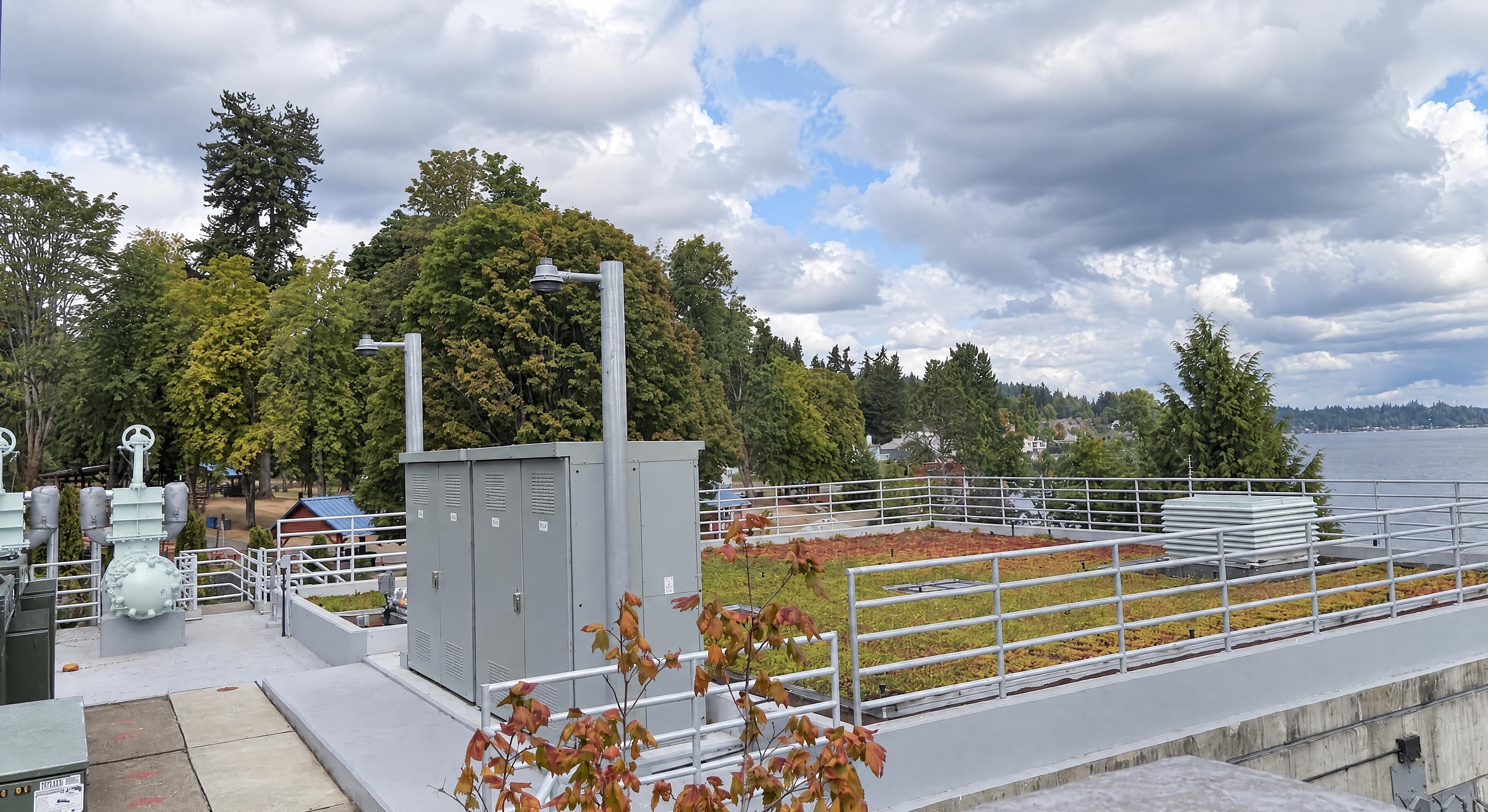
Madison, ME Solves Primary Clarifier Odor Problems with the Speece Cone® by ECO₂
ECO₂'s case study of the Anson-Madison Sanitary District in Maine, where raising the oxygen in the primary clarifiers' influent ended the odors at the weirs.
Details
Summary
Anson-Madison Sanitary District with Woodard and Curran use elevated D.O. levels in their primary clarifier influent to stop odors at the clarifier weir.
The Project
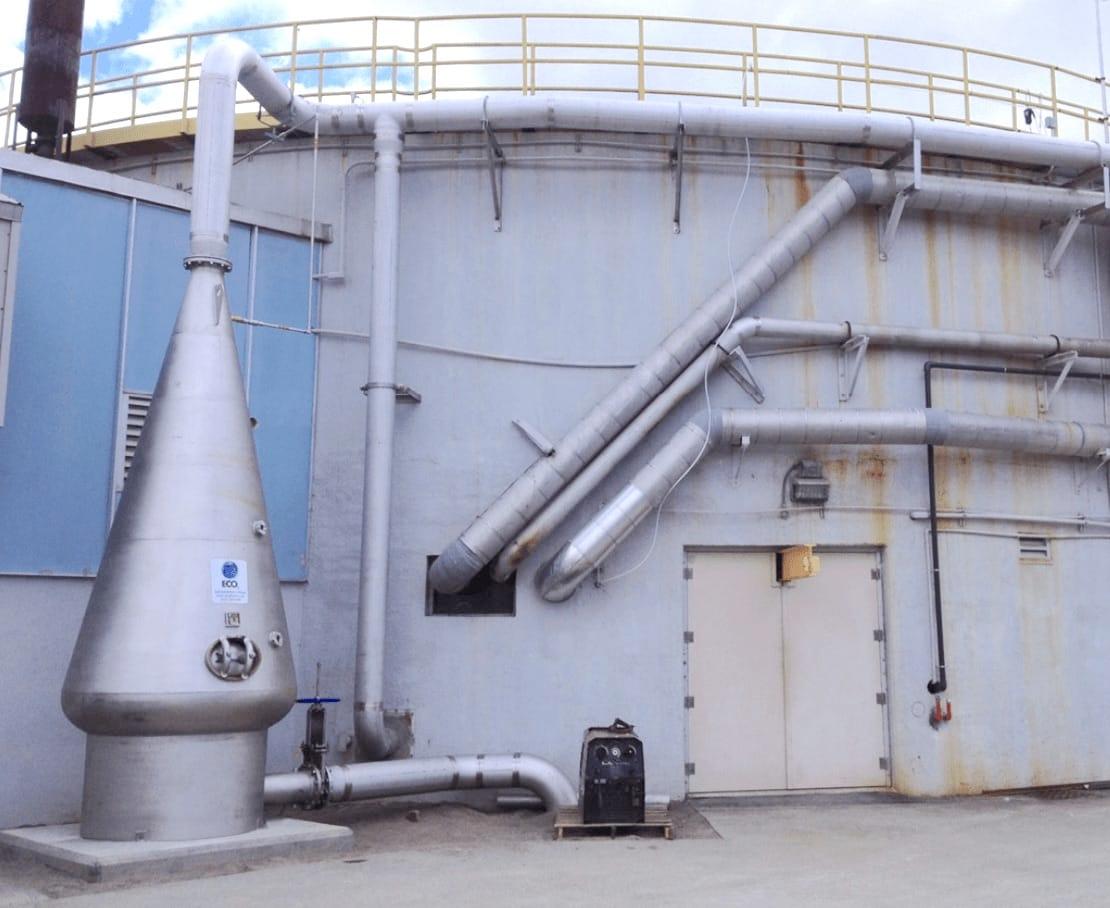
Paper Mill Primary Clarifier
In Full
Full Text as Published
The text as its authors wrote it.
UPM Madison Paper Industries, Anson Madison, ME: Primary Clarifier Odor Control
4 MGD Wastewater Treatment Plant.
Reference: Dale Clark, Woodard & Curran, Madison, ME.
Project Description
The Anson-Madison Sanitary District is operated by Woodard and Curran and treats 4 MGD of wastewater from Madison Paper Industries as well as the communities of Anson and Madison, ME. The treatment facility is located in close proximity to neighbors and has experienced odor issues for many years. Wastewater entering the treatment facility is oxygen deficient and the BOD degrading microorganisms are using sulfates as an oxygen source, forming high levels of hydrogen sulfide (H2S) gas. H2S levels have been recorded at 150ppm average with spikes of up to 800ppm.
In 2010 the District began adding calcium nitrate into the wastewater stream prior to the primary clarifier as an oxygen source for the microorganisms. This proved to be effective in controlling hydrogen sulfide levels, but very expensive ($1,000 per day).
In 2011 the District started exploring other options. Dissolved oxygen is the preferred source of oxygen for BOD degrading microorganisms and as long as aerobic conditions can be maintained, sulfide formation is effectively prevented. Woodard and Curran worked with ECO₂ to design a SuperOxygenation System for the primary clarifiers. The goals were to eliminate H2S formation for employee safety, corrosion of equipment and control of odors. Another major goal was to off-set the use / cost of chemical addition.
The system was installed and started up in early 2012. Two VSA Oxygen Generators provide pure oxygen on-site and on demand for approx. $36,000 / year. The odors have been successfully eliminated and the SuperOxygenation System is saving the District about $300,000 / year.
Primary Clarifier Odor Control
ECO₂ is the market leader in SuperOxygenation with over 10 years of experience and a multitude of successfully operating systems in the water and wastewater industry.
The ECO₂ Technology effectively dissolves pure oxygen in (waste)water to increase the dissolved oxygen (D.O.) level in the water and maintain aerobic conditions, which in turn prevents sulfide (H2S) formation and the associated odors and corrosion.
Our systems distinguish themselves through robust design with few moving parts and wide openings, capable of passing raw wastewater without clogging, resulting in reliable operation with ultra low O&M costs.
Our oxygen transfer efficiency of 95% on average has not been exceeded in the market place to date.
Odor Control for Primary Clarifiers
Primary Clarifiers are often the source for sulfide formation and downstream H2S odors. While the wastewater sits in the settling tank for several hours, dissolved oxygen is consumed and BOD degrading bacteria use sulfates as an oxygen source, producing dissolved sulfides. When the water flows over the effluent weirs, the turbulence strips out H2S, resulting in odor and potential corrosion.
Sulfide formation can be effectively prevented by maintaining aerobic conditions in primary clarifiers. The ECO₂ SuperOxygenation System dissolves pure oxygen gas in water, raising the D.O. of the influent and providing for sufficient dissolved oxygen to satisfy the oxygen uptake rate and maintain aerobic conditions in the primaries. No sulfides are generated and therefore no H2S will be stripped out at the effluent weirs.
Technical Specifications
Primary Clarifier
- Flow: 3.5-4 MGD
- Diameter: 90 ft
- Depth: 12 ft
- HRT: 3.5 hours
- Oxygen Uptake Rate: 5-10 mg/L/hr
- H2S Concentrations before: 150 ppm avg.
ECO₂ System Design
- Cone diameter: 6 ft
- Oxygen Dissolution Capacity: 1,800 ppd
- Sidestream Flow: 2,500 gpm
- D.O. at Cone Discharge: 62 mg/L
- D.O. at Effluent Weirs: 8-12 mg/L
- H2S at Effluent Weirs: 0 ppm
Impact of D.O. on Primary Clarifier Odor Control: A) D.O. at Cone Discharge entering the Primaries; B) Test Set-Up (D.O. Meter & OdaLog on weirs); C) D.O. at Effluent Weirs (12mg/L); D) OdaLog Reading above effluent weirs: 0ppm H2S.
Results
The ECO₂ SuperOxygenation System efficiently adds sufficient D.O. to the primaries to maintain aerobic conditions and prevent sulfide formation. The ECO₂ System raises the D.O. level in the influent stream to approx. 62mg/L. Since all of the oxygen is in a dissolved form, no spontaneous effervescence occurs in the influent well, despite the water being highly supersaturated with D.O. The available D.O. is consumed in the primary clarifier. A positive D.O. is measured at the effluent weirs, proving the existence of aerobic conditions in the primaries. Sulfide formation is effectively prevented during aerobic conditions and H2S off-gassing has been minimized, solving the Districts odor problems at a fraction of the cost of the prior chemical treatment.
How to Cite
One line to paste into a report.
Madison, ME Solves Primary Clarifier Odor Problems with the Speece Cone® by ECO₂. ECO₂, 2013. Project engineer: Woodard & Curran. Eco Oxygen Technologies Technical Library. https://eco2tech.com/technical-library/madison-me-solves-primary-clarifier-odor-problems-with-the-speece-cone-by-eco2/
https://eco2tech.com/technical-library/madison-me-solves-primary-clarifier-odor-problems-with-the-speece-cone-by-eco2/
The Next Step
Ask an ECO₂ Engineer
Questions about this case study, or about your own water? An application engineer answers, with the figures.