Superoxygenation in Wastewater Treatment: Integrating Renewable Hydrogen Production and High-Purity Oxygen for Sustainable Solutions
A conference poster on building green hydrogen production at a wastewater plant and feeding its spare oxygen to the activated sludge, with the Speece Cone® as one option.
Details
Summary
Oxygen from Green Hydrogen, Put to Work
Electrolyzers that make green hydrogen also give off oxygen. This conference poster proposes building the hydrogen plant at a wastewater treatment plant and feeding that oxygen to the activated sludge process. It names the Speece Cone as one of four aeration processes for high purity oxygen and calls for a full scale test with a working electrolyzer (p. 1).
Key Figures
1950s
First tests of high purity oxygen in activated sludge Source: PDF page 1 (opens in a new tab)
1980s
When nitrification became important, and carbon dioxide in the covered gas space held it back Source: PDF page 1 (opens in a new tab)
Questions
Can the oxygen from green hydrogen production be used in wastewater treatment?
That is what the poster proposes: build the hydrogen plant at a wastewater treatment plant and use the electrolyzer's byproduct oxygen in the activated sludge process (p. 1).
Why did high purity oxygen activated sludge fall out of use?
Carbon dioxide in the covered gas space reduced nitrification rates, which became important from the 1980s, and the cost of producing the oxygen rose with energy prices (p. 1).
What is alpha SOTE?
SOTE is the standard oxygen transfer efficiency, the share of supplied oxygen that dissolves in clean water under standard conditions, and alpha corrects it for real wastewater. The poster says high purity oxygen with new aeration technologies can raise it (p. 1).
Which aeration processes does the poster list for high purity oxygen?
The Speece Cone, supersaturation, MABR and nanobubbles (p. 1).
Has electrolyzer oxygen been tested in a full scale wastewater plant?
Not according to the poster. It reports promising lab scale tests and simulation modeling, and calls for full scale testing in a municipal activated sludge plant with an operating electrolyzer (p. 1).
What does the poster propose?
Co-locating a renewable hydrogen plant at a wastewater treatment plant and using the electrolyzer's byproduct oxygen in the activated sludge process. (PDF page 1) (opens in a new tab)
Why did pure oxygen activated sludge fall out of use?
Carbon dioxide in the covered head space reduced nitrification, which became important from the 1980s, and the cost of producing oxygen rose with energy prices. (PDF page 1) (opens in a new tab)
Which aeration methods does it list for high purity oxygen?
The Speece Cone, supersaturation, MABR and nanobubbles. (PDF page 1) (opens in a new tab)
What benefit does pure oxygen offer with new aeration technology?
Higher alpha SOTE, which allows operation at higher MLSS in smaller bioreactors, cutting capital cost or adding capacity, plus oxygen storage to shift energy use toward solar output. (PDF page 1) (opens in a new tab)
What is needed next?
Full scale testing of pure oxygen in a municipal activated sludge plant with an operating electrolyzer. (PDF page 1) (opens in a new tab)
In Full
More Key Figures
One more, each with what it measures and its PDF page.
From the PDF
| Figure | What It Measures |
|---|---|
| 1970s and 1980s | When most full scale high purity oxygen plants were built, mostly in North America (PDF page 1 (opens in a new tab)) |
The Full Write-Up
The problem, the work, the results and who did it.
Byproduct Oxygen Goes Unused, & Pure Oxygen Fell Out of Favor in Activated Sludge
An electrolyzer splits water into hydrogen and oxygen. Green hydrogen projects want the hydrogen, which can be sold or used on site: in a fuel cell to make electricity, or in industry for ammonia and ironmaking. The oxygen is a byproduct. The poster's case is to give that oxygen a use in the activated sludge process, and to ease water security concerns by using wastewater for electrolysis (p. 1).
High purity oxygen is not new in activated sludge. Early testing took place in the 1950s, and full scale plants followed, mostly in the 1970s and 1980s in North America. They were claimed to save energy and sludge, though some of those benefits were disputed (p. 1).
Those plants generally used surface aeration in an oxygen rich atmosphere, with an enclosed gas space over the bioreactor or the surface aerator. They met the BOD reduction goals of their time. But carbon dioxide in that gas space reduced nitrification, the step that turns ammonia into nitrate, which became important for wastewater treatment in the 1980s and beyond. The cost of producing the oxygen also rose with energy prices (p. 1).
Heat, Oxygen & Water Shared Between Two Plants
The poster sums up the idea as heat, oxygen and water. Its diagram shows solar panels powering an electrolyzer that sends hydrogen out. The oxygen goes to storage and on to the activated sludge tank. Treated effluent passes through a water purification step and returns to the electrolyzer as its feed water, and a heat line links the electrolyzer with that purification step (p. 1).
Two things have changed since the older plants, the poster says. Green hydrogen initiatives are producing lots of surplus oxygen, and new high efficiency aeration technologies have become available. It lists four aeration processes for high purity oxygen: the Speece Cone, supersaturation, MABR (membrane aerated biofilm reactors) and nanobubbles (p. 1).
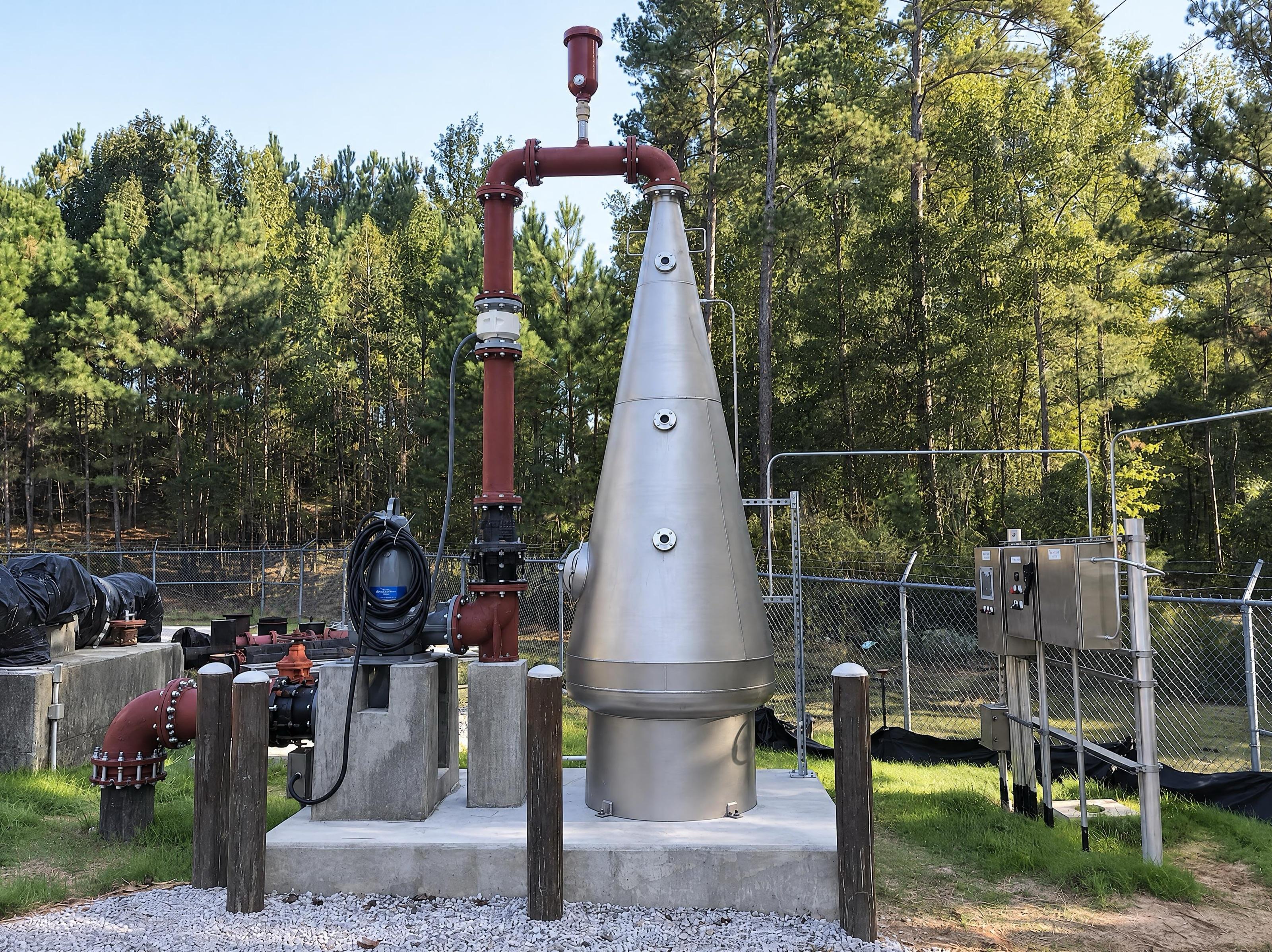
Its drawing of the Speece Cone shows a side stream pump feeding water into the top of the cone, with oxygen gas fed in and the oxygenated water leaving at the bottom (p. 1). In the cone, the water flows down while the cone widens, so the water slows and the oxygen bubbles are held in it until they dissolve.
Promising Lab Results, & a Full Scale Trial Still to Come
This is a proposal, not a project report, and it prints no measured results. The key benefit it claims is a higher alpha SOTE when high purity oxygen is used with the new aeration technologies (p. 1).
A higher alpha SOTE, the oxygen transfer efficiency corrected for real wastewater, would let a plant run at higher MLSS in smaller bioreactors, which means lower capital cost or more capacity from the same tanks. Stored, compressed oxygen could also shift energy use to match the output of solar panels (p. 1).
The poster reports that lab scale tests show a promising boost in alpha SOTE, and that simulation modeling found room for energy shifting and greater use of renewable electricity. What it says is needed is full scale testing of high purity oxygen in a municipal activated sludge plant with an operating electrolyzer (p. 1).
A Poster from Jacobs
The poster carries the Jacobs name and its own title, "Coupling hydrogen and wastewater through oxygen". It prints no author names and no date. It names the Speece Cone as one of the aeration processes that could put the oxygen to use (p. 1).
Why It Matters If a Hydrogen Project Is Planned Near Your Plant
If a green hydrogen project is planned near your treatment plant, its oxygen is a resource worth planning for. The poster sets out what the oxygen could buy: more capacity from existing tanks, smaller new ones, and an oxygen store that follows the solar day (p. 1).
The history of the older plants also shows what a new design must avoid. The cone in the poster works on a side stream: the oxygen is dissolved in pumped water inside the cone. That is a different arrangement from the covered tanks of the 1970s and 1980s, where the oxygen sat in a gas space over the bioreactor (p. 1). The open question the poster names is how it performs at full scale.
Written up from the presentation. Every figure is as the presentation prints it, with the PDF page it comes from; the authors' own words appear only in quotation marks.
How to Cite
One line to paste into a report.
Rickey Donald. Superoxygenation in Wastewater Treatment: Integrating Renewable Hydrogen Production and High-Purity Oxygen for Sustainable Solutions. OzWater24. Eco Oxygen Technologies Technical Library. https://eco2tech.com/technical-library/superoxygenation-in-wastewater-treatment-integrating-renewable-hydrogen-production-and-high-purity-oxygen-for-sustainable-solutions/
https://eco2tech.com/technical-library/superoxygenation-in-wastewater-treatment-integrating-renewable-hydrogen-production-and-high-purity-oxygen-for-sustainable-solutions/
The Next Step
Ask an ECO₂ Engineer
Questions about this presentation, or about your own water? An application engineer answers, with the figures.