Oxygenation System Prevents Odor and Corrosion in Force Main
The City of Raymore, Missouri had daily hydrogen sulfide peaks of 600 to 900 ppm where an oversized force main discharged into its gravity sewers.
Details
Summary
Raymore Stops 600 to 900 ppm H₂S Peaks
It installed an ECO₂ Superoxygenation system, which dissolves oxygen into a sidestream and returns it to the main. H₂S fell rapidly from over 600 ppm on the day it was switched on (p. 2).
Key Figures
600 to 900ppm H₂S
Daily hydrogen sulfide peaks before treatment Source: PDF page 2 (opens in a new tab)
Over 600ppm H₂S
H₂S on the day the system was turned on, before it fell Source: PDF page 2 (opens in a new tab)
Questions
Why does an oversized force main produce hydrogen sulfide?
Flow moves slowly through it, so wastewater stays in the pipe a long time. Conditions turn anaerobic and hydrogen sulfide forms, as it did in Raymore, Missouri (p. 2).
How high can H₂S get at a force main discharge without treatment?
In Raymore, with no chemical feed, hydrogen sulfide peaked at 600 to 900 ppm every day, causing corrosion, odor and worker safety concerns (p. 2).
How does a Superoxygenation system control H₂S in a force main?
It dissolves high levels of oxygen into a sidestream of wastewater and blends it back into the force main. Automated controls pace the oxygen feed so the line stays aerobic (p. 2).
What maintenance does a force main oxygenation system need?
The system is a stainless steel cone, automated controls and a sidestream pump. The article says the pump is the only moving part needing standard maintenance (p. 2).
How quickly does dissolved oxygen reduce H₂S in a force main?
In Raymore, hydrogen sulfide fell rapidly from over 600 ppm on the day the system was turned on (p. 2).
What did the city install?
An ECO₂ Superoxygenation System that dissolves oxygen into a wastewater sidestream and returns it to the force main, with automatic controls pacing the oxygen feed. (PDF page 2) (opens in a new tab)
The Project
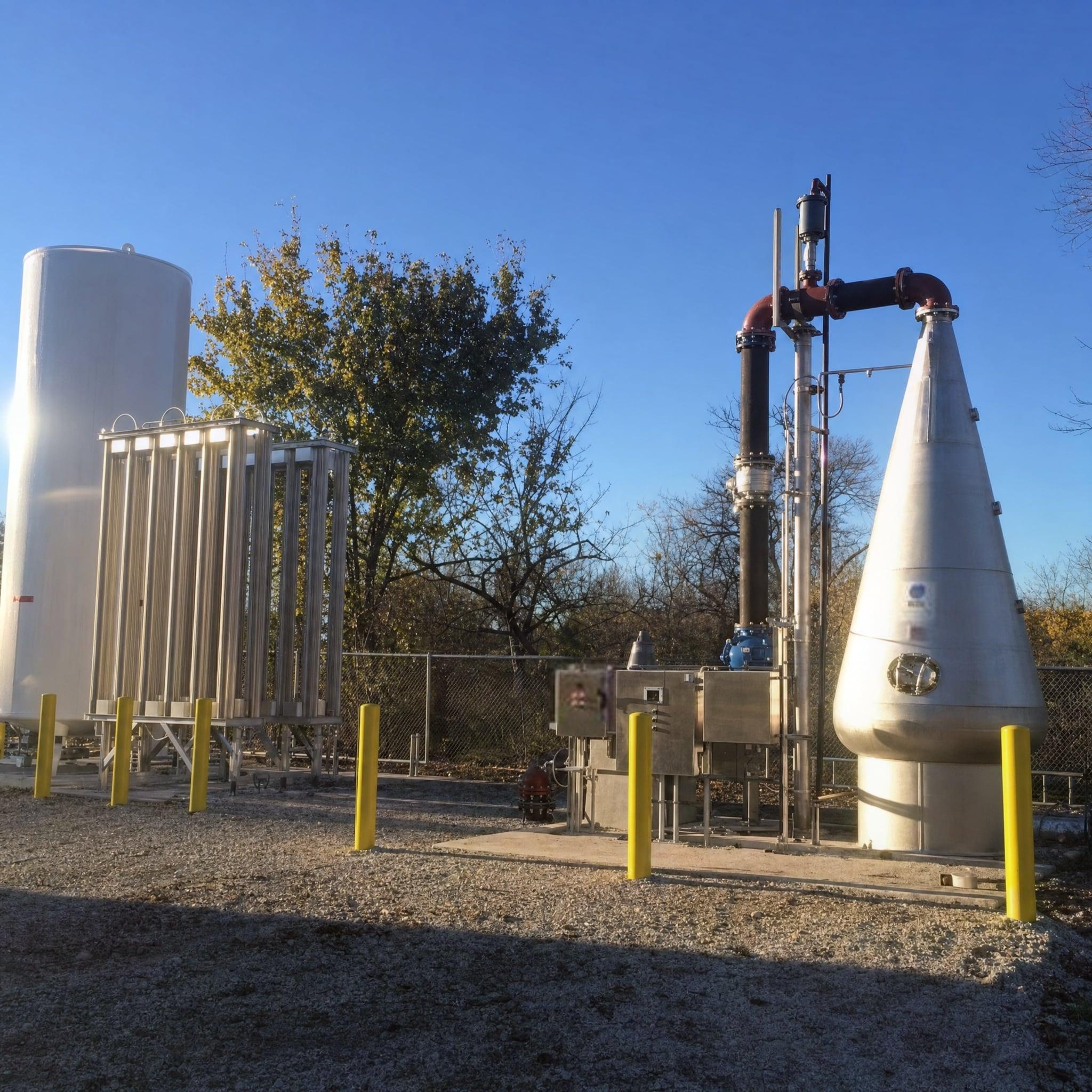
Owen Good Pump Station
In Full
More Key Figures
One more, each with what it measures and its PDF page.
From the PDF
| Figure | What It Measures |
|---|---|
| 600 to 900 ppm H₂S | Daily H₂S peaks with no chemical feed (PDF page 2 (opens in a new tab)) |
The Full Write-Up
The problem, the work, the results and who did it.
An Oversized Force Main That Turned Septic
Raymore, Missouri had a history of odor and corrosion in its gravity collection system, where a force main discharged. The force main was oversized. Wastewater moved through it slowly and stayed in it a long time, conditions turned anaerobic, and hydrogen sulfide formed (p. 2).
Why that happens is well understood. A force main is a pressure pipe that carries wastewater from a pump station to a gravity sewer or a plant. It runs full, so the wastewater has no air above it to take oxygen from. Bacteria on the pipe wall use up the dissolved oxygen the flow brings with it, and the longer the flow stays in the pipe, the longer it spends with none. Without oxygen, bacteria turn sulfate into sulfide. Where the main empties into a gravity sewer, the sulfide escapes as H₂S gas.
With no chemical feed, H₂S at Raymore peaked at 600 to 900 ppm every day. The article names the consequences: corrosion, odor and concerns for worker safety (p. 2).
Oxygen Dissolved into a Sidestream & Paced to the Line
The city installed an ECO₂ Superoxygenation system from Eco Oxygen Technologies. It treats the wastewater itself. Part of the flow is drawn off as a sidestream, high levels of oxygen are dissolved into it, and it is blended back into the force main (p. 2). The dissolved oxygen then travels with the flow, so bacteria along the main have oxygen to use instead of sulfate.
Automated controls pace the oxygen feed to keep enough dissolved oxygen in the line to hold it aerobic (p. 2). Pacing matters because the oxygen a force main needs rises with the time wastewater spends in it.
The equipment list is short: a stainless steel cone where the oxygen dissolves, automated system controls, and a sidestream pump. The article notes that the pump is the only moving part needing standard maintenance (p. 2).
H₂S Fell on the Day the Oxygen Went On
The article reports a fast result. On the day the system was turned on, hydrogen sulfide fell rapidly from over 600 ppm, and the article describes H₂S as effectively eliminated (p. 2).
It is a short item and gives no long-term record, oxygen dose or cost. ECO₂'s own Raymore case study, a separate entry in this library, covers the project in more detail.
The City of Raymore, with Eco Oxygen Technologies
The City of Raymore installed the system on its own sewer, and Eco Oxygen Technologies supplied it (p. 2). The item closes with ECO₂'s telephone number and web address, so it reads as a supplier case study. It ran in the June 2016 issue of Treatment Plant Operator (TPO) magazine, on a page of short product case studies (pp. 1, 2). No author or engineer is named.
What It Means for a Utility with an Oversized Force Main
A force main sized for more flow than it carries will behave the way Raymore's did: slow flow, long retention and sulfide. Raymore's peaks of 600 to 900 ppm were measured with no chemical feed (p. 2).
Dissolving oxygen into the wastewater goes after the cause, because bacteria that have oxygen do not make sulfide. Treating the gas at the discharge deals only with H₂S that has already formed. Pacing the oxygen to the line, as Raymore's controls do, lets the dose follow the demand.
If your force main is oversized, gather its length and diameter, the flows through the day and the H₂S at the discharge before asking for a design.
Written up from the published article. Every figure is as the published article prints it, with the PDF page it comes from; the authors' own words appear only in quotation marks.
How to Cite
One line to paste into a report.
ECO₂. Oxygenation System Prevents Odor and Corrosion in Force Main. TPO Magazine, June 2016. Project engineer: HDR. Eco Oxygen Technologies Technical Library. https://eco2tech.com/technical-library/oxygenation-system-prevents-odor-and-corrosion-in-force-main/
https://eco2tech.com/technical-library/oxygenation-system-prevents-odor-and-corrosion-in-force-main/
The Next Step
Ask an ECO₂ Engineer
Questions about this published article, or about your own water? An application engineer answers, with the figures.