O2 to the Rescue - Savannah Harbor Expansion
Deepening Savannah's harbor for larger ships would lower the river's dissolved oxygen, and this article explains how Speece Cones® will put the oxygen back.
Details
Summary
In this July/August 2016 Civil Engineering feature, Richard Speece, ECO₂ president David Clidence and coauthors from Amec Foster Wheeler, the Georgia Ports Authority and the U.S. Army Corps of Engineers explain how the Savannah Harbor Expansion Project will protect dissolved oxygen in the Savannah River. The $706 million project deepens the navigation channel from 42 ft to 47 ft at mean low water so larger New Panamax ships can use the Port of Savannah. A deeper, slower harbor takes up less oxygen from the air and lets seawater reach farther upstream, which lowers oxygen saturation, and the lower river is already listed as impaired for low dissolved oxygen, with a 5 mg/L minimum in the harbor. Corps modeling showed the deeper channel needs an extra 40,000 lb of oxygen per day. A 2004 study of 25 alternatives found injecting Superoxygenated water the most cost-effective option, and the ECO₂ Superoxygenation System was chosen to dissolve the oxygen. The permanent design uses on-site oxygen generation at two stations: near Hutchison Island, 65 cfs through three cones adds 12,000 lb per day, and near Rincon, 150 cfs through seven cones adds 28,000 lb per day, each with a spare cone.
Key Figures
40,000lbs/day
Supplemental dissolved oxygen needed to offset the harbor deepening Source: PDF page 3 (opens in a new tab)
47ft
New channel depth at mean low water (from 42 ft) Source: PDF page 4 (opens in a new tab)
5mg/L
Minimum dissolved oxygen required in Savannah's harbor Source: PDF page 5 (opens in a new tab)
Questions
Why does deepening Savannah's harbor lower dissolved oxygen?
A deeper channel has more water under the same surface area and less vertical mixing, so it takes up less oxygen from the air per liter. Slower currents also let seawater reach farther upstream, and saltier water holds less oxygen. (PDF page 6) (opens in a new tab)
How much oxygen is needed and where will it be added?
40,000 lb per day: 12,000 lb at Hutchison Island, where 65 cfs is pumped through three Speece cones, and 28,000 lb near Rincon, where 150 cfs passes through seven cones. Each site has one extra cone for redundancy. (PDF page 9) (opens in a new tab)
Why use high-purity oxygen instead of air?
Air is only 21 percent oxygen, so it dissolves far less; dissolving it takes more than 2,000 kWh per ton of oxygen; and the nitrogen in air can supersaturate and harm fish. High-purity oxygen allows 30 to more than 200 mg/L in a small side stream. (PDF page 6) (opens in a new tab)
Could the oxygen-rich discharge harm fish?
Modeling showed the plume diluted from 85 mg/L to about 10 mg/L within one to two seconds and about 15 ft. Abundant wildlife was seen near the discharge, and agency staff expressed no further concerns about fish mortality. (PDF page 8) (opens in a new tab)
Why did the Corps choose on-site oxygen generation?
Oxygen is needed only in warm months, when liquid oxygen supply at stable prices is hard to secure. On-site generation gives reliable seasonal supply and long-term price stability and removes delivery truck traffic. (PDF page 7) (opens in a new tab)
The Project
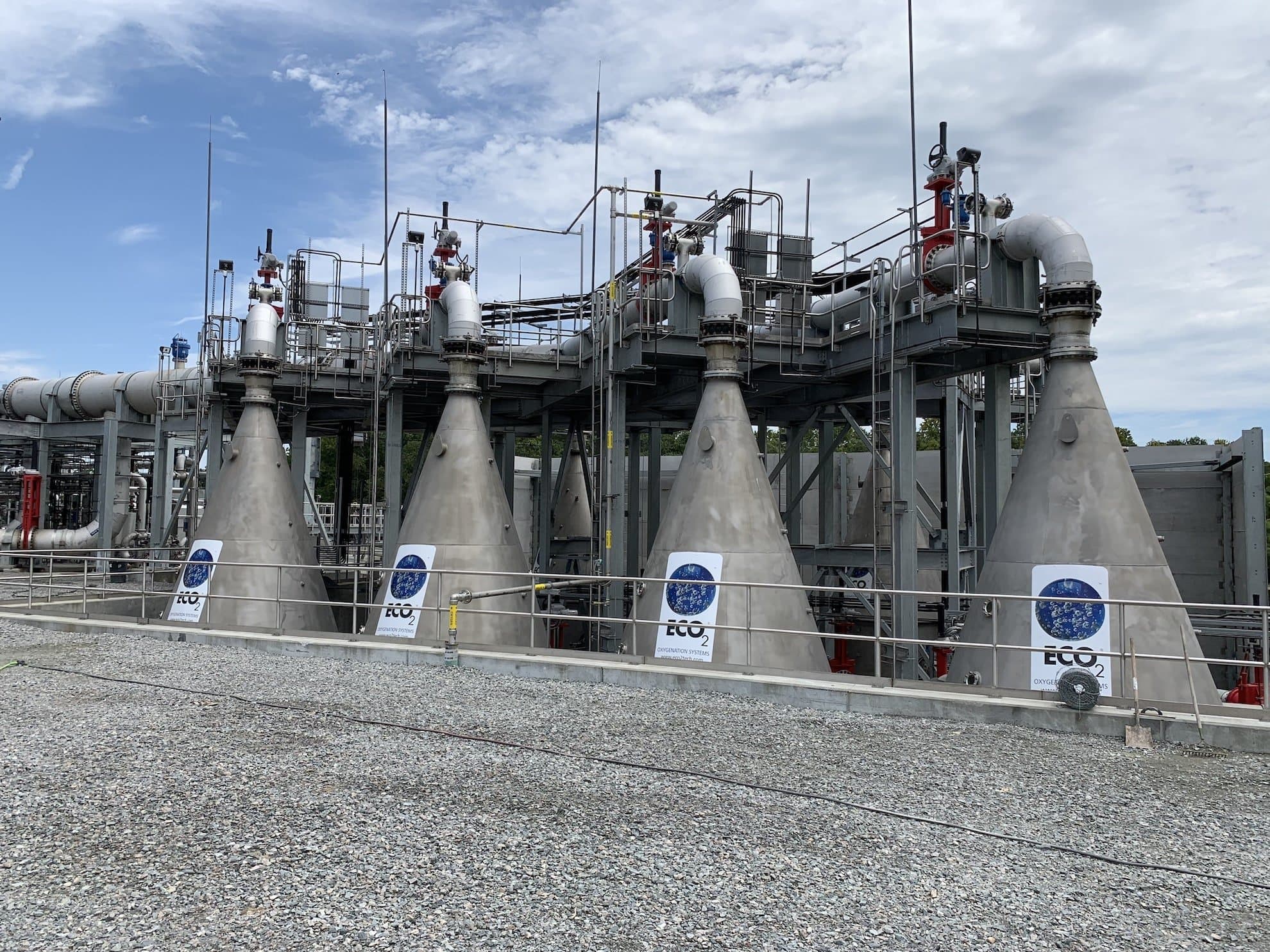
Savannah Harbor Expansion
In Full
More Key Figures
Four more, each with what it measures and its PDF page.
From the PDF
| Figure | What It Measures |
|---|---|
| 25 alternatives | Oxygenation alternatives evaluated in the 2004 study (PDF page 7 (opens in a new tab)) |
| 85 mg/L | Initial D.O. of the demonstration discharge, diluted to about 10 mg/L within about 15 ft (PDF page 8 (opens in a new tab)) |
| 12,000 lbs/day | Oxygen added at Hutchison Island (65 cfs through three cones) (PDF page 8 (opens in a new tab)) |
| 28,000 lbs/day | Oxygen added near Rincon (150 cfs through seven cones) (PDF page 9 (opens in a new tab)) |
How to Cite
One line to paste into a report.
Richard E. Speece, David Clidence, Larry Neal et al. O2 to the Rescue - Savannah Harbor Expansion. ASCE Civil Engineering, July 2016. Project engineer: Amec Foster Wheeler, CDM Smith, U.S. Army Corps of Engineers. Eco Oxygen Technologies Technical Library. https://eco2tech.com/technical-library/o2-to-the-rescue-savannah-harbor-expansion/
https://eco2tech.com/technical-library/o2-to-the-rescue-savannah-harbor-expansion/
The Next Step
Ask an ECO₂ Engineer
Questions about this published article, or about your own water? An application engineer answers, with the figures.