Nitrification and Total Nitrogen Removal in a Super-oxygenated Wetland
A paper on a Michigan treatment wetland supersaturated with oxygen from a Speece Cone®, and how much faster it removed ammonia than wetlands left to themselves.
Details
Summary
An Oxygenated Wetland Nitrifies Faster
A surface flow treatment wetland in Michigan pumps its own water through a Speece Cone and back in, supersaturated with oxygen. Mean ammonia nitrogen fell from 8.0 mg/L in to 0.6 mg/L out, nitrification ran over an order of magnitude faster than in passive wetlands, and the treatment area needed fell by at least 90% (pp. 1, 4).
Key Figures
15times
Nitrification rate compared with the median for passive surface flow wetlands Source: PDF page 1 (opens in a new tab)
90%
Reduction in treatment area needed for nitrification (at least) Source: PDF page 1 (opens in a new tab)
8.0mg/L
Mean inflow ammonia nitrogen (NH3-N) Source: PDF page 1 (opens in a new tab)
Questions
How can a surface flow wetland nitrify faster?
By Superoxygenation: a pump recirculates wetland water through a Speece Cone, and the water returns supersaturated with dissolved oxygen. In this study nitrification ran over an order of magnitude faster than in passive wetlands (pp. 2, 4).
Why not use diffused air in a surface flow wetland?
Rodents destroy plastic diffusers, plant growth heaves them up, and in planted zones 0.1 to 0.3 m deep diffused air transfers less than 5% of its oxygen (p. 2).
Does a Superoxygenated wetland keep nitrifying in winter?
It held until the water reached 0.5 °C under ice in late December, then slowly declined. Nitrifying bacteria added in late February restored it by March 23, 2017 (p. 3).
How much smaller can a Superoxygenated wetland be?
The authors regard the reduction in treatment area for nitrification as 90%, compared with a passive surface flow wetland (p. 4).
Does high dissolved oxygen stop denitrification in a wetland?
Not in this study. Denitrification rates were within published values despite saturated to supersaturated oxygen, peaking at 76 m/y in June 2017 and falling close to zero in winter (pp. 1, 6).
Why Superoxygenate a surface flow wetland?
Surface flow wetlands get oxygen only from the air, so they nitrify slowly and must be very large. Diffused air does not work in their shallow planted zones, while Superoxygenated water can deliver enough oxygen to nitrify at rates closer to aerated subsurface flow wetlands, without their media cost or clogging. (PDF page 2) (opens in a new tab)
How is the oxygen delivered?
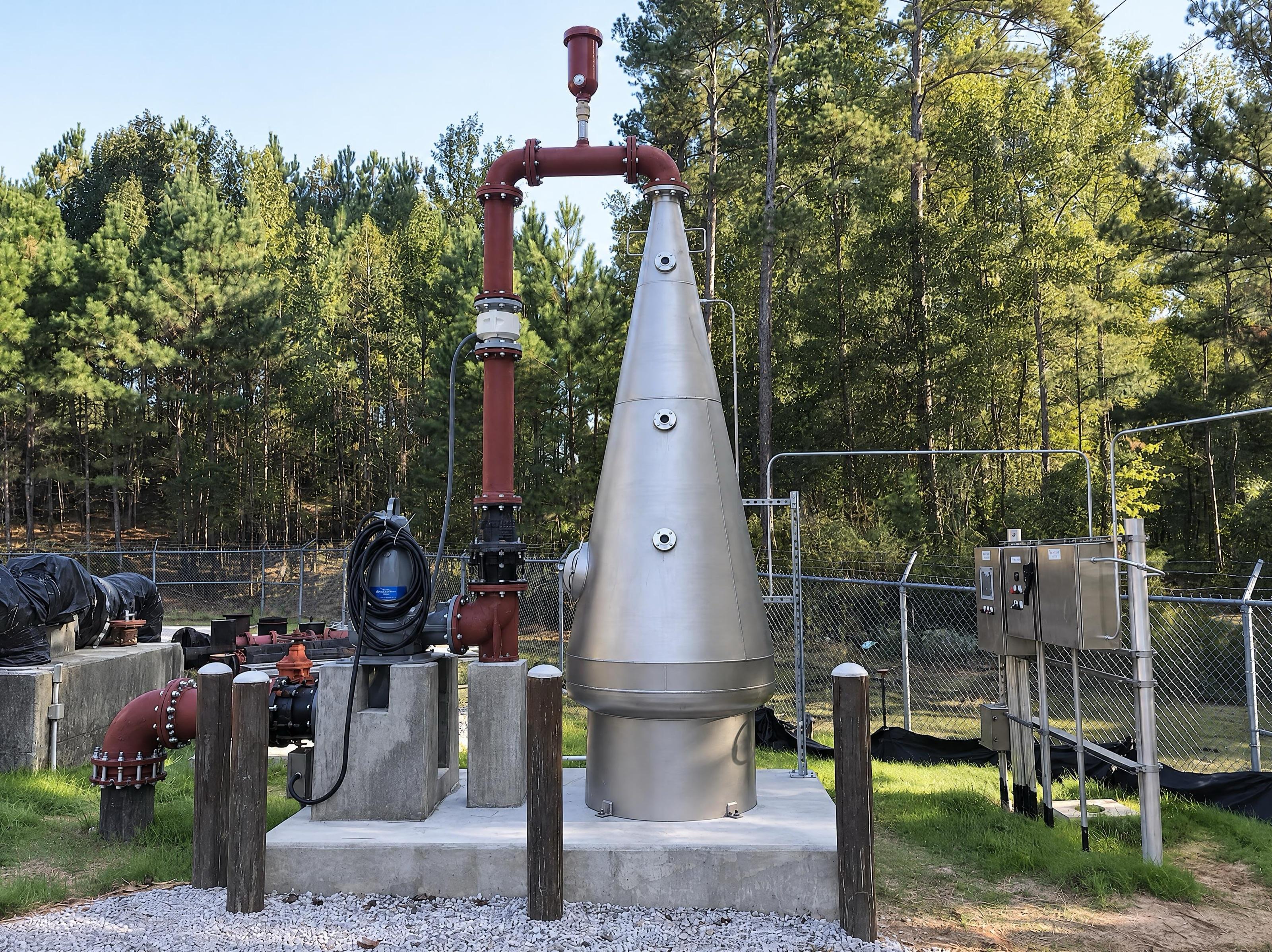
A 19 kW pump recirculates 4000 m3 per day from the outlet end through a Speece cone pressurized to 3 atm and supplied with liquid oxygen. The supersaturated water is discharged into three open water zones through eductor diffusers. (PDF page 2) (opens in a new tab)
Did nitrification survive the winter?
It held until the water reached 0.5 °C under ice in late December, then slowly fell to about half the summer rate. Adding nitrifying bacteria restored it within a month while the water was still below 3.3 °C. (PDF page 1) (opens in a new tab)
What does this mean for wetland design and cost?
The higher nitrification rate allows at least a 90% smaller treatment area for nitrification, at about one third the capital cost of aerated subsurface flow wetlands. (PDF page 1) (opens in a new tab)
In Full
More Key Figures
10 more, each with what it measures and its PDF page.
From the PDF
| Figure | What It Measures |
|---|---|
| 0.6 mg/L | Mean outflow ammonia nitrogen (NH3-N) (PDF page 1 (opens in a new tab)) |
| 23,000 m² | Wetland area (the final 21,000 m2 is oxygenated) (PDF page 1 (opens in a new tab)) |
| 863 m³/d | Mean flow through the wetland (PDF page 1 (opens in a new tab)) |
| 76 m/y | Peak monthly mean denitrification rate, June 2017 (PDF page 1 (opens in a new tab)) |
| 8.0 mg/L | Mean inflow ammonia nitrogen (PDF page 1 (opens in a new tab)) |
| 0.6 mg/L | Mean outflow ammonia nitrogen (PDF page 1 (opens in a new tab)) |
| 4000 m³/d | Water recirculated through the Speece Cone (PDF page 2 (opens in a new tab)) |
| 67 mg/L | Calculated dissolved oxygen leaving the cone, at 20 °C (PDF page 2 (opens in a new tab)) |
| 0.5 °C | Water temperature before nitrification began to decline (PDF page 3 (opens in a new tab)) |
| 76 m/y | Peak monthly denitrification rate, June 2017 (PDF page 1 (opens in a new tab)) |
The Full Write-Up
The problem, the work, the results and who did it.
Surface Flow Wetlands Are Cheap & Never Clog, but They Nitrify Slowly
In a surface flow wetland, oxygen reaches the water only from the air, and that limits nitrification, the step that turns ammonia into nitrate. The paper cites a median nitrification rate coefficient of 14.7 m/y for such wetlands. At that rate, a passive wetland treating 10,000 m³/d from 10 mg/L to 1 mg/L of ammonia nitrogen would need 770,000 m² (p. 2).
Aerated subsurface flow wetlands reach almost 3000 m/y with diffusers laid under granular media, but they need costly media and can clog. Surface flow wetlands cost about one third as much to build and never clog (p. 2).
Diffused air cannot fix them. Muskrats and nutria chew plastic diffusers in deep zones, and plant growth heaves up diffusers in the shallow planted zones, where diffused air transfers less than 5% of its oxygen. Sediment decay also uses oxygen faster than the air can supply it (p. 2).
Supersaturated Water from a Speece Cone, Recirculated Through the Wetland
The wetland is an unlined earthen basin in Michigan, designed to treat up to 1500 m³/d of groundwater contaminated with ammonia nitrogen to less than the 1.0 mg/L discharge standard. Its wetted area is 23,000 m², of which 21,000 m² is oxygenated (p. 2).
A 19 kW pump returns 4000 m³/d from the discharge end to just downstream of the inlet, about 5 times the mean forward flow. The water passes through a Speece Cone pressurized to 3 atm and fed from a liquid oxygen tank and vaporizers. The calculated dissolved oxygen leaving the cone is 67 mg/L at 20 °C. Eductor diffusers release it into three open water zones that cross the wetland from berm to berm (p. 2).
For winter, a heated station can dose a commercial liquid suspension of nitrifying bacteria into the recirculation line (p. 2). Planted in 2015, the wetland began operating on April 1, 2016 (p. 3).
Ammonia Removed from Start-Up, with One Fix in Late Winter
Nitrification began at once and reached the 1.0 mg/L goal within six weeks. Dissolved oxygen at the discharge stayed near or over saturation over oxygen feed rates of 40 to 140 L/min, and the peak nitrification demand of 60 kg/d was always met (p. 3). Outflow dissolved oxygen ran from 150% of saturation in summer to 300% in winter (p. 6).
Nitrification held until late December, when the water fell to 0.5 °C under ice. Then it slowly declined. Two 4 L batches of nitrifying bacteria added after February 23, 2017 brought outflow ammonia nitrogen back below 1.0 mg/L by March 23, 2017, with the water at 3.3 °C (p. 3).
After the ramp-up, monthly nitrification rates, counting results below the detection limit as reported, ranged from 25 m/y in February 2017 to 369 m/y in November 2016 (p. 3). Nitrification did not differ significantly between summer and winter, but the removal of dissolved inorganic nitrogen did: a median of 51 m/y from May to October against 9 m/y from November to April (p. 3). The peak monthly denitrification rate was 76 m/y in June 2017 (p. 1). The authors put the cut in treatment area at 90% (p. 4).
Engineers at Jacobs with the Dow Chemical Company
The authors are David Austin, Rafael Vazquez-Burney and Gary Dyke of Jacobs, and Timothy King of The Dow Chemical Company. The paper appeared in Science of the Total Environment, volume 652, available online in October 2018 (p. 1). The authors thank Dow for the chance to publish the results (p. 7). The paper names the Speece Cone but not its maker.
Why It Matters for a Wetland Designed to Remove Ammonia
If ammonia limits your wetland's design, this paper shows that oxygen, not area, can do the work. The authors conclude that the method suits any climate where emergent wetland plants grow, and both greenfield and retrofit projects (p. 7).
They also give design advice. Take the design temperature as 20 °C and plan to add nitrifying bacteria in cold water, ideally in early winter (p. 6). Allow for seasonal swings in denitrification, as in other wetlands. And mind the permit: a discharge limit of 5.0 mg/L of dissolved oxygen made the operators err on the side of too much oxygen (p. 6). How best to set oxygen supply and recirculation is still open (p. 7).
Written up from the published article. Every figure is as the published article prints it, with the PDF page it comes from; the authors' own words appear only in quotation marks.
How to Cite
One line to paste into a report.
David Austin, Rafael Vazquez-Burney, Gary Dyke and Timothy King. Nitrification and Total Nitrogen Removal in a Super-oxygenated Wetland. Science of the Total Environment, October 2018. https://doi.org/10.1016/j.scitotenv.2018.10.110 Eco Oxygen Technologies Technical Library. https://eco2tech.com/technical-library/nitrification-and-total-nitrogen-removal-in-a-super-oxygenated-wetland/
https://eco2tech.com/technical-library/nitrification-and-total-nitrogen-removal-in-a-super-oxygenated-wetland/
The Next Step
Ask an ECO₂ Engineer
Questions about this published article, or about your own water? An application engineer answers, with the figures.