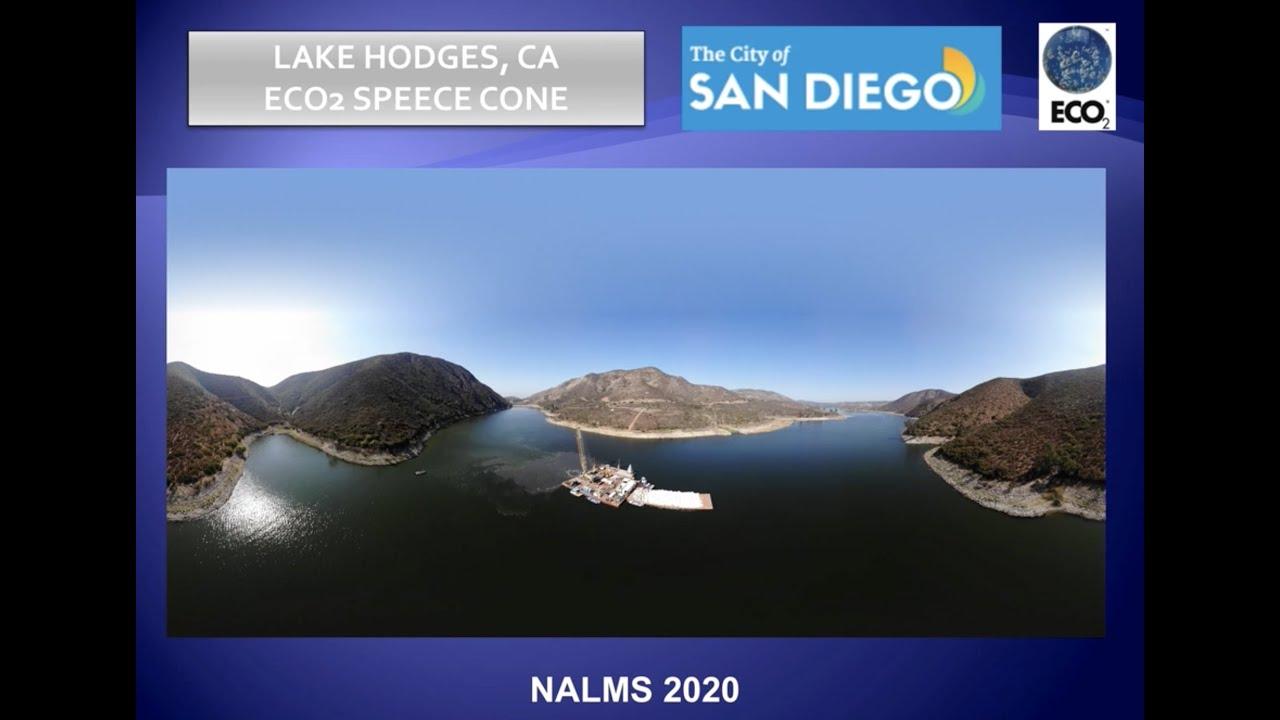
Lake Hodges Presentation Conference NALMS 2020
How the Lake Hodges Speece Cone® was designed, fed from shore and set on the reservoir floor, in a 2020 talk to the North American Lake Management Society.
Details
Summary
Designing the Lake Hodges Cone
At the 2020 conference of the North American Lake Management Society, David Clidence of ECO₂ walked through the City of San Diego's Lake Hodges oxygenation system (video description). A Speece Cone sits on the reservoir floor, fed by a submersible pump and liquid oxygen from shore, designed to dissolve 10,000 pounds of oxygen into the hypolimnion (8:46).
Key Figures
10,000pounds of oxygen
What the Lake Hodges cone was designed to dissolve into the hypolimnion (said at 8:46) Source: The video (opens in a new tab)
12ft
Diameter of the Lake Hodges Speece Cone (said at 8:42) Source: The video (opens in a new tab)
5years
How long before the project the planning study that chose oxygenation was done (about) Source: The video (opens in a new tab), 6:53
Questions
Why was the Lake Hodges Speece Cone placed on the bottom of the reservoir?
On the bottom the cone gets free hydrostatic pressure, so it delivers more dissolved oxygen without more pump horsepower. Cones can also sit on grade on the shoreline; the design team chose the floor (8:31).
How much oxygen was the Lake Hodges cone designed to dissolve?
David Clidence says it was designed to dissolve 10,000 pounds of oxygen into the hypolimnion (8:46).
How does the Lake Hodges intake protect fish?
The intake screen was sized to keep the water velocity across its face below half a foot per second, to prevent fish impingement (9:49).
Who designed the Lake Hodges oxygenation system?
Brown and Caldwell was the design engineer, with Bill Faisst and Marc Beutel, using sediment oxygen demand testing of Hodges (9:11).
Does the NALMS 2020 talk report results from Lake Hodges?
No. The system was not yet producing data at the time of the talk. It shows the sampling buoys installed to measure dissolved oxygen and temperature near the bottom and the surface (12:22).
How does a Speece Cone dissolve oxygen into reservoir water?
A submersible pump draws water from the hypolimnion through a screen and feeds it into the top of the cone, where oxygen gas enters as bubbles. The inlet jet pushes the rising bubbles down; the cone widens toward the bottom, so the water slows until the bubbles rise again. They circulate until they dissolve, and the oxygenated water leaves the bottom of the cone.
Why did the City of San Diego oxygenate Lake Hodges?
To improve water quality in Hodges and the connected Olivenhain Reservoir, which supply drinking water to the San Diego region, by addressing the nutrient loading that causes excessive algae blooms. Reducing mercury in fish was a benefit the city did not expect when it started.
The Project
Lake Hodges
In Full
More Key Figures
Two more, each with what it measures.
From the Video
| Figure | What It Measures |
|---|---|
| 10,000 pounds of oxygen | What the cone was designed to dissolve into the hypolimnion ("10,000 pounds of oxygen", said without a time unit) (The video (opens in a new tab), 8:46) |
| 12 ft | Diameter of the Speece Cone (The video (opens in a new tab), 8:42) |
The Full Write-Up
The problem, the work, the results and who did it.
Lake Hodges Had Water Quality Problems for a Long Time
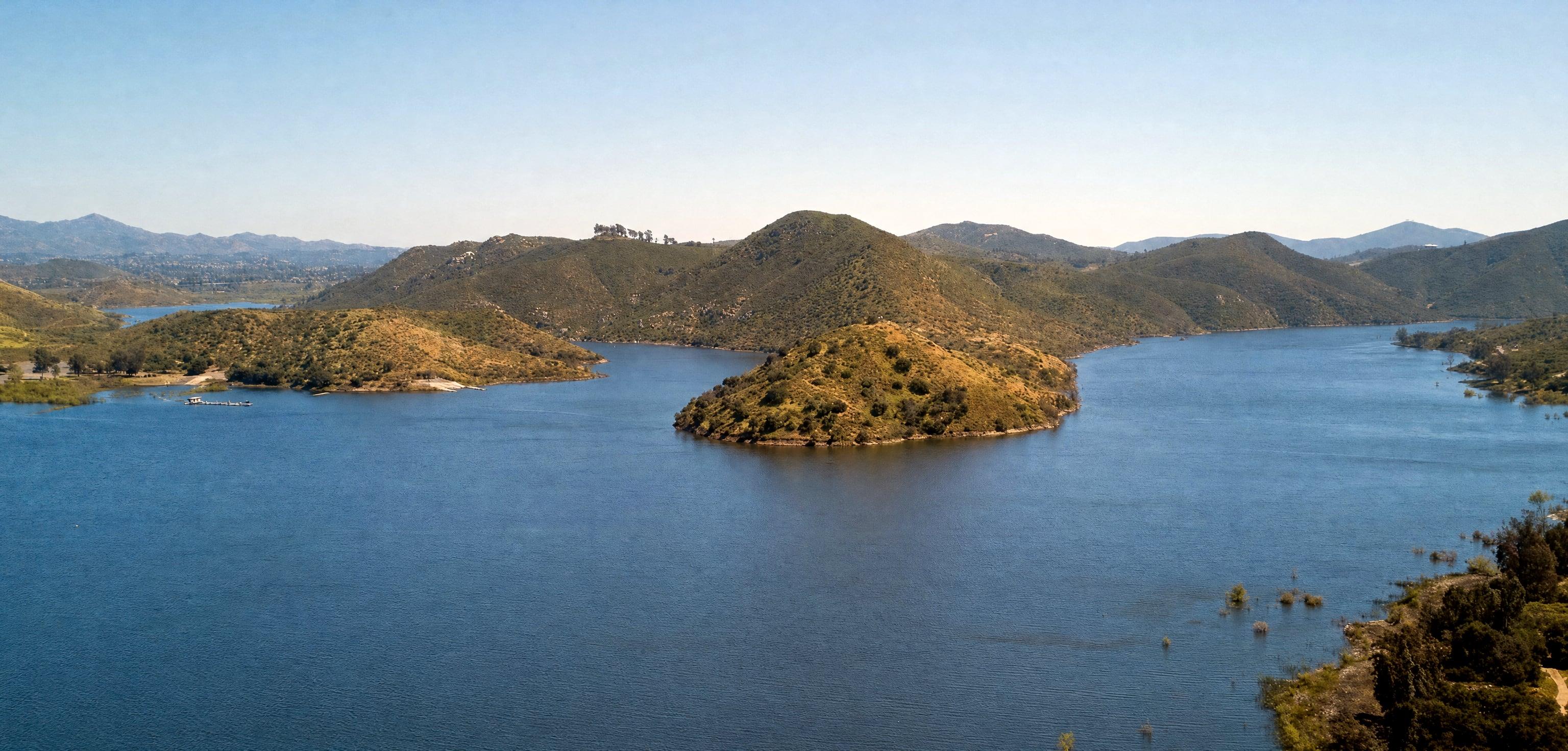
Lake Hodges is the City of San Diego's largest lake, and its water also feeds the city's drinking water treatment plant (video description). In the City's own video, played in the talk, Jeff Pasek of the City of San Diego says the reservoir has had water quality problems for a long time (7:15).
The cause he names is nutrient loading, which drives excessive algae blooms. The water matters well beyond the lake: Hodges and the connected Olivenhain Reservoir are primarily drinking water supply for the San Diego region. A planning study done about 5 years earlier identified oxygenation with a Speece Cone as the most cost-effective way to address those problems (6:53). The project was funded in part by a state grant and in part by the City.
A Cone on the Reservoir Floor, Fed from Shore
The system pulls water from the hypolimnion, the cold bottom layer, through an intake screen. A submersible side-stream pump sits inside a pump tube, so it can be raised and lowered for maintenance, and feeds the water into the top of the cone (4:23).
Oxygen gas enters the side of the cone as bubbles. The fast inlet jet pushes the rising bubbles down, and the cone widens toward the bottom, so the water slows until the bubbles rise again. They circle until they dissolve, and the oxygenated water leaves the bottom of the cone through a short diffuser into the reservoir (3:13).
The cone is bolted to a concrete pad on a base of stone. A liquid oxygen tank stands on shore, and an umbilical from shore carries both the oxygen line and the pump's power (4:51).
The design team chose the reservoir floor over a shoreline site. On the bottom the cone gets free hydrostatic pressure, so it puts out water with more dissolved oxygen without more pump horsepower (8:31).
Built from a Barge & Ready for Monitoring
The talk shows the build. The cone is lifted from its delivery truck onto a barge, beside bags of aggregate stone for the foundation on the reservoir bed, and a City video shows the cone being sunk into place (10:56).
The intake screen was sized so the water crosses its face at less than half a foot per second, to prevent fish impingement. The cone itself is 12 ft in diameter and was designed to dissolve 10,000 pounds of oxygen into the hypolimnion (8:46).
For performance testing, the system includes sampling buoys that measure dissolved oxygen, temperature and other parameters near the bottom and near the surface. At the time of the talk the system was not yet producing data, so the presentation reports none (12:45).
The City of San Diego, Brown and Caldwell and ECO₂
The City of San Diego operates Hodges Reservoir with the County Water Authority. Brown and Caldwell was the design engineer, with Bill Faisst and Marc Beutel, and sediment oxygen demand testing of Hodges went into the final design (9:11).
Paul Gantzer of Gantzer Water designed and provided the sampling buoys. David Clidence, president of ECO₂, gave the talk; Jeff Pasek speaks for the City in its video.
What the Talk Shows a Reservoir Owner
If nutrients feed algae in a drinking water reservoir, Lake Hodges shows one utility's route from a planning study and sediment oxygen demand testing to a working design. The choices are practical ones: a cone on the bottom to use the depth for pressure, a pump that lifts out for service, a screen sized for fish, and oxygen stored on shore.
The full transcript below follows each step, and the City's own video, Lake Hodges Oxygenation System, is in the library.
Written up from the video. Every figure is as the video's speakers give it or its YouTube description prints it, with the moment it comes from; the speakers' own words appear only in quotation marks.
Transcript
Every word of the video, set for reading.
Lake Hodges oxygenation project: NALMS 2020
A transcript of the video, edited from its YouTube captions for reading. Presented by David Clidence of ECO₂ at the North American Lake Management Society's 2020 conference; uploaded November 2020.
Introduction
David Clidence, ECO₂: Hello, my name is David Clidence, president of Eco Oxygen Technologies. Thank you, NALMS, for having me. I'm here to present on a project we did with the City of San Diego in Lake Hodges, California, involving the installation of a Speece Cone in the hypolimnion of Lake Hodges.
Very quick presentation outline. We'll speak on ECO₂, our company; get into the Speece Cone, how it's designed; Lake Hodges specific project design components; some results; and conclusion.
Company profile
Company profile. ECO₂, or Eco Oxygen Technologies, is headquartered in Indianapolis, Indiana, founded in the year 2000 to commercialize the Speece Cone that Dr. Richard Speece developed in the mid-'90s to add oxygen to lakes and rivers for water quality enhancement. We have now partnered with Dr. Speece, who sits on our board of directors and is active in the day-to-day business of the company, to enhance this technology and further this technology to both the water quality markets and the wastewater markets. The other gentleman there pictured is Dr. George Tchobanoglous, professor at UC Davis, who also helps advise us and sits on our board of directors.
ECO₂, or Eco Oxygen Technologies, is a US-based company in Indianapolis, Indiana. Most of our installations are in the United States, although we have a few in Canada and in China and Southeast Asia. Longest operating system is over 20 years. About 100 installations to date, and some pretty notable clients: Army Corps of Engineers, City of New York, Dallas, Hong Kong and others. This particular project, Lake Hodges, is in San Diego, California, and you can see there we have quite a few installations there in Southern California.
How the Speece Cone works
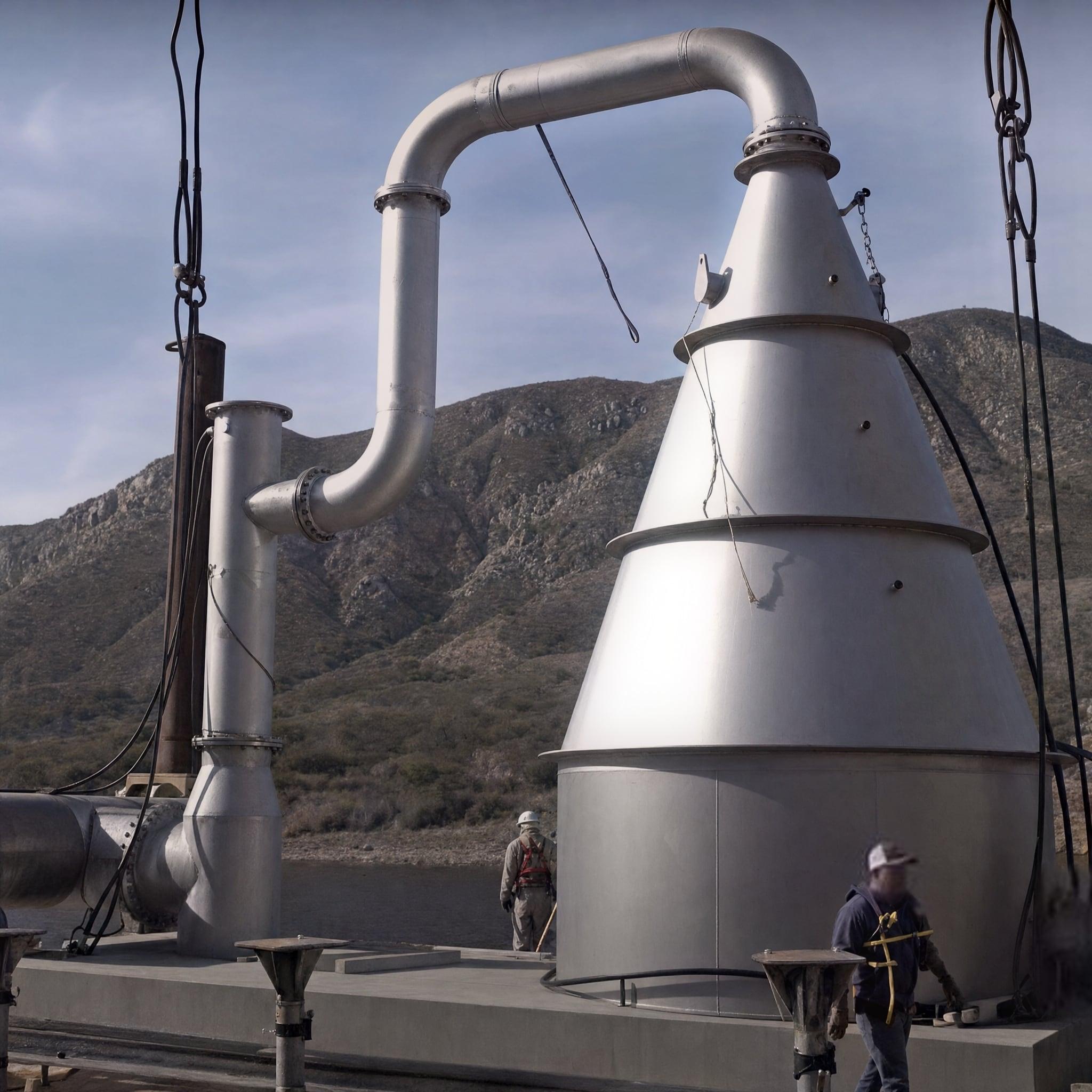
The subject of this presentation is centered around the Speece Cone, shown here. This installation was actually at a wastewater treatment plant, on a primary clarifier. You can see the intake piping connected to the top of the cone, the Speece Cone itself, and then the discharge piping connected from the bottom of the Speece Cone.
So, the quick technology overview of the Speece Cone. We are pulling water out of the hypolimnion, running it through a raw water screen, up through a side stream pump, which is a submersible pump, and that raw water then is fed to the top of the cone. Gaseous oxygen is piped into the side of the cone, and that oxygen gas comes in in bubble form. So once the bubble enters the cone, it has a buoyant velocity, or rise velocity, so that bubble starts rising towards the top of the cone, where the inlet water jet, which is high velocity, pushes those bubbles back down inside the cone. So the bubbles travel to the bottom of the cone, where it reaches the point. And the whole reason that the system is cone shaped is that at the bottom of the cone the cross-section of the cone is widened, where we're slowing down the water velocity to a point where the bubble rise velocity is higher than the water velocity at that point. So the bubbles then start to rise again, where they rise up to the inlet jet and are pushed back down into the cone. They're in the circular pattern until they completely dissolve. Once they're dissolved, then that oxygen in the water is discharged out the bottom of the cone, back down into the hypolimnion.
The system at Lake Hodges
So schematically, what the system looks like in Lake Hodges is the cone sits on the bottom of the reservoir. It sits on a concrete pad that's formed on a base of stone, to support the concrete pad and the cone. We have an intake screen and intake piping for the side stream pump. The side stream pump actually sits inside of a pump tube that can be easily raised and lowered for maintenance. That pump tube then is connected to the top of the Speece Cone, to feed the raw water into the top of the cone. We have an oxygen line that feeds the cone. There's a liquid oxygen tank that sits on grade, on shore, and there's what we call an umbilical cord that's running from shore that contains both the oxygen line and the pump feed power to the system. So then you have the Speece Cone itself, that's bolted to the concrete pad, and then you have a short diffuser to distribute that oxygenated water to the reservoir.
So here's what the system looks like in real life. You can see the system sitting on the concrete pad. This is on the barge before it is installed, but you have the intake screen there to your left, you have the pump and the pump tube that's connected to the cone with intake piping, you can see the Speece Cone itself, and then the diffuser port. The diffuser is not attached to the cone in this picture, but it'll be bolted to that flange on the discharge of the cone.
On the next slide I'm going to show you a YouTube video put on by the City of San Diego and Jeff Pasek, describing the background of the project, some of the particulars of the project, why they did the project, and some of the benefits. It's much better hearing from Jeff than it is for me. Hope you enjoy the video.
The City of San Diego's video
Jeff Pasek, City of San Diego: This is the Hodges oxygenation project. We're here at Hodges Reservoir, which is operated by the City of San Diego along with the County Water Authority. We are building a Speece Cone, and that's a fairly unique method for adding oxygen to a reservoir. There's only a few of them in the world. There's one in Northern California; there's another in a reservoir in Colorado. And this project derived from a planning study that was done about five years ago, which identified oxygenation using a Speece Cone as being the most cost-effective way of addressing the water quality problems in Hodges.
The oxygenation project is intended to put a lot of highly oxygenated water deep into the reservoir, at the bottom of the reservoir, to overcome water quality problems that have been here at Hodges for a long time. The project was funded in part by a state grant and also with money from the City of San Diego.
The benefits of the project are that it will improve water quality in Hodges and connected Olivenhain Reservoir, and those reservoirs are primarily for drinking water supply for the San Diego region. It will improve water quality by addressing nutrient loading that causes excessive algae blooms in the reservoir. An ancillary benefit, not anticipated when we got started on the project, is to address the accumulation of mercury in fish, which can be harmful to people and wildlife that eat the fish from the reservoir.
System design
David Clidence: So we're talking now about the system design. The Speece Cone was installed underwater. Sometimes they are installed on grade, on the shoreline. In this case the design team thought it was optimal to place the cone on the bottom of the reservoir. By doing that, you get free hydrostatic pressure on top of the cone, so you're able to increase the dissolved oxygen concentration coming out of the cone without increased horsepower. So there's many advantages to setting the cone on the bottom of the reservoir.
It's 12 ft diameter, 20 foot tall. It was designed to dissolve 10,000 pounds of oxygen into the hypolimnion. It's installed at 55 foot of depth. And an intake screen was designed so that no more than half a foot per second water velocity across the screens, to prevent fish impacting.
Brown and Caldwell was the design engineer on the project. Bill Faisst and Marc Beutel helped in this effort. You can see a picture of Marc, some of the other members that helped with the sediment oxygen demand testing of Hodges that was used in the ultimate design of the oxygenation system.
The components
Again, here's the schematic of the system. In the next few slides I'll go through specific pictures of each component of the system.
Here's a picture of the intake screen. Again, this intake screen was sized to limit the water velocity across the face of the screen to less than a half foot per second, to prevent fish impingement.
Here's the Flygt submersible pump. So there's a picture of the pump to your left, and then the pump tube to your right that the submersible pump sits down in.
Here's a picture of the liquid oxygen system and vaporizers, and then the PLC controls there to your right.
Installation
Here's a picture of the Speece Cone being lifted off the bed of the delivery truck and onto the deck of the barge.
So here you can see a picture of the barge. To the left there's the crane; you have the Speece Cone on the right-hand side. What's in front of you there, in those white bags, is actually the aggregate stone that they are going to use to build up the foundation on the bottom of the reservoir, that they would ultimately set the Speece Cone and the concrete pad on.
Here's another video from the City of San Diego, of the installation and sinking of the Speece Cone.
[The City's installation video plays with music and no speech.]
Performance testing
In terms of performance testing, the system included some sampling buoys designed and provided by Paul Gantzer of Gantzer Water. These buoys were incorporated to measure dissolved oxygen, temperature and some other parameters, near the bottom in the hypolimnion as well as near the surface.
Unfortunately, the project has not been up and running [inaudible] data by this presentation. Unfortunately, it's not available. So here's [inaudible].
Close
That sums up my presentation. Thank you for listening. If you have any questions, I'll be available during the speaker panel, but below is my email and website if you want to reach out to me directly. Thank you.
How to Cite
One line to paste into a report.
Lake Hodges Presentation Conference NALMS 2020. ECO₂, November 2020. Project engineer: Brown and Caldwell. Eco Oxygen Technologies Technical Library. https://eco2tech.com/technical-library/lake-hodges-presentation-conference-nalms-2020/
https://eco2tech.com/technical-library/lake-hodges-presentation-conference-nalms-2020/
The Next Step
Ask an ECO₂ Engineer
Questions about this video, or about your own water? An application engineer answers, with the figures.