St. Joseph News-Press Now Opinion - City Clears the Air on Parkway A
A St. Joseph News-Press editorial on the city's long fight with sewer odor on Parkway A, written about a month after the city's oxygen system came online.
Details
Summary
Fewer Odor Days on Parkway A
Parkway A in St. Joseph, Missouri had a long-running sewer smell. The City Council authorized more than $500,000 for a Superoxygenation system that injects oxygen into the wastewater to slow it going septic. The local paper's editorial reports fewer odor days since it went online, while the city avoids calling the problem solved (p. 3).
Key Figures
$500,000USD
Council authorization for the Superoxygenation system (more than) Source: PDF page 3 (opens in a new tab)
Questions
Why do combined sewers smell?
On Parkway A, the editorial blames flat, low ground: waste in the combined sewer moves slowly and gas vents. The city says some venting is normal in a combined system, but the severity there was unusual (p. 3).
What did St. Joseph spend on the Parkway A odor system?
The City Council authorized more than $500,000 toward the Superoxygenation system (p. 3).
Why did St. Joseph not separate its sewers?
A separated sewer system would have solved the odor, but the projected cost was not feasible (p. 3).
Is oxygen cheaper than odor control chemicals?
St. Joseph's director of public works said that in the long run the system might be cheaper than chemicals. The city had found chemicals expensive for a semi-permanent fix (p. 3).
Did the oxygen system solve the Parkway A odor?
The city avoids saying so. Its goal was fewer and less severe odor events, and drivers and the local school principal report fewer odor days since the system went online (pp. 2, 3).
What caused the odor on Parkway A?
The combined sewer: on the flat, low ground near the parkway, waste moves slowly and gas vents, which was unusually severe there. (PDF page 3) (opens in a new tab)
What did the city do?
The City Council authorized more than $500,000 for a Superoxygenation system that injects oxygen into the wastewater to slow it going septic. (PDF page 3) (opens in a new tab)
Has it worked?
Since it came online in August, drivers and the Mark Twain Elementary principal report fewer odor days, though the city avoids calling the problem solved. (PDF page 3) (opens in a new tab)
The Project
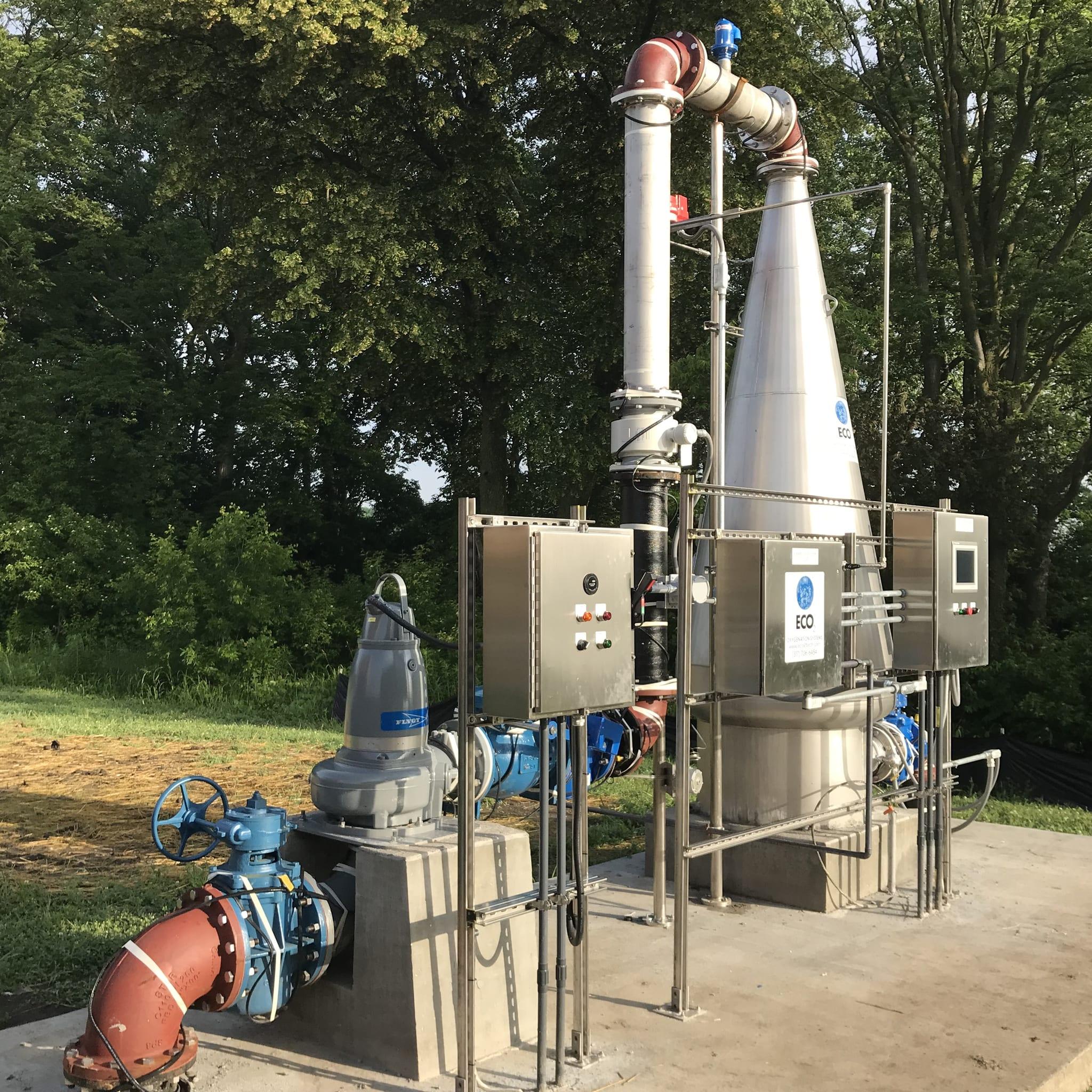
Parkway-A Force Main
In Full
More Key Figures
One more, each with what it measures and its PDF page.
From the PDF
| Figure | What It Measures |
|---|---|
| More than $500,000 | Authorized by the City Council toward the Superoxygenation system (PDF page 3 (opens in a new tab)) |
The Full Write-Up
The problem, the work, the results and who did it.
A Scenic Parkway with a Sewer Smell
Parkway A is a picturesque stretch of road in St. Joseph, Missouri. Residents had long complained of a periodic stench along it, between 28th Street to the west and Mark Twain Elementary School to the east (pp. 2, 3). The editorial describes the kind of odor that makes a driver hope for a green light, and a lower quality of life for the people who live there (p. 3).
The cause, it explains, is the combined sewer, which carries rainwater and waste in the same pipe. The ground near Parkway A is flat and low, so waste moves slowly and gas vents. The city's director of public works and transportation said some venting is normal in a combined system, but the severity on Parkway A was unusual (p. 3).
The editorial does not go into the chemistry, but going septic has a well-known meaning. Bacteria in slow sewage use up its dissolved oxygen, then turn to sulfate and make hydrogen sulfide, the gas that smells of rotten eggs.
Chemicals Cost Too Much & Separation More, so the City Chose Oxygen
The city had tried odor-neutralizing chemicals. They were expensive for what residents considered a semi-permanent fix. Separating the combined sewer would solve the problem, but its projected cost was out of reach (p. 3).
The City Council then authorized more than $500,000 toward a Superoxygenation system designed to control the odor (p. 3). The system injects oxygen into the wastewater, which slows the process of the sewage going septic. Bacteria that have dissolved oxygen use it first, so the sulfide behind the smell does not form while the oxygen lasts.
The director also expects a saving: in the long run, he said, the new system might be cheaper than using chemicals to control odor (p. 3).
Fewer Odor Days, & a City Careful Not to Claim Victory
Since the system went online, people who drive through the area have noticed fewer days with foul odor (p. 3). Mindi Richardson, principal of Mark Twain Elementary School, agreed that bad odor events seem less frequent, and said she had basically not noticed any odor issue lately (p. 3).
Andy Clements, the city's director of public works and transportation, chose his words carefully. He wrote that staff had never suggested the problem would be solved, and that the goal was to reduce the frequency and severity of the issues along Parkway A (p. 2). He did say the city was getting good benefit so far in the season (p. 3).
The editorial gives no measurements: no H₂S readings, oxygen dose or running cost. Its verdict is that the city seems to be making progress on a long-running nuisance (p. 3).
The City's Public Works Team, as the St. Joseph News-Press Saw It
The editorial ran in the St. Joseph News-Press under the heading Our Opinion (p. 1). It quotes Andy Clements, the city's director of public works and transportation, and Mindi Richardson, principal of Mark Twain Elementary School, and credits the City Council with the funding (pp. 2, 3).
It names neither the supplier nor the engineer. The system is on ECO₂'s project list as the Parkway-A Force Main, and ECO₂'s St. Joseph case study, a separate entry in this library, gives the engineering detail.
What It Means for a City with an Odor It Cannot Rebuild Away
St. Joseph's choices are common ones. Chemicals treat the odor but cost money every year. Rebuilding the sewer removes the cause but may cost more than a city can raise. Adding oxygen to the wastewater sits between the two: it targets the septic conditions that make the smell, without replacing the pipe (p. 3).
The editorial is also a reminder of how results look to the public. Residents and a school principal judged the project by odor days, not readings, and the city set its goal as fewer and milder odor events, not none (pp. 2, 3). Setting that expectation early is worth copying.
Written up from the published article. Every figure is as the published article prints it, with the PDF page it comes from; the authors' own words appear only in quotation marks.
How to Cite
One line to paste into a report.
St. Joseph News Press Now. St. Joseph News-Press Now Opinion - City Clears the Air on Parkway A. St. Joseph News Press Now, September 2019. Project engineer: Burns & McDonnell. Eco Oxygen Technologies Technical Library. https://eco2tech.com/technical-library/st-joseph-news-press-now-opinion-city-clears-the-air-on-parkway-a/
https://eco2tech.com/technical-library/st-joseph-news-press-now-opinion-city-clears-the-air-on-parkway-a/
The Next Step
Ask an ECO₂ Engineer
Questions about this published article, or about your own water? An application engineer answers, with the figures.