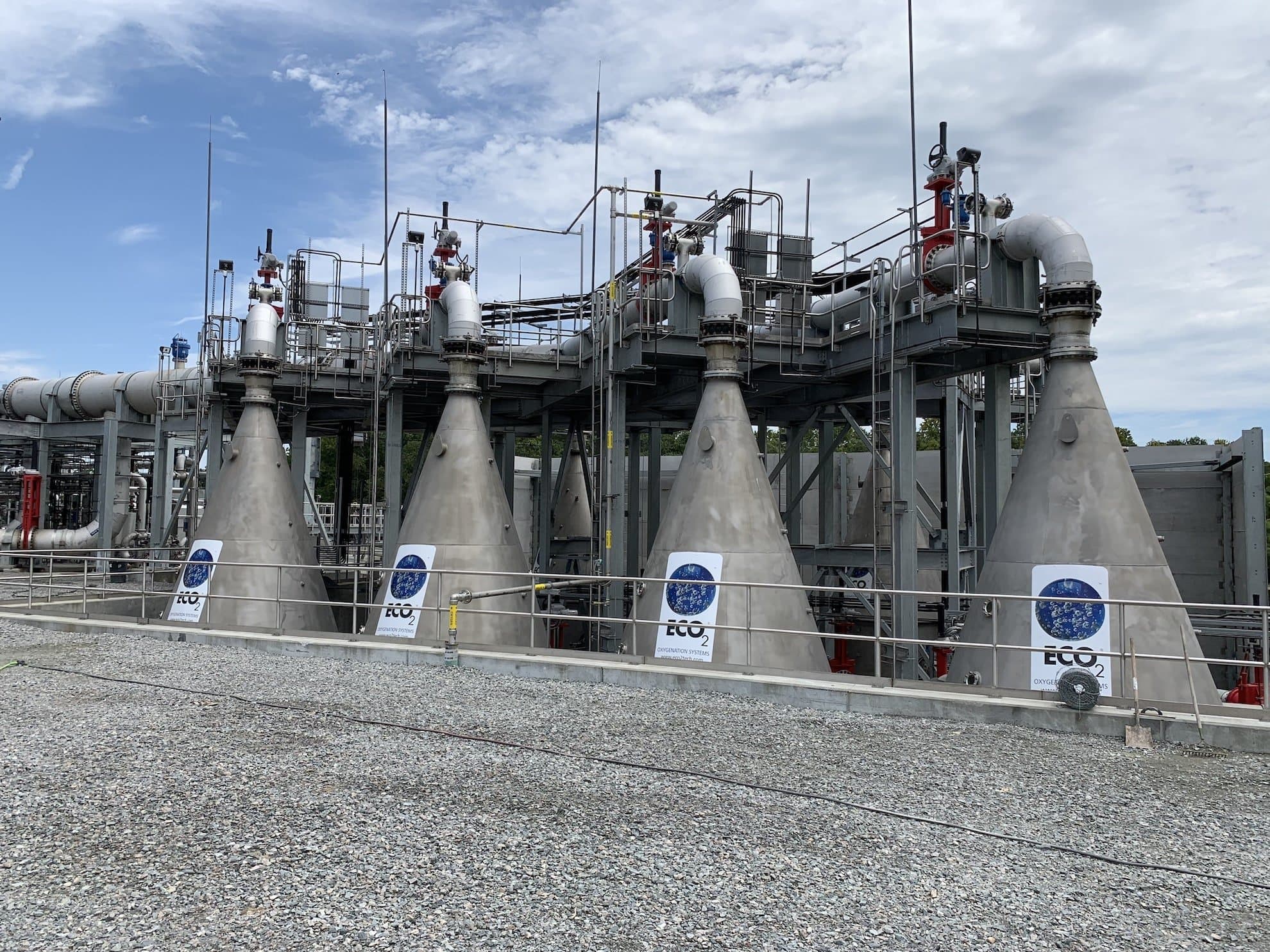
Gowanus Canal in Brooklyn, NY Receives Superoxygenation System for Water Quality Remediation Project
ECO₂'s case study of the Gowanus Canal in Brooklyn, where a Superoxygenation system raised dissolved oxygen in the canal's water during its remediation.
Details
Summary
While New York City shut down the Gowanus Canal's flushing tunnel for 26 months of sewer overflow construction, it needed to keep enough dissolved oxygen in the canal to support aquatic life. Commissioned in mid-July 2010, it quickly raised D.O. to 12 mg/L and easily held 8 mg/L, so construction stayed on schedule.
Key Figures
4mg/L
Minimum dissolved oxygen the design maintains along the canal Source: PDF page 1 (opens in a new tab)
7,500ft
Canal length covered by the design Source: PDF page 1 (opens in a new tab)
26months
Construction period with the flushing tunnel shut down Source: PDF page 1 (opens in a new tab)
Questions
Why did the Gowanus Canal need supplemental oxygen?
NYC DEP had to shut down the canal's flushing tunnel for 26 months to build a new pump station that controls combined sewer overflows. Without flushing from Upper New York Bay, dissolved oxygen would quickly deplete, and the canal still had to support existing aquatic life. (PDF page 1) (opens in a new tab)
Why was the Speece Cone® chosen over other aeration methods?
Dvirka & Bartilucci reviewed interim flushing, surface aeration, surface aspiration, venturi aspiration, diffused aeration and side stream oxygenation. Side stream oxygenation with the Speece Cone was chosen for 90 to 95% oxygen transfer regardless of water level, no clogging or fouling, low O&M costs, no odor stripping, flexible D.O. control and no interference with canal use. (PDF page 2) (opens in a new tab)
What happened after startup?
The system was commissioned in mid-July 2010 and quickly raised D.O. to 12 mg/L. Because it could easily hold 8 mg/L, the flushing tunnel was shut down and construction went ahead on schedule. (PDF page 2) (opens in a new tab)
The Project
Gowanus Canal Remediation
In Full
More Key Figures
Four more, each with what it measures and its PDF page.
From the PDF
| Figure | What It Measures |
|---|---|
| 2,500 ft | Length of the diffuser pipeline (PDF page 2 (opens in a new tab)) |
| 90 to 95% | Oxygen transfer rate, regardless of canal water level (PDF page 2 (opens in a new tab)) |
| 12 mg/L | Dissolved oxygen reached soon after commissioning (PDF page 2 (opens in a new tab)) |
| 8 mg/L | Dissolved oxygen the system easily maintained in the canal (PDF page 2 (opens in a new tab)) |
Full Text as Published
The text as its authors wrote it.
Gowanus Canal, Brooklyn, New York: D.O. Supplementation of Canal
Design Performance: Maintain 4 mg/l minimum D.O. throughout 7500 ft canal length.
Reference: Roger Owens, Dvirka & Bartilucci Consulting Engineers, Woodbury, NY.
Project Background
The Gowanus Canal originally served as a navigable waterway prior to the development of efficient railroads and truck routes. Built in the 1860s, the canal served industries such as tanneries, cement works, paint, ink and soap facilities. As a result of years of discharges, storm water runoff, sewer outflows and industrial pollutants, the Gowanus Canal has become one of the nation's most extensively contaminated bodies of water. Contaminants include PCBs, coal tar wastes, heavy metals and volatile organics. In 2010, the Gowanus Canal was added to the EPA's Superfund National Priorities list for further investigation.
In 1911, a flushing tunnel was built to allow for artificial circulation of the water in the canal. This flushing tunnel had to be updated and a new pump station was needed to control Combined Sewer Overflows (CSOs) at the head end of the canal. During the 26 months construction period, the Gowanus Canal had to be able to support existing aquatic life. Without the flushing action from the Upper New York Bay, dissolved oxygen (D.O.) levels would quickly deplete. The New York City Department of Environmental Protection (NYC DEP) chose the ECO₂ SuperOxygenation technology out of 5 investigated aeration technologies to maintain D.O. levels in Gowanus Canal.
Design Considerations and Selection of ECO₂ SuperOxygenation
The Gowanus Canal is 7,500 feet in length and 100 feet in width with a depth ranging from 4 to 16 feet at mean low water. The Gowanus Canal is an estuarine waterbody with a semi-diurnal tidal cycle varying between 5 and 7 feet. During a period between the mid-1960s and 1999 when the flushing tunnel was inoperable the median D.O. level was 2 mg/L resulting in discoloration, odors, and adverse impacts to aquatic life. After the tunnel returned to operation in 1999, the median D.O. level was 8 mg/L, considerably improving water quality.
The NYC DEP developed a facility plan to reduce the level of CSO occurring into the Gowanus Canal requiring the shut down of the flushing tunnel for a period of 26 months while construction occurred. Dvirka & Bartilucci Consulting Engineers reviewed a number of alternatives to maintain D.O. levels, including an interim flushing system, surface aeration, surface aspiration, venturi aspiration, diffused aeration, and side stream oxygenation. Side stream oxygenation, using the Speece Cone developed by ECO₂, was selected based upon several important considerations:
- Efficient oxygen transfer rates (90-95%), regardless of canal water level
- Non-clogging / Non-fouling
- Low operations & maintenance costs
- No stripping of odors due to gas bubble action
- Versatile control of D.O. levels
- No interference with canal use
- Oxygen transfer performed in a centralized, controlled unit
The ECO₂ SuperOxygenation System is sized for a maximum oxygen feed rate of 3,250 lb/day and is designed to run continuously during the 26 month construction period. The oxygenated water is distributed along a 2,500 ft diffuser pipeline to ensure adequate lateral mixing of the water without undue disturbance of bottom sediments.
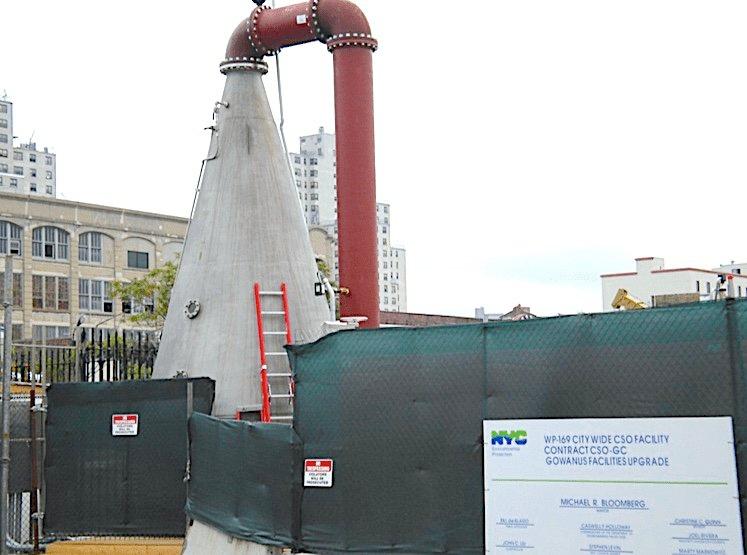
Installation of ECO₂'s Speece Cone at Gowanus Canal.
Results
The system was commissioned in mid-July 2010 and quickly elevated D.O. levels to 12 mg/L. As the system could easily maintain 8 mg/L in the canal, the project team and contractor were able to shut down the flushing tunnel and move forward with the construction project according to schedule.
Exposed Diffuser Pipe at Low Tide.
Dissolved Oxygen Supplementation of Lakes, Rivers, Reservoirs
The ECO₂ SuperOxygenation technology is an innovative, economical and environmentally friendly solution for Dissolved Oxygen (D.O.) Supplementation in lakes, rivers and reservoirs. Applications include D.O. discharge compliance, supplemental oxygenation below powerhouse dams, and injection into the hypolimnion of reservoirs to improve fish habitats and reduce algae blooms. The proprietary ECO₂ technology has been proven at locations including the Marston Reservoir in Colorado, the Upper Oso Reservoir in California, and the Savannah Harbor ReOx Demonstration Project.
How to Cite
One line to paste into a report.
Gowanus Canal in Brooklyn, NY Receives Superoxygenation System for Water Quality Remediation Project. ECO₂. Project engineer: Dvirka & Bartilucci Consulting Engineers. Eco Oxygen Technologies Technical Library. https://eco2tech.com/technical-library/gowanus-canal-in-brooklyn-ny-recieves-superoxygenation-system-for-water-quality-remediation-project/
https://eco2tech.com/technical-library/gowanus-canal-in-brooklyn-ny-recieves-superoxygenation-system-for-water-quality-remediation-project/
The Next Step
Ask an ECO₂ Engineer
Questions about this case study, or about your own water? An application engineer answers, with the figures.