Flygt Submersible Pump in Denver, CO for Hypolimnetic Oxygenation of Marston Reservoir
How the one moving part of Denver Water's Marston Reservoir oxygenation system, a Flygt submersible pump, feeds the Speece Cone® on the reservoir floor.
Details
Summary
One 35 HP Pump Drives Marston's Cone
This sponsored case study looks at Denver Water's Marston Reservoir from the pump's side. A 35 HP Flygt submersible pump, the only moving part in the system, feeds a Speece Cone on the reservoir floor at 3,200 GPM. At full output, the liquid oxygen cost $92 a day (pp. 2, 3).
Key Figures
250MGD
Capacity of Denver Water's Marston Water Treatment Plant Source: PDF page 2 (opens in a new tab)
621acres
Area of Marston Reservoir Source: PDF page 2 (opens in a new tab)
66feet
Depth of the reservoir where the Speece Cone sits Source: PDF page 2 (opens in a new tab)
Questions
What pump does the Marston Reservoir Speece Cone use?
A 35 HP Flygt submersible pump in a stainless steel pump column, delivering 3,200 GPM at a head of 23 feet. It is the only moving part of the system (p. 2).
How much does liquid oxygen cost to run a reservoir oxygenation system?
At Marston Reservoir the delivered liquid oxygen cost $92 a day at full output and $69 a day at 75 percent output (p. 3).
Why use pure oxygen instead of compressed air in a reservoir?
Air is about 21 percent oxygen, so a compressor must move nearly five times the volume to deliver the same oxygen, and its relatively low efficiency raises life cycle operations and maintenance costs (p. 2).
Does oxygenating the bottom of a reservoir destratify it?
Not at Marston. The water is released 6 feet above the sediment, which keeps turbulence low and the reservoir stratified, and the bottom water stays cool (p. 3).
When does the Marston Reservoir oxygenation system run?
It starts in June, before the reservoir stratifies, and pumps oxygenated water into the 20 to 30 foot thick hypolimnion (p. 2).
What water quality problem did Denver Water face at Marston?
Seasonal stratification and turnover depleted oxygen in the reservoir's bottom layer, causing taste, odor and elevated manganese in raw water drawn from a single outlet 43 feet below the surface. (PDF page 2) (opens in a new tab)
How is oxygen delivered at Marston Reservoir?
An ECO₂ Speece Cone on the bottom of the 66-foot-deep reservoir pumps oxygenated water into the 20 to 30 foot thick hypolimnion, starting in June before stratification. A 35 HP Flygt submersible pump is the only moving part. (PDF page 2) (opens in a new tab)
Why use pure oxygen instead of compressed air?
Air is about 21 percent oxygen, so a conventional compressor must move nearly five times the volume to deliver the same oxygen, which raises life cycle operating costs. (PDF page 2) (opens in a new tab)
Does the system mix the reservoir?
No. Water is discharged 6 feet above the sediment, which keeps the reservoir stratified, suppresses nutrient releases and keeps the hypolimnion cool while raising oxygen right above the sediment. (PDF page 3) (opens in a new tab)
The Project
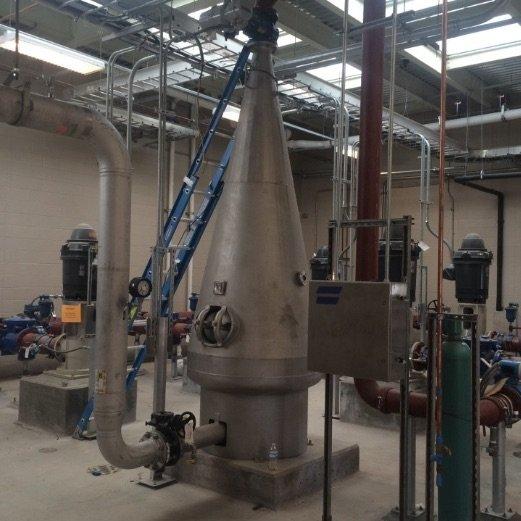
Marston Reservoir
In Full
More Key Figures
12 more, each with what it measures and its PDF page.
From the PDF
| Figure | What It Measures |
|---|---|
| 3,200 gpm | Flow of the 35 HP Flygt pump at 23 feet of head (PDF page 2 (opens in a new tab)) |
| 92 USD/day | Delivered liquid oxygen cost at 100 percent output (PDF page 3 (opens in a new tab)) |
| 1,500 lbs/day | Oxygen fed after four weeks, at 75 percent output (PDF page 3 (opens in a new tab)) |
| 69 USD/day | Liquid oxygen cost at 75 percent output (PDF page 3 (opens in a new tab)) |
| 10 mg/L | Dissolved oxygen in the hypolimnion on July 1 (PDF page 3 (opens in a new tab)) |
| 2 mg/L | Normal early July dissolved oxygen in the hypolimnion before oxygenation (PDF page 3 (opens in a new tab)) |
| 35 hp | Submersible pump, the only moving part of the system (PDF page 2 (opens in a new tab)) |
| 3,200 gpm | Pump flow, at a head of 23 feet (PDF page 2 (opens in a new tab)) |
| $92 a day | Delivered liquid oxygen cost at 100 percent output (PDF page 3 (opens in a new tab)) |
| $69 a day | Liquid oxygen cost at 75 percent output (PDF page 3 (opens in a new tab)) |
| 10 mg/L | Hypolimnion dissolved oxygen on July 1, against a normal 2 mg/L in early July (PDF page 3 (opens in a new tab)) |
| 6 ft | Height above the sediment bed where the oxygenated water is released (PDF page 3 (opens in a new tab)) |
The Full Write-Up
The problem, the work, the results and who did it.
Autumn Taste, Odor & Manganese from a Single Outlet
Raw water drawn from deep reservoirs can pick up taste, odor and manganese, especially in autumn. Seasonal stratification and turnover let decaying plant and organic residue reach the bottom layer, the hypolimnion, and use up what little oxygen it has (p. 2).
At Denver Water the problem was worst at the 250 million gallon per day Marston Water Treatment Plant. The plant draws its raw water from a single outlet 43 feet below the surface of the 621-acre Marston Reservoir, so it cannot switch to a better depth when the deep water turns (p. 2).
Denver Water wanted a cost-effective and environmentally sensitive way to end the recurring seasonal changes and the customer complaints about water quality that followed them (p. 2).
A Cone on the Reservoir Floor, & One Pump to Drive It
Denver Water chose hypolimnetic oxygenation with a Speece Cone, a submerged downflow contact oxygenation system. It is an alternative to chemicals, costly filtration, or complicated and environmentally risky bypass schemes. Beginning in June, before the reservoir stratifies, the cone sits at the bottom of the 66-foot-deep reservoir and pumps oxygenated water into the 20 to 30 foot thick hypolimnion (p. 2).
Nothing in the system moves except the pump (p. 2). In plain terms, the pump takes water from the bottom of the reservoir and drives it down through the cone, where pure oxygen dissolves into it, and the oxygen-rich water goes back out near the bottom.
The pump sits in a stainless steel pump column on one side of the 8-foot-diameter, 18-foot-high system. It is a heavy duty 35 HP Flygt submersible pump, and it delivers 3,200 GPM at a head of 23 feet (p. 2). Head is the pressure a pump adds, stated as a height of water.
Bottom Oxygen Back to 10 mg/L for $92 a Day of Oxygen
The system began at 100 percent output, at a delivered cost of $92 a day in liquid oxygen. That reversed the dissolved oxygen depletion and raised the bottom of the reservoir to its pre-stratification level of 10 mg/L (p. 3).
After four weeks, the feed was cut to 75 percent output and the cost to $69 a day. Dissolved oxygen stayed high: 10 mg/L in the hypolimnion on July 1, where early July normally brought 2 mg/L (p. 3).
The oxygenated water is released 6 feet above the sediment bed. That keeps turbulence low, suppresses nutrient release and keeps the reservoir stratified, with high dissolved oxygen right above the sediment. Because the lake is not destratified, algae from the surface are not mixed down and the bottom water stays cool (p. 3).
Denver Water's Project, Told by the Pump's Maker
Denver Water owns the reservoir and the plant, and Kelly DiNatale, PE, led the project. The cone is an ECO₂ Speece Cone (p. 2).
The article is a sponsored case study posted by Water & Wastes Digest on September 1, 2020, on Flygt's storefront page. Its editor's note says the publisher is not liable for the accuracy of the claims and that the views are not its editorial teams' (pp. 1, 4). The WaterWorld article on Marston, linked below, tells the full story, including the site conditions and the trial of feed rates.
Pure Oxygen Keeps the Machinery Small
For anyone weighing oxygen against air, DiNatale's point is about volume. Air from a conventional compressor is about 21 percent oxygen, so nearly five times as much air must be pumped to deliver the same oxygen. The compressor's relatively low efficiency then weighs on life cycle operations and maintenance costs. With pure oxygen dissolved in the cone, the moving machinery at Marston is one 35 horsepower pump (p. 2).
The running cost is easy to read, because the oxygen is bought by the day, and the feed can be trimmed: at 75 percent it still held the bottom water at 10 mg/L in early July (p. 3). To judge your own reservoir, start with a late summer dissolved oxygen profile and the depth of your outlet.
Written up from the published article. Every figure is as the published article prints it, with the PDF page it comes from; the authors' own words appear only in quotation marks.
How to Cite
One line to paste into a report.
Flygt. Flygt Submersible Pump in Denver, CO for Hypolimnetic Oxygenation of Marston Reservoir. Water & Wastes Digest, September 2020. Project engineer: CDM. Eco Oxygen Technologies Technical Library. https://eco2tech.com/technical-library/flygt-submersible-pump-in-denver-co-for-hypolimnetic-oxygenation-of-marston-reservoir/
https://eco2tech.com/technical-library/flygt-submersible-pump-in-denver-co-for-hypolimnetic-oxygenation-of-marston-reservoir/
The Next Step
Ask an ECO₂ Engineer
Questions about this published article, or about your own water? An application engineer answers, with the figures.