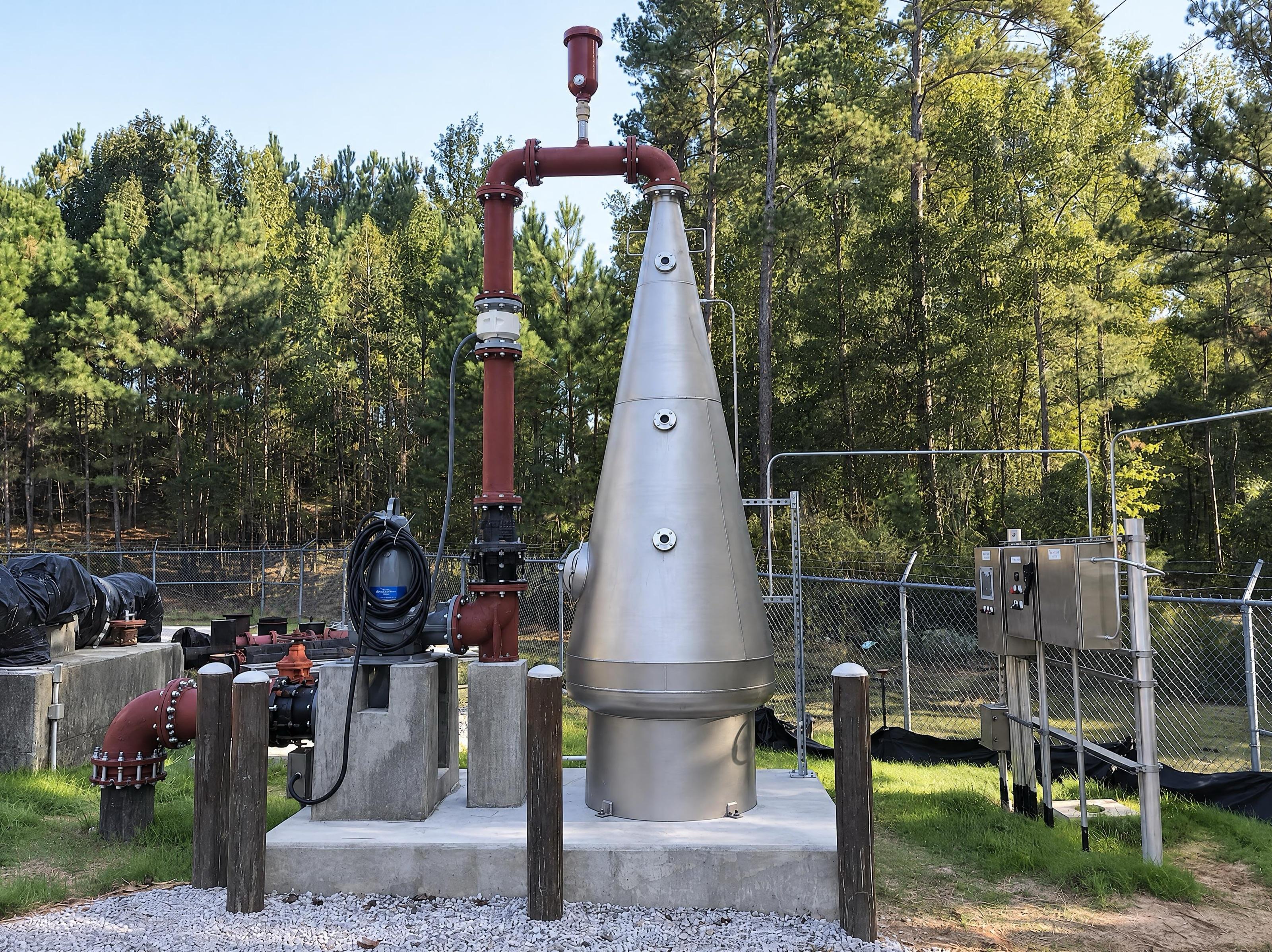
Controlling Odors in Sludge Holding Tanks and Sludge Transfer Lines
Why a small dose of high purity oxygen, held just below what the sludge uses, turns its hydrogen sulfide into sulfur instead of stripping it into the air.
Details
Summary
An ECO₂ application note on stopping H₂S odor and corrosion in sludge holding tanks and solids handling. Instead of scrubbing foul air or bubbling air through the tank, which absorbs only 5% of the oxygen and strips H₂S out, a Speece Cone® adds a small amount of high purity oxygen on a sidestream. Kept just below the sludge's oxygen uptake rate, it holds micro-aerophilic conditions in which H₂S is converted to elemental sulfur.
Key Figures
95%
Oxygen absorption efficiency of the Speece Cone Source: PDF page 1 (opens in a new tab)
5%
Oxygen absorption of coarse bubble aeration in a sludge tank Source: PDF page 1 (opens in a new tab)
99ft³ of off gas
Odorous off gas escaping for every 100 ft³ of air bubbled through a sludge tank Source: PDF page 1 (opens in a new tab)
Questions
How can odors from sludge holding tanks be controlled without scrubbers?
By adding a small amount of high purity oxygen to a sidestream through a Speece Cone, which oxidizes H₂S in the sludge so it is never released, instead of collecting and scrubbing the foul air. (PDF page 1) (opens in a new tab)
Why is coarse bubble aeration a poor choice for sludge tank odor control?
It absorbs only 5% of the oxygen diffused, so for every 100 ft³ of air only one cubic foot of oxygen dissolves and 99 ft³ of odorous off gas escapes, stripping H₂S into the air. (PDF page 1) (opens in a new tab)
Does Superoxygenating sludge need enough oxygen to meet its full oxygen demand?
No. Oxidizing H₂S is much faster than carbonaceous BOD demand, so oxygen is added at a rate below the total uptake rate, keeping micro-aerophilic conditions (D.O. near zero) where sulfide stops at elemental sulfur. (PDF page 1) (opens in a new tab)
In Full
Full Text as Published
The text as its authors wrote it.
Sludge tank odor control through SuperOxygenation
Speece Cone by ECO₂: pure oxygen injection; oxidize sulfide to sulfur; 95% absorption efficiency; reduce O&M costs; eliminate odor & corrosion.
Diagram in the PDF: the ECO₂ SuperOxygenation sidestream process on a sludge tank.
High levels of hydrogen sulfide (H₂S) exist in Primary and Waste Activated Sludge. This presents a problem in the sludge holding tanks and solids handling facilities, where the H₂S gas causes foul odors and equipment deterioration due to its highly corrosive properties.
Traditional treatment options include gas scrubbing and coarse bubble aeration. Collecting and scrubbing foul gasses from the sludge holding tank and sludge handling facility can eliminate odors but does not prevent corrosion, and is a costly option. Coarse bubble aeration achieves only 5% absorption of the oxygen diffused, resulting in stripping of the volatile, odorous H₂S compounds. In fact, for every 100 ft³ of air bubbled through the sludge tank, only one cubic foot of oxygen is absorbed and 99 ft³ of odorous off gas escapes to the air.
The ECO₂ sludge treatment alternative involves adding a small amount of high purity oxygen on a sidestream, using a Speece Cone and a process called SuperOxygenation. Although sludge has a very high oxygen demand, the reaction to oxidize H₂S has a much faster rate of oxygen demand than that of carbonaceous BOD. SuperOxygenation can be used to maintain micro-aerophilic conditions (D.O. near zero) in the sludge, by supplementing dissolved oxygen (D.O.) at a rate less than the total uptake rate. In this environment, the biological conversion of H₂S stops at elemental sulfur rather than being oxidized all the way to sulfate, resulting in a low cost, low maintenance method for eliminating the odorous and corrosive H₂S compounds common to all wastewater sludge holding tanks and solids handling facilities.
How to Cite
One line to paste into a report.
Controlling Odors in Sludge Holding Tanks and Sludge Transfer Lines. ECO₂. Eco Oxygen Technologies Technical Library. https://eco2tech.com/technical-library/controlling-odors-in-sludge-holiding-tanks-and-sludge-transfer-lines/
https://eco2tech.com/technical-library/controlling-odors-in-sludge-holiding-tanks-and-sludge-transfer-lines/
The Next Step
Ask an ECO₂ Engineer
Questions about this application note, or about your own water? An application engineer answers, with the figures.