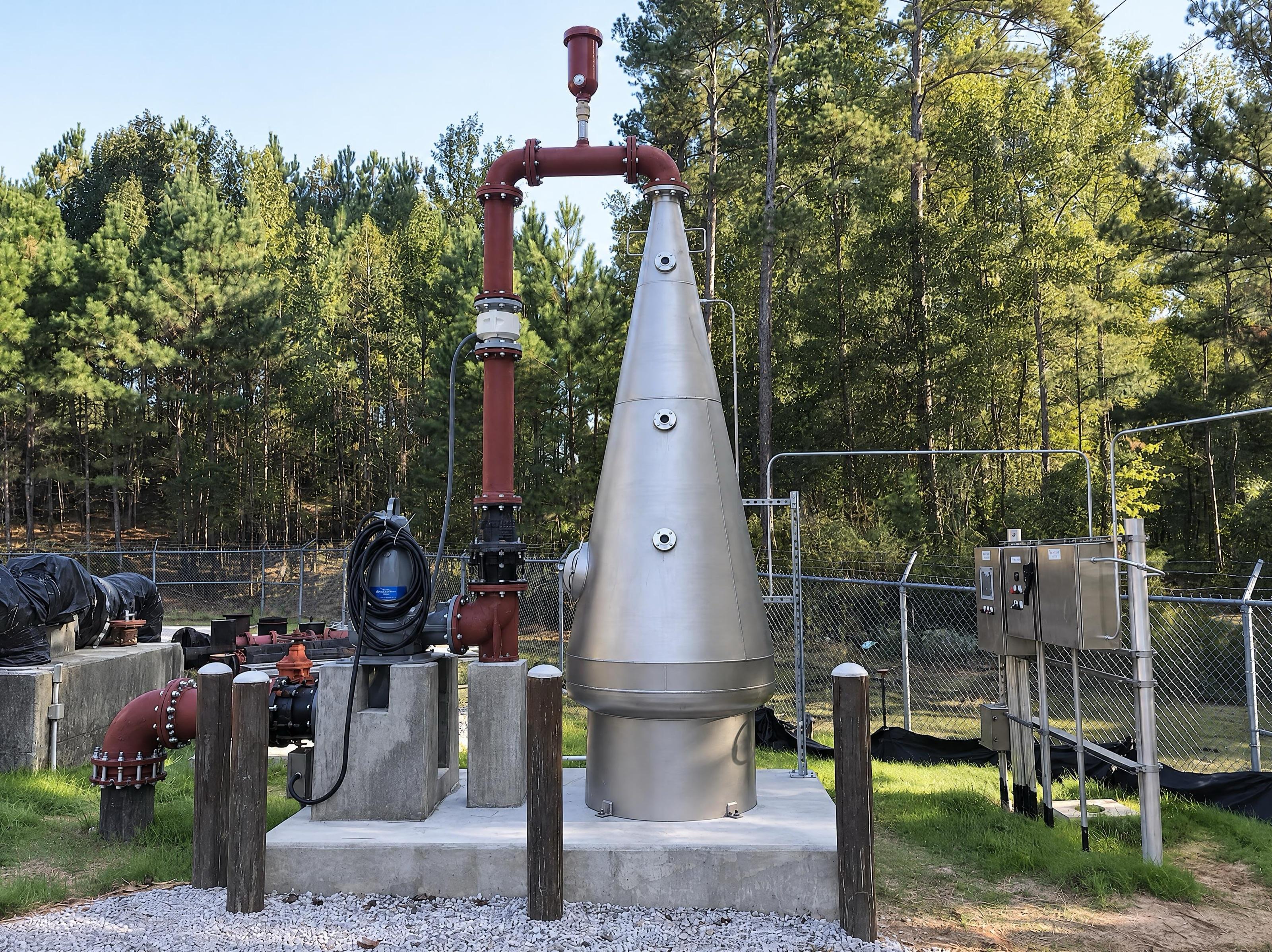
Secondary Clarifier Superoxygenation to Increase Active Biomass and Stop Rising Sludge
An ECO₂ application note on oxygenating secondary clarifiers to keep more of the biomass active and stop rising sludge, without adding tank volume.
Details
Summary
An application note on dissolving pure oxygen into the influent of a secondary clarifier so the sludge blanket stays aerobic while it settles. A typical secondary clarifier has a dissolved oxygen demand of about 40 mg/L, and pure oxygen allows 40 to 60 mg/L to be dissolved without exceeding saturation or changing settling.
Key Figures
40mg/L
Typical dissolved oxygen demand of a secondary clarifier Source: PDF page 1 (opens in a new tab)
40 to 60mg/L
D.O. that pure oxygen can dissolve in clarifier influent without exceeding saturation Source: PDF page 1 (opens in a new tab)
60mg/L
D.O. saturation with pure oxygen at 15 ft head Source: PDF page 1 (opens in a new tab)
Questions
What does Superoxygenating the secondary clarifier influent do?
It keeps the sludge blanket aerobic through settling, which adds solids under air, lowers F:M, lengthens SRT, adds BOD removal and prevents rising sludge from denitrification. (PDF page 1) (opens in a new tab)
How much dissolved oxygen does a secondary clarifier need?
Demand depends on hydraulic retention time times oxygen uptake rate; typical secondary clarifiers have a D.O. demand of 40 mg/L. (PDF page 1) (opens in a new tab)
How does it compare with contact stabilization?
The idea is similar, giving bacteria time to metabolize stored BOD before return, but it happens inside the existing clarifier with no extra tank volume. (PDF page 1) (opens in a new tab)
In Full
More Key Figures
Five more, each with what it measures and its PDF page.
From the PDF
| Figure | What It Measures |
|---|---|
| 6,700 lbs/MGD | Solids under air with an oxic clarifier, against 4,200 lbs/MGD for an anoxic one (PDF page 2 (opens in a new tab)) |
| 750 gpd/ft² | Clarifier surface loading in ECO₂'s example (PDF page 2 (opens in a new tab)) |
| 9,000 mg/L | Return sludge concentration in the example (PDF page 2 (opens in a new tab)) |
| 2,500 lbs/MGD | Solids in the clarifier's 5 ft sludge blanket, kept under air by Superoxygenation (PDF page 2 (opens in a new tab)) |
| 3,000 mg/L | MLSS in the aeration basin in the example (4200 lbs MLSS/MGD) (PDF page 2 (opens in a new tab)) |
Full Text as Published
The text as its authors wrote it.
Wastewater Application: Clarifier Superoxygenation
Allow Clarifier to Operate as an Oxic Bioreactor
Does your WRF have process challenges?
…violations or consent decree?
…operating in the "red-zone"?
Common Process Challenges:
- Rising Sludge? …denitrification in the sludge blanket?
- Restricted by Capacity? …landlocked with no room for expansion?
- Need Lower F:M or Longer SRT? …insufficient BOD removal or nitrification?
- Difficulty Meeting Nutrient Limits? …winter changes or future permit?
Adding pure dissolved oxygen may be the solution.
The aerobic microbial sludge inventory can be increased up to 60% simply by superoxygenation of the influent to the secondary clarifier, allowing the sludge blanket to support aerobic metabolism throughout the settling process.
Aerobic Sludge Blanket in the Clarifier has the following benefits:
- Increased "solids under air" for a lower F:M ratio, and longer SRT
- Additional BOD removal for plants lacking physical space to expand
- Prevents rising sludge from denitrification in the sludge blanket
- Will not disturbing settling characteristics.
Wastewater superoxygenation is a process to dissolve pure oxygen to maintain oxic (or aerobic) conditions without disturbing quiescent settling conditions.
The level of dissolved oxygen (D.O.) required to support aerobic metabolism in a secondary clarifier is relative to its hydraulic retention time and oxygen uptake rate (HRT x OUR). Typical secondary clarifiers have a D.O. demand of 40 mg/L.
By using pure oxygen, 40-60 mg/L D.O. can be dissolved in the clarifier influent without exceeding the saturation level¹ ² ³. Thus, D.O. level of up to 60 mg/L will not cause effervescent loss of D.O. and will not change the settling characteristics. This makes secondary clarifier superoxygenation an ideal solution for plants facing certain operational challenges listed above.
The concept of Secondary Clarifier Superoxygenation is similar to the well-known principle of "Contact Stabilization" yet requires no additional tank volume. Both provide additional time for the bacteria to aerobically metabolize their internally-stored BOD before being recycled back to the aeration tanks. This ensures the RAS is "hungry" and therefore able to metabolize a new cycle of BOD when re-introduced into the plant flow. Superoxygenation allows this to occur inside the secondary clarifier, along with preventing rising sludge.
Notes on D.O. Saturation:
- The DO Saturation level with pure oxygen is 40 mg/L @ 0 ft head (STP)
- The DO Saturation level with pure oxygen is 60 mg/L @ 15 ft head
- The DO Saturation level with air is 8 mg/L @ 0 ft head (air=21% O₂)
Example: Anoxic Clarifier
The first diagram below shows a conventional secondary clarifier, where the entire mass of solids in the clarifier has zero D.O. content. During such conditions, these solids are unable to continue aerobic metabolization of BOD; and may be subject to denitrification which causes rising sludge. Maintaining a shallow sludge blanket, however, makes increasing MLSS and RAS concentration difficult to achieve.
Note: In the example below, the total mass of "solids under air" is equal to the solids in the aeration basin = 4,200 lbs / MGD.
Diagram: aeration basin at MLSS 3000 mg/L (4200 lbs MLSS/MGD), D.O. = 2 mg/L to the clarifier, RAS = 50% Q. Secondary clarifier: 750 gpd/ft², 5 ft deep sludge blanket, return sludge concentration 9000 mg/L, average MLSS in sludge blanket 6000 mg/L, 2500 lbs of solids/MGD, anoxic blanket.
Example: Oxic Clarifier (60% More Aerobic Biomass)
Alternatively, as shown in the diagram below, superoxygenation of the clarifier influent greatly increases the mass of "solids under air" – without additional tank volume, and without changing the settling characteristics.
Note: In the "Oxic Clarifier" example below, the total mass of solids under air equals A-Basin Solids + Sec. Clarifier Solids = (4200 + 2500) = 6,700 lbs / MGD. This is an increase of 60% more aerobic biomass.
Diagram: the same plant with a Speece Cone on the clarifier influent, D.O. = 40 mg/L, and an oxic 5 ft sludge blanket.
Food-for-thought: Without rising sludge in the clarifier, superoxygenation provides an opportunity to maintain a thicker sludge blanket and develop an even greater active biomass and higher sludge concentration.
How to Cite
One line to paste into a report.
Secondary Clarifier Superoxygenation to Increase Active Biomass and Stop Rising Sludge. ECO₂. Eco Oxygen Technologies Technical Library. https://eco2tech.com/technical-library/secondary-clarifier-superoxygenation-to-increase-active-biomass-and-stop-rising-sludge/
https://eco2tech.com/technical-library/secondary-clarifier-superoxygenation-to-increase-active-biomass-and-stop-rising-sludge/
The Next Step
Ask an ECO₂ Engineer
Questions about this application note, or about your own water? An application engineer answers, with the figures.