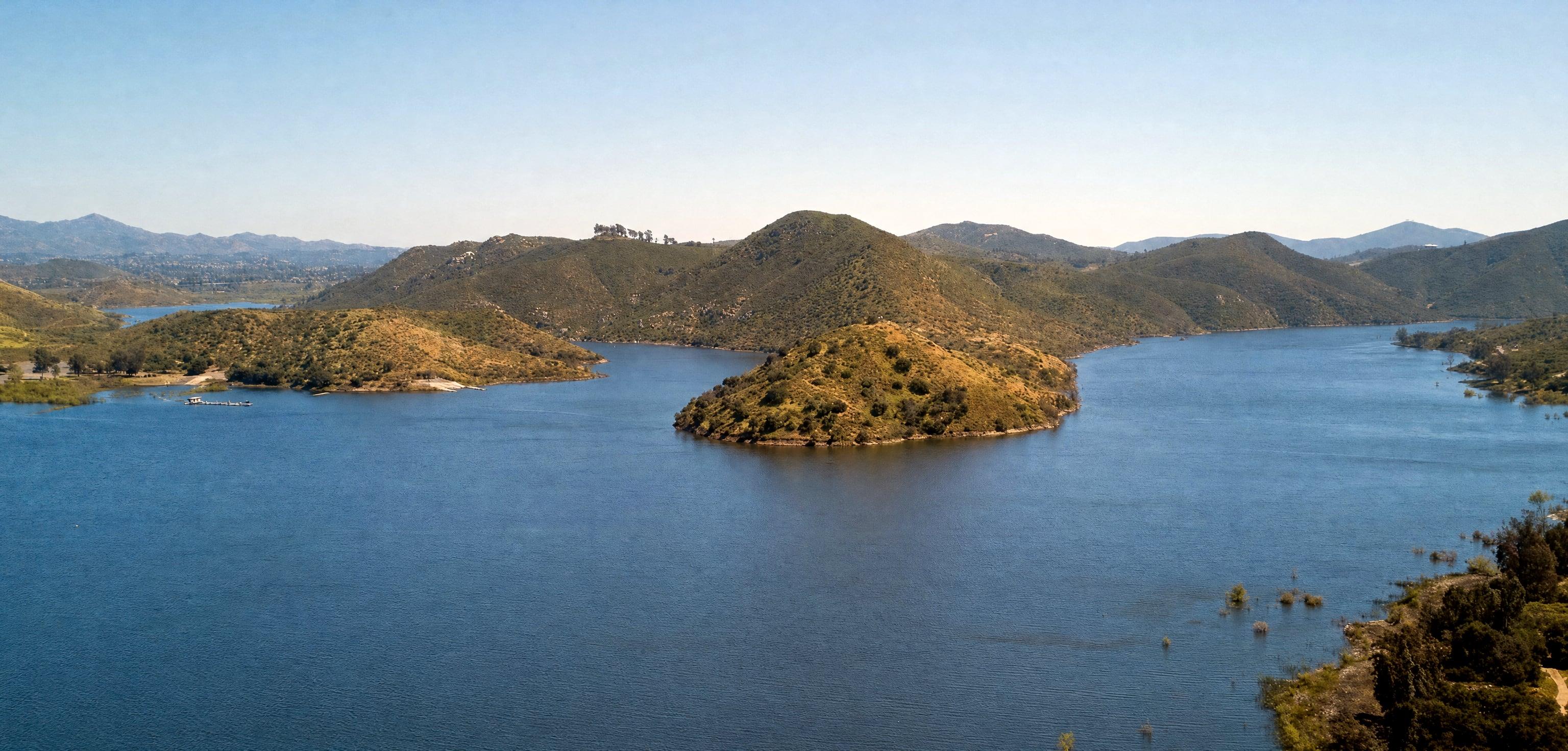
20 Years of Successful Hypolimnetic Oxygenation at EBMUD's Camanche Reservoir near San Francisco, CA
ECO₂'s case study of Camanche Reservoir, where EBMUD put in a Speece Cone® after hatchery fish kills below the dam, and what twenty years of oxygenation did there.
Details
Summary
Twenty years of hypolimnetic oxygenation suppressed internal nutrient loading, cut chlorophyll a by 88% and blue-green algae blooms by 99%, and switched the reservoir from eutrophic to mesotrophic.
Key Figures
300,000salmonids
Fish that died in the hatchery from anoxic reservoir water in 1986-1990 ("over 300,000") Source: PDF page 1 (opens in a new tab)
3miles
How far the plume of oxygenated water extended into the reservoir Source: PDF page 2 (opens in a new tab)
88%
Overall decline in chlorophyll a Source: PDF page 2 (opens in a new tab)
Questions
What did 20 years of oxygenation do to algae at Camanche Reservoir?
Chlorophyll a declined by 88% overall, Secchi depths increased, and large blue-green algae blooms fell by over 93% in the first five years and 99% thereafter. (PDF page 2) (opens in a new tab)
How far does oxygenated water spread from the Camanche Speece Cone?
The final plume of oxygenated water extended up to 3 miles into the reservoir, spreading horizontally across the sediment with minimal turbulence. (PDF page 2) (opens in a new tab)
Did oxygenation change Camanche Reservoir's trophic state?
Yes. ECO₂ reports that 20 years of hypolimnetic oxygenation switched the reservoir from eutrophic to mesotrophic. (PDF page 2) (opens in a new tab)
How does a Speece Cone create an aerobic cap above the sediment?
A submersible pump draws hypolimnion water into the 12 ft diameter cone, where oxygen bubbles are held until they dissolve; the oxygenated water returns to the hypolimnion and prevents release of nutrients, iron and manganese and the formation of H₂S. (PDF page 2) (opens in a new tab)
In Full
More Key Figures
Three more, each with what it measures and its PDF page.
From the PDF
| Figure | What It Measures |
|---|---|
| 99% | Decline in large blue-green algae blooms after the first five years (over 93% in the first five) (PDF page 2 (opens in a new tab)) |
| 6 to 1.6 | Fall in the TN:TP ratio after oxygenation started (PDF page 2 (opens in a new tab)) |
| 95% | Average oxygen transfer efficiency proven across ECO₂'s systems (PDF page 2 (opens in a new tab)) |
Full Text as Published
The text as its authors wrote it.
20 years of successful hypolimnetic oxygenation: EBMUD's Camanche Reservoir, CA
ECO₂ water quality case study, November 2014
EBMUD
The East Bay Municipal Utility District (EBMUD) supplies about 1.5 Million residents in the East Bay of San Francisco with drinking water.
Camanche Reservoir
The Camanche Reservoir was built in 1964 on the Lower Mokelumne River. The reservoir has a maximum volume of 417,000 acre feet and is up to 135ft deep. It is used for flood control, downstream flow regulation, hydroelectric power generation and recreation.
Fish hatchery
A fish hatchery was built at the bottom of the dam to mitigate the loss of spawning habitat for Chinook Salmon and Steelhead Trout. In 1986-1990 over 300,000 salmonids died in the hatchery due to anoxic water released from the reservoir. This prompted the District to investigate technologies to prevent future fish kills.
ECO₂ Speece Cone installation
After thousands of fish were killed in the downstream hatchery, the District investigated preventative solutions, such as Hypolimnetic Oxygenation, multi-level intake structures or diversions from another reservoir. The goals were to prevent future fish kills and the formation of H₂S in the reservoir's sediment. Fishery needs, such as maintaining a cold water fish habitat, had to be balanced with the District's water supply needs.
The installation of a Speece Cone for Hypolimnetic Oxygenation in 1993 was the most cost-effective and feasible solution.
Speece Cone design
A submersible water pump pulls water from the hypolimnion into the 12ft diameter Speece Cone, where gaseous oxygen is added. The Speece Cone is designed to trap oxygen bubbles inside and to keep them in suspension until they are dissolved. An average oxygen transfer efficiency of 95% has been proven across ECO₂'s systems. The oxygenated water is added back into the hypolimnion to create an "aerobic cap" above the sediment, which prevents the release of internal nutrients, iron and manganese, as well as the formation of H₂S.
Diagram in the PDF: the sidestream pump draws water, oxygen gas is added in the cone, and the oxygenated sidestream returns to the hypolimnion.
Positive effects on water quality
The advantage of the Speece Cone is that it adds already dissolved oxygen to the reservoir's hypolimnion. The liquid to liquid phase mixing allows for a horizontal distribution of oxygenated water across the sediment with minimal turbulence. The final plume of oxygenated water in Camanche Reservoir extended up to 3 miles into the reservoir.
Nutrient levels were reduced successfully
Oxygenation successfully suppressed the internal nutrient loads. All nutrient levels decreased dramatically after start-up of the Oxygenation System. The TN:TP ratio fell from 6 to 1.6.
Algae growth declined
Fewer nutrients resulted in reduced algae growth. Chlorophyll A declined by 88% overall and Secchi Depths increased. Large blooms of blue-green algae declined by over 93% in the first five years and 99% thereafter.
20 Years of Hypolimnetic Oxygenation have successfully switched the trophic level of Camanche Reservoir from eutrophic to mesotrophic.
Charts in the PDF; source: Alex Horne.
ECO₂
ECO Oxygen Technologies, LLC was founded in cooperation with Dr. Speece in 2002 to make the Speece Cone Technology available for the water and wastewater industry.
How to Cite
One line to paste into a report.
20 Years of Successful Hypolimnetic Oxygenation at EBMUD's Camanche Reservoir near San Francisco, CA. ECO₂, November 2014. Project engineer: Dr. Alex Horne. Eco Oxygen Technologies Technical Library. https://eco2tech.com/technical-library/20-years-of-successful-hypolimnetic-oxygenation-at-ebmuds-camanche-reservoir-near-san-francisco-ca/
https://eco2tech.com/technical-library/20-years-of-successful-hypolimnetic-oxygenation-at-ebmuds-camanche-reservoir-near-san-francisco-ca/
The Next Step
Ask an ECO₂ Engineer
Questions about this case study, or about your own water? An application engineer answers, with the figures.