Large-Scale Oxygen Injection for Odor Control at Primary Clarifiers at the Trinity River Authority of Texas
Why the Trinity River Authority of Texas chose oxygen over covering its primary clarifiers, and how bench and pilot tests shaped the full scale design.
Details
Summary
Covering the clarifiers would have meant collecting and treating well over 150,000 cfm of foul air, and cover and scrub methods for the grit basins and clarifiers were estimated at over $50 million over the life of the system.
Key Figures
150,000cfm
Foul air that covering the primary clarifiers would have meant collecting and treating ("well over") Source: PDF page 1 (opens in a new tab)
50million dollars
Estimated cost of covering and scrubbing the grit basins and primary clarifiers over the life of the system ("over") Source: PDF page 2 (opens in a new tab)
60%
Average drop in total sulfide from the pump station to the grit basins with oxygen in the pilot ("over"), against 13% without Source: PDF page 3 (opens in a new tab)
Questions
Why did the Trinity River Authority use oxygen instead of covering its primary clarifiers?
Covering the primary clarifiers could involve acres of covers and the collection and treatment of well over 150,000 cfm of foul air. The Authority and Alan Plummer Associates ran full-scale pilot studies of pure oxygen as the alternative. (PDF page 1) (opens in a new tab)
What did the full-scale oxygen pilot achieve?
Over eight weeks, the average drop in total sulfide between the influent pump station and the aerated grit basin influent box rose from 13% to over 60%, and the drop in dissolved sulfide from 5% to over 68%. Downstream of the grit basin, total sulfide fell below detectable limits in most samples. (PDF page 3) (opens in a new tab)
How fast does oxygen remove sulfide in this wastewater?
In the bench tests sulfide oxidation followed a first-order reaction, at 0.10 per minute for total sulfide and 0.14 per minute for dissolved sulfide and hydrogen sulfide. About 80% of total sulfide was gone in the first ten minutes. (PDF page 8) (opens in a new tab)
How much dissolved oxygen did the design call for?
To keep 1.0 mg/L up to the primary clarifier launders, the design adds the oxygen consumed over 134 minutes at 108 mgd (22.3 mg/L) to 6.5 mg/L for oxidizing an average 1.3 mg/L of H₂S at 5 pounds of oxygen per pound, for 29.8 mg/L at the injection point, or 33.3 mg/L allowing for 99.5% oxygen purity and 90% efficiency. (PDF page 6) (opens in a new tab)
Why were downflow bubble contactors chosen over multiple injection points?
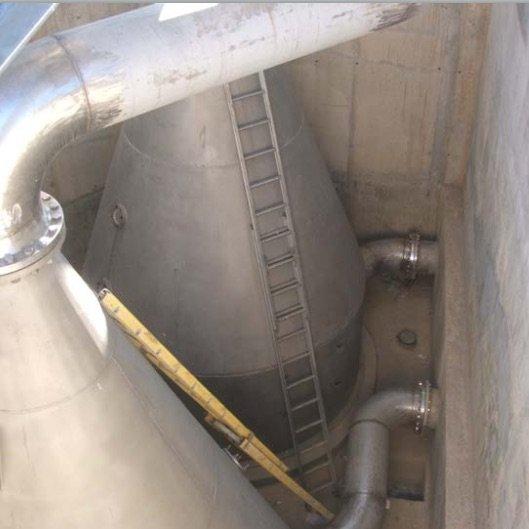
Little or no DO could be lost in the enclosed headworks building, where oxygen coming out of solution could enrich the air above 23.5% and create a fire hazard. Over 20 years the contactors were estimated at $9.8 million against $12.7 million for multiple injection points, and contactors made by Eco Oxygen Technologies were specified. (PDF page 14) (opens in a new tab)
Where does the oxygen come from?
From leased liquid oxygen tanks and vaporizers, with the oxygen bought in bulk. Buying VPSA equipment had the lowest 20-year cost ($3.8 million against $4.5 million), but leasing had the lowest capital cost, left safety and maintenance with the gas supplier, and avoided a break-even point of about 15 years. (PDF page 15) (opens in a new tab)
The Project
TRA Central Plant Influent Pump Station
In Full
More of the Summary
Two more paragraphs of our summary.
A full-scale pilot on one 40 mgd pump at Pump Station 6 raised the average drop in total sulfide between the pump station and the grit basins from 13% to over 60%, cut surface H₂S at the primary clarifier by over 80%, and shrank the plant's modeled area of odor impact by 96%. A bench study then showed that sulfide oxidation follows a first-order reaction, with about 80% of total sulfide gone in the first ten minutes, so an injection point with at least 15 minutes of detention time would be enough.
Phase 1 was bid at $3.3 million against $8 million projected for both phases.
More Key Figures
Seven more, each with what it measures and its PDF page.
From the PDF
| Figure | What It Measures |
|---|---|
| 80% | Drop in surface H₂S at the primary clarifier during the pilot ("over") (PDF page 4 (opens in a new tab)) |
| 96% | Reduction in the plant's modeled area of odor impact, with oxygen at the primary clarifiers and odors controlled at the grit basins (PDF page 4 (opens in a new tab)) |
| 29.8 mg/L | Dissolved oxygen needed at the injection point by the design calculation (PDF page 6 (opens in a new tab)) |
| 0.10 per minute | First-order oxidation rate of total sulfide in the bench tests (0.14 per minute for dissolved sulfide and H₂S) (PDF page 8 (opens in a new tab)) |
| 4.7 million dollars | Potential construction saving from phasing: phase 1 bid at $3.3 million against $8 million projected for both phases (PDF page 12 (opens in a new tab)) |
| 9.8 million dollars | 20-year life cycle cost of the downflow bubble contactors made by Eco Oxygen Technologies, against $12.7 million for multiple injection points (PDF page 14 (opens in a new tab)) |
| 183,000 dollars a year | Operating savings projected from the bench study (PDF page 16 (opens in a new tab)) |
How to Cite
One line to paste into a report.
James S. McMillen, Betty L. Jordan, William C. Rackley et al. Large-Scale Oxygen Injection for Odor Control at Primary Clarifiers at the Trinity River Authority of Texas. WEF, 2008. Project engineer: Alan Plummer & Associates. Eco Oxygen Technologies Technical Library. https://eco2tech.com/technical-library/large-scale-oxygen-injection-for-odor-control-at-primary-clarifiers-at-the-trinity-river-authority-of-texas/
https://eco2tech.com/technical-library/large-scale-oxygen-injection-for-odor-control-at-primary-clarifiers-at-the-trinity-river-authority-of-texas/
The Next Step
Ask an ECO₂ Engineer
Questions about this technical paper, or about your own water? An application engineer answers, with the figures.