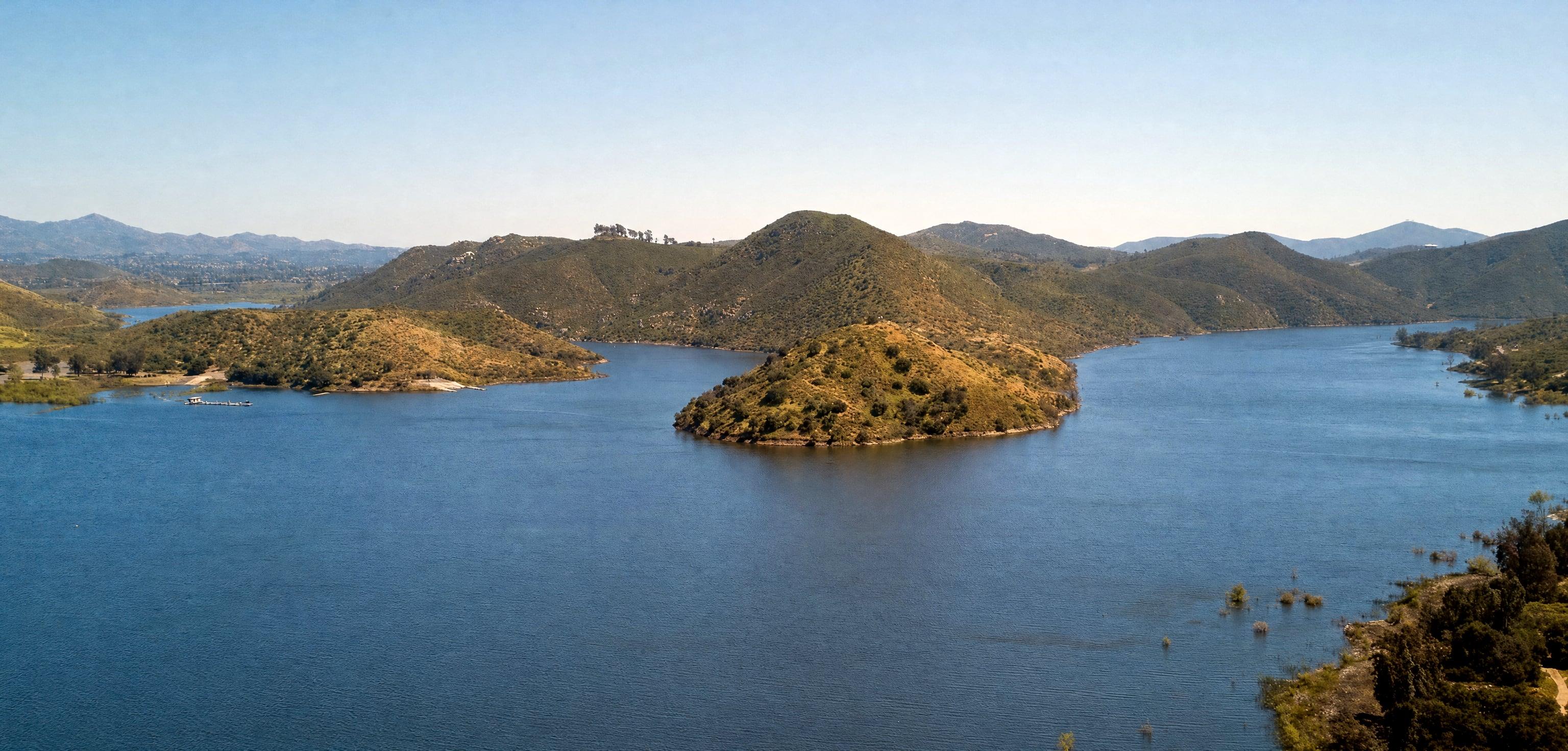
20 Years of Successful Hypolimnetic Oxygenation at EBMUD's Camanche Reservoir near San Francisco, CA
Estudo de caso da ECO₂: no Camanche Reservoir, a EBMUD instalou um Speece Cone® após mortes na estação de piscicultura abaixo da barragem, e o efeito de vinte anos de oxigenação.
Detalhes
Resumo
Vinte anos de oxigenação hipolimnética suprimiram a carga interna de nutrientes, reduziram a clorofila a em 88% e as florações de cianobactérias em 99% e fizeram o reservatório passar de eutrófico a mesotrófico.
Números-chave
300.000salmonídeos
Peixes que morreram na estação de piscicultura, de 1986 a 1990, por causa da água anóxica do reservatório (“mais de 300.000”) 3milhas
Alcance da pluma de água rica em oxigênio reservatório adentro 88%
Queda geral da clorofila a
Perguntas
O que 20 anos de oxigenação fizeram com as algas no Camanche Reservoir?
A clorofila a caiu 88% no total, as profundidades de Secchi aumentaram e as grandes florações de cianobactérias caíram mais de 93% nos cinco primeiros anos e 99% depois disso. (PDF, página 2) (abre em nova aba)
Até onde a água rica em oxigênio se espalha a partir do Speece Cone de Camanche?
A pluma final de água rica em oxigênio se estendeu por até 3 milhas reservatório adentro, espalhando-se horizontalmente sobre o sedimento com turbulência mínima. (PDF, página 2) (abre em nova aba)
A oxigenação mudou o estado trófico do Camanche Reservoir?
Sim. A ECO₂ relata que 20 anos de oxigenação hipolimnética fizeram o reservatório passar de eutrófico a mesotrófico. (PDF, página 2) (abre em nova aba)
Como um Speece Cone cria uma capa aeróbia acima do sedimento?
Uma bomba submersível puxa água do hipolímnio para dentro do cone de 12 pés de diâmetro, onde as bolhas de oxigênio ficam retidas até se dissolverem; a água rica em oxigênio retorna ao hipolímnio e impede a liberação de nutrientes, ferro e manganês e a formação de H₂S. (PDF, página 2) (abre em nova aba)
Na íntegra
Mais números-chave
Mais três, cada um com o que mede e sua página no PDF.
Do PDF
| Número | O que mede |
|---|---|
| 99% | Queda das grandes florações de cianobactérias após os cinco primeiros anos (mais de 93% nos cinco primeiros) (Página 2 do PDF (abre em nova aba)) |
| 6 a 1,6 | Queda da razão TN:TP após o início da oxigenação (Página 2 do PDF (abre em nova aba)) |
| 95% | Eficiência média de transferência de oxigênio comprovada nos sistemas da ECO₂ (Página 2 do PDF (abre em nova aba)) |
Texto completo como publicado (em inglês)
O texto como seus autores o escreveram.
20 years of successful hypolimnetic oxygenation: EBMUD's Camanche Reservoir, CA
ECO₂ water quality case study, November 2014
EBMUD
The East Bay Municipal Utility District (EBMUD) supplies about 1.5 Million residents in the East Bay of San Francisco with drinking water.
Camanche Reservoir
The Camanche Reservoir was built in 1964 on the Lower Mokelumne River. The reservoir has a maximum volume of 417,000 acre feet and is up to 135ft deep. It is used for flood control, downstream flow regulation, hydroelectric power generation and recreation.
Fish hatchery
A fish hatchery was built at the bottom of the dam to mitigate the loss of spawning habitat for Chinook Salmon and Steelhead Trout. In 1986-1990 over 300,000 salmonids died in the hatchery due to anoxic water released from the reservoir. This prompted the District to investigate technologies to prevent future fish kills.
ECO₂ Speece Cone installation
After thousands of fish were killed in the downstream hatchery, the District investigated preventative solutions, such as Hypolimnetic Oxygenation, multi-level intake structures or diversions from another reservoir. The goals were to prevent future fish kills and the formation of H₂S in the reservoir's sediment. Fishery needs, such as maintaining a cold water fish habitat, had to be balanced with the District's water supply needs.
The installation of a Speece Cone for Hypolimnetic Oxygenation in 1993 was the most cost-effective and feasible solution.
Speece Cone design
A submersible water pump pulls water from the hypolimnion into the 12ft diameter Speece Cone, where gaseous oxygen is added. The Speece Cone is designed to trap oxygen bubbles inside and to keep them in suspension until they are dissolved. An average oxygen transfer efficiency of 95% has been proven across ECO₂'s systems. The oxygenated water is added back into the hypolimnion to create an "aerobic cap" above the sediment, which prevents the release of internal nutrients, iron and manganese, as well as the formation of H₂S.
Diagram in the PDF: the sidestream pump draws water, oxygen gas is added in the cone, and the oxygenated sidestream returns to the hypolimnion.
Positive effects on water quality
The advantage of the Speece Cone is that it adds already dissolved oxygen to the reservoir's hypolimnion. The liquid to liquid phase mixing allows for a horizontal distribution of oxygenated water across the sediment with minimal turbulence. The final plume of oxygenated water in Camanche Reservoir extended up to 3 miles into the reservoir.
Nutrient levels were reduced successfully
Oxygenation successfully suppressed the internal nutrient loads. All nutrient levels decreased dramatically after start-up of the Oxygenation System. The TN:TP ratio fell from 6 to 1.6.
Algae growth declined
Fewer nutrients resulted in reduced algae growth. Chlorophyll A declined by 88% overall and Secchi Depths increased. Large blooms of blue-green algae declined by over 93% in the first five years and 99% thereafter.
20 Years of Hypolimnetic Oxygenation have successfully switched the trophic level of Camanche Reservoir from eutrophic to mesotrophic.
Charts in the PDF; source: Alex Horne.
ECO₂
ECO Oxygen Technologies, LLC was founded in cooperation with Dr. Speece in 2002 to make the Speece Cone Technology available for the water and wastewater industry.
Como citar
Uma linha para colar em um relatório.
20 Years of Successful Hypolimnetic Oxygenation at EBMUD's Camanche Reservoir near San Francisco, CA. ECO₂, November 2014. Project engineer: Dr. Alex Horne. Eco Oxygen Technologies Technical Library. https://eco2tech.com/technical-library/20-years-of-successful-hypolimnetic-oxygenation-at-ebmuds-camanche-reservoir-near-san-francisco-ca/
https://eco2tech.com/technical-library/20-years-of-successful-hypolimnetic-oxygenation-at-ebmuds-camanche-reservoir-near-san-francisco-ca/
O próximo passo
Pergunte a um engenheiro da ECO₂
Dúvidas sobre este estudo de caso ou sobre a sua água? Um engenheiro de aplicações responde, com os números.