Denver Water's Marston Reservoir Receives Supplemental Dissolved Oxygen System to Resolve Seasonal Water Quality Issues
Estudo de caso da ECO₂ sobre o Marston Reservoir, cuja fina camada de fundo ficava anóxica todo verão, e o Speece Cone® que a Denver Water escolheu para devolver oxigênio a ela.
Detalhes
Resumo
O Marston Reservoir, que abastece a estação de tratamento Marston, da Denver Water, tem, com 20 a 30 pés de espessura, um fino hipolímnio que ficava anóxico todo verão e mandava água com matéria orgânica, gosto e odor, manganês e algas para a estação por sua única captação, em cota baixa.
Números-chave
66pés
Profundidade do reservatório, o que deixa um hipolímnio fino, de 20 a 30 pés 15anos
Período de estudos antes da escolha da oxigenação 1 milhãopessoas
Pessoas que a Denver Water abastece com água potável (“mais de 1 milhão”)
Perguntas
Que problemas de qualidade da água o Marston Reservoir causava na estação de tratamento da Denver Water?
O hipolímnio, pouco espesso, ficava anóxico por meses a cada verão, e a única captação, de nível baixo, enviava essa água para a estação de tratamento, com matéria orgânica elevada, gosto e odor, manganês elevado e florações de algas. (PDF, página 1) (abre em nova aba)
Por que a Denver Water escolheu um Speece Cone para o Marston Reservoir?
Ele produz e mantém oxigênio dissolvido elevado com pouco efeito sobre o gradiente de temperatura do hipolímnio, transfere oxigênio com eficiência mesmo na altitude de Denver, ocupa pouca área e opera em silêncio, e mantém um fluxo horizontal de baixa turbulência sobre os sedimentos. (PDF, página 2) (abre em nova aba)
Quem avaliou as opções de oxigenação para o Marston Reservoir?
A Denver Water, em conjunto com a Alex Horne Associates e a CDM, analisou opções de tratamento hipolimnético ao longo de um período de 15 anos de estudos. (PDF, página 2) (abre em nova aba)
O projeto
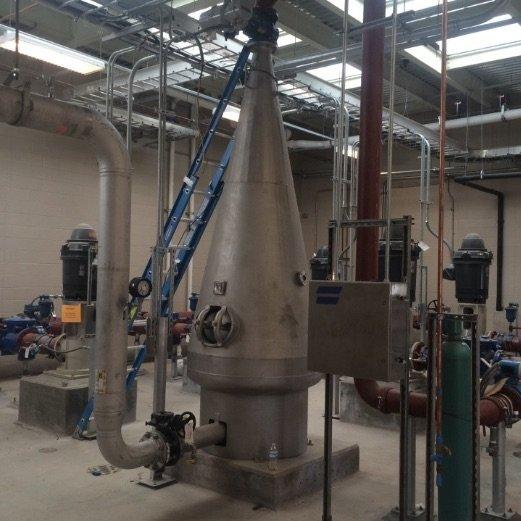
Marston Reservoir
Na íntegra
Texto completo como publicado (em inglês)
O texto como seus autores o escreveram.
Denver Water's Marston Reservoir receives supplemental dissolved oxygen system
Denver Water supplies drinking water to over 1 million people using water from multiple locations including Marston Reservoir. The reservoir, constructed over 115 years ago, stores 250 million gallons of water diverted from the South Platte River. The water is piped 12 miles to the reservoir, followed by treatment at the Marston Water Treatment Plant (WTP).
The reservoir's 66 foot depth results in a thin 20 to 30 foot hypolimnion which becomes anoxic (depleted of dissolved oxygen, D.O.) for several months after stratification occurs each summer.
The reservoir has only one low level intake which results in anoxic water being piped to the Marston WTP during the peak summer water usage months. During those months, water quality issues included elevated organics, taste and odors, elevated manganese levels, and algal blooms.
Denver Water takes pride in the high-quality drinking water provided to their customers and began evaluating strategies to improve water quality and reduce nutrient loadings on the WTP. After studies conducted over a period of 15 years, oxygenation using ECO₂'s Speece Cone was selected based on performance efficiencies, silent operations, and economic considerations.
Photo in the PDF: aerial view of Marston Reservoir, Denver, CO (photo credit: Wikimapia.org).
ECO₂ system selection
Denver Water, working with Alex Horne Associates and CDM, conducted an analysis of hypolimnetic treatment options that would fit the specific conditions of the Marston Reservoir.
Oxygenation, using the Speece Cone, developed by ECO₂, was selected based on the following:
- Produce and maintain high D.O.
- Little effect on temperature gradient in the hypolimnion
- Efficient oxygen transfer, even at the high Denver altitude
- Small footprint, few pipelines
- Silent operations
- Ability to continue horizontal water flow over the sediments with a low turbulence method.
Results
The ECO₂ SuperOxygenation System is sized for a maximum oxygen feed rate of 2,000 lbs/day, and runs from May, prior to the first turnover, through the fall. The System is attached to a concrete pad, and set on a base of rock and gravel at the reservoir bottom.
The graph in the PDF shows the D.O. readings taken at the reservoir bottom. Note the difference between the Summer 2008, prior to oxygenation, and the Summer 2009 with the ECO₂ System in use.
Chart in the PDF: Marston Reservoir bottom dissolved oxygen, 2008 vs. 2009.
Como citar
Uma linha para colar em um relatório.
Denver Water's Marston Reservoir Receives Supplemental Dissolved Oxygen System to Resolve Seasonal Water Quality Issues. ECO₂. Project engineer: CDM. Eco Oxygen Technologies Technical Library. https://eco2tech.com/technical-library/denver-waters-marston-reservoir-receives-supplemental-dissolved-oxygen-system-to-resolve-seasonal-water-qulity-issues/
https://eco2tech.com/technical-library/denver-waters-marston-reservoir-receives-supplemental-dissolved-oxygen-system-to-resolve-seasonal-water-qulity-issues/
O próximo passo
Pergunte a um engenheiro da ECO₂
Dúvidas sobre este estudo de caso ou sobre a sua água? Um engenheiro de aplicações responde, com os números.